Home
Class 12
MATHS
Find the values of b for which the point...

Find the values of b for which the points `(2b+3, b^(2))` lies above of the line 3x-4y-a(a-2) = 0 `AA a in R`.

Text Solution

Verified by Experts
Given line is 3x-4y-a(a-2)=0
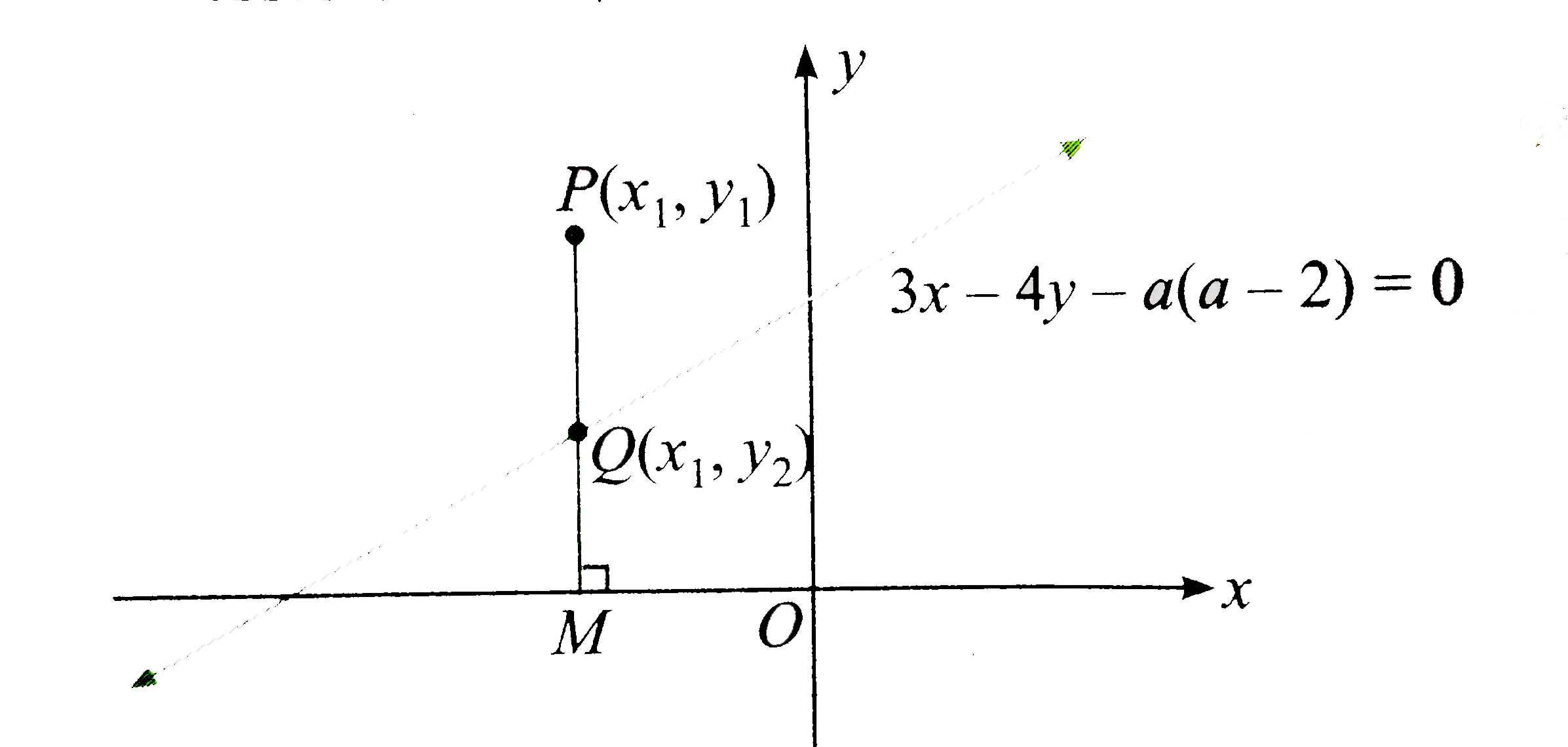
One of the possible lines is as shown in the following figure.

Consider the point `P(x_(1), y_(1))` lying above this line.
Draw perpendicular from point P to the x-axis meeting the line at `Q(x_(1), y_(2))" and x-axis at M"`
`"Clearly, PM" gt QM`
`therefore y_(1) gt y_(2)`
`rArr -4y_(1) lt -4y_(2)`
`rArr 3x_(1)-a(a-2)-4y_(1) lt 3x_(1) -a(a-2)-4y_(2)`
`rArr 3x_(1)-a(a-2)-4y_(1) lt 0 " " ("As point Q lies on the line")`
`rArr 3(2b+3)-a(a-2)-4b^(2) lt 0, AAa in R`
`" " ("Putting " x_(1) = 2b +3 " and "y_(1) = b^(2))`
`a^(2)-2a+4b^(2)-6b-9 gt 0 AA a in R`
`therefore " Discriminant" lt 0`
`rArr 4-4(4b^(2)-6b-9) lt 0`
`rArr 1-4b^(2) + 6b+9) lt 0`
`rArr 2b^(2)-3b-5 gt 0`
`rArr (2b-5)(b+1) gt 0`
`rArr b in (-oo, -1) uu ((5)/(2), oo)`
Promotional Banner

Topper's Solved these Questions

  • STRAIGHT LINES

    CENGAGE|Exercise Exercise 2.1|23 Videos
  • STRAIGHT LINES

    CENGAGE|Exercise Exercise 2.2|4 Videos
  • STRAIGHT LINE

    CENGAGE|Exercise Multiple Correct Answers Type|8 Videos
  • THEORY OF EQUATIONS

    CENGAGE|Exercise JEE Advanced Previous Year|9 Videos

Similar Questions

Explore conceptually related problems

The maximum negative integral value of b for which the point (2b+3, b^(2)) lies above the line 3x-4y-a(a-2)=0, AA ain R is

Find the value of c so that the point (3,c) lies on the line represented by 2x-3y+5=0.

Find the value of a so that the point (3,a) lies on the line represented by 2x-3y+5=0

The exhaustive range of a for which the point (a,0) lies inside the triangle formed by the lines y+3x+2=0 , 3y-2x-5=0 and 4y+x-14=0 is

Find the values of a and b for which the line (x-2)/(a)=(y+3)/(4)=(z-6)/(-2) is perpendicular to the plane 3x-2y+bz+10=0

Two point (b+3,b+k) and (2,b) are on the line x-2y+9=0 find k

Find the ration in which the line joining the points A(1,2) and B(-3,4) is divided by the line. x+y-5=0

If the point (3, 4) lies on the locus of the point of intersection of the lines x cos alpha + y sin alpha = a and x sin alpha - y cos alpha = b ( alpha is a variable), the point (a, b) lies on the line 3x-4y=0 then |a+b| is equal to

The set of values of b for which the origin and the point (1,1) lie on the same side of the straight line,a^(2)x+aby+1=0AA a in R,b>0 are(A) b in(2,4)(B)b in(0,2)(C)b in[0,2](D)(2,oo)

If the point (3,4) lies on the locus of the point of intersection of the lines x cos alpha+y sin alpha=a and x sin alpha-y cos alpha=b ( alpha is a variable) ,the point (a, b) lies on the line 3x-4y=0 then |a+b| is equal to

