Home
Class 12
MATHS
The equations of bisectors of two lines ...

The equations of bisectors of two lines `L_1 & L_2` are `2x-16y-5=0` and `64x+ 8y+35=0`. lf the line `L_1` passes through `(-11, 4)`, the equation of acute angle bisector of `L_1` & `L_2` is:

Text Solution

Verified by Experts
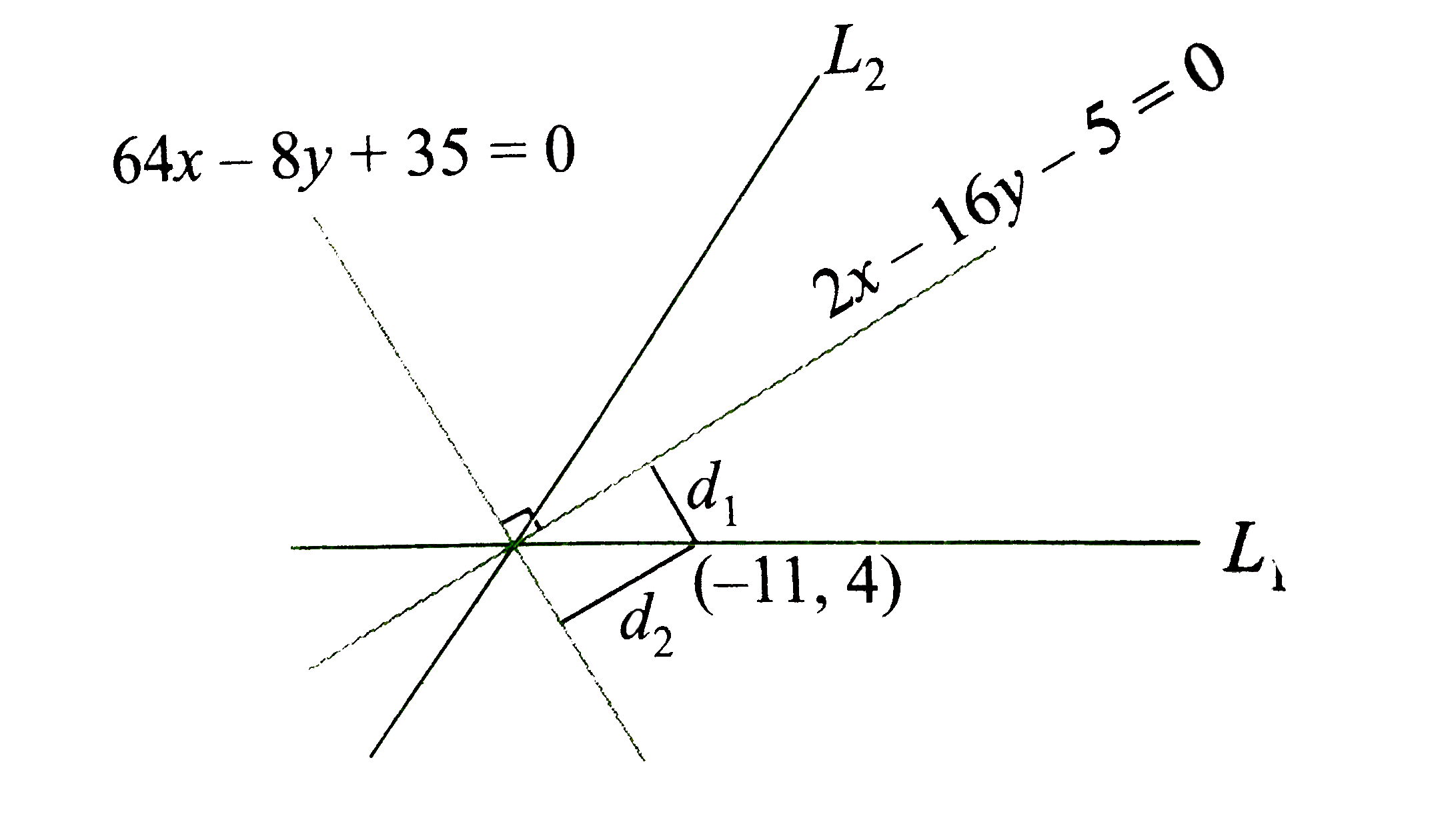

From the figure,
`d_(1) = (|2(-11)-16(4)-5|)/(sqrt(4+256)) = (91)/(2sqrt(65)) ~= 5.6 " " (1)`
`d_(2) = (|64(-11)+8(4)+35|)/(sqrt((64)^(2)+8^(2))) = (637)/(64.49) ~= 9.87 " " (2)`
`d_(1) lt d_(2)`
Therefore, 2x-16y-5=0 is acute angle bisector and 64x+8y+35=0 is obtuse angle bisector.
Promotional Banner

Topper's Solved these Questions

  • STRAIGHT LINES

    CENGAGE|Exercise Exercise 2.1|23 Videos
  • STRAIGHT LINES

    CENGAGE|Exercise Exercise 2.2|4 Videos
  • STRAIGHT LINE

    CENGAGE|Exercise Multiple Correct Answers Type|8 Videos
  • THEORY OF EQUATIONS

    CENGAGE|Exercise JEE Advanced Previous Year|9 Videos

Similar Questions

Explore conceptually related problems

The equations of bisectors of two lines L_(1)&L_(2) are 2x-16y-5=0 and 64x+8y+35=0. lf the line L_(1) passes through (-11,4), the equation of acute angle bisector of L_(1)o*L_(2) is:

The bisector of two lines L and L are given by 3x^(2)-8xy-3y^(2)+10x+20y-25=0. If the line L_(1) passes through origin,find the equation of line L_(2).

theta_(1) and theta_(2) are the inclination of lines L_(1) and L_(2) with the x axis.If L_(1) and L_(2) pass through P(x,y) ,then the equation of one of the angle bisector of these lines is

The combined equation of the lines L_1 and L_2 is 2x^2+6xy+y^2=0 , and that of the lines L_3 and L_4 is 4x^2+18xy+y^2=0 . If the angle between L_1 and L_4 be alpha , then the angle between L_1 and L_3 will be .

The portion of the line 4x+5y=20 in the first quadrant is trisected by the lines L_(1) and L_(2) passing through the origin.The tangent of an angle between the lines L_(1) and L_(2) is:

Consider the lines give by L_1: x+3y -5=0, L_2:3x - ky-1=0, L_3: 5x +2y -12=0

The perpendicular bisector of a line segment with end points (1, 2, 6) and (-3, 6, 2) passes through (-6, 2, 4) and has the equation of the form (x+6)/(l)=(y-2)/(m)=(z-4)/(n) (where l gt0 ), then the value of lmn -(l+m+n) equals to

The combined equation of the lines L_(1) and L_(2) is 2x^(2)+6xy+y^(2)=0 and that lines L_(3) and L_(4) is 4x^(2)+18xy+y^(2)=0 . If the angle between L_(1) and L_(4) be alpha , then the angle between L_(2) and L_(3) will be

A point P is 3units away from line L_1= 3x + 4y +5=0 and 4 units away from the line L_2 = 8x-by +9=0, The reflection of P on L_1, is P_1 the reflection of P_1 on L_2, is P_2 the reflection of P_3, on L_2, is P_4, Then the area (in sq. units) of figure formed by joining P_1P_2P_3, and P_4, is-

Equation of a line segment in first quadrant is given as 4x+5y=20 , two lines l_1 , and l_2 are trisecting given line segment. If l_1 and l_2 pass through the origin the find then tangent of angle between l_1 , and l_2 .

