

Home
Class 12
CHEMISTRY
Rutherford model: The approximate size o...

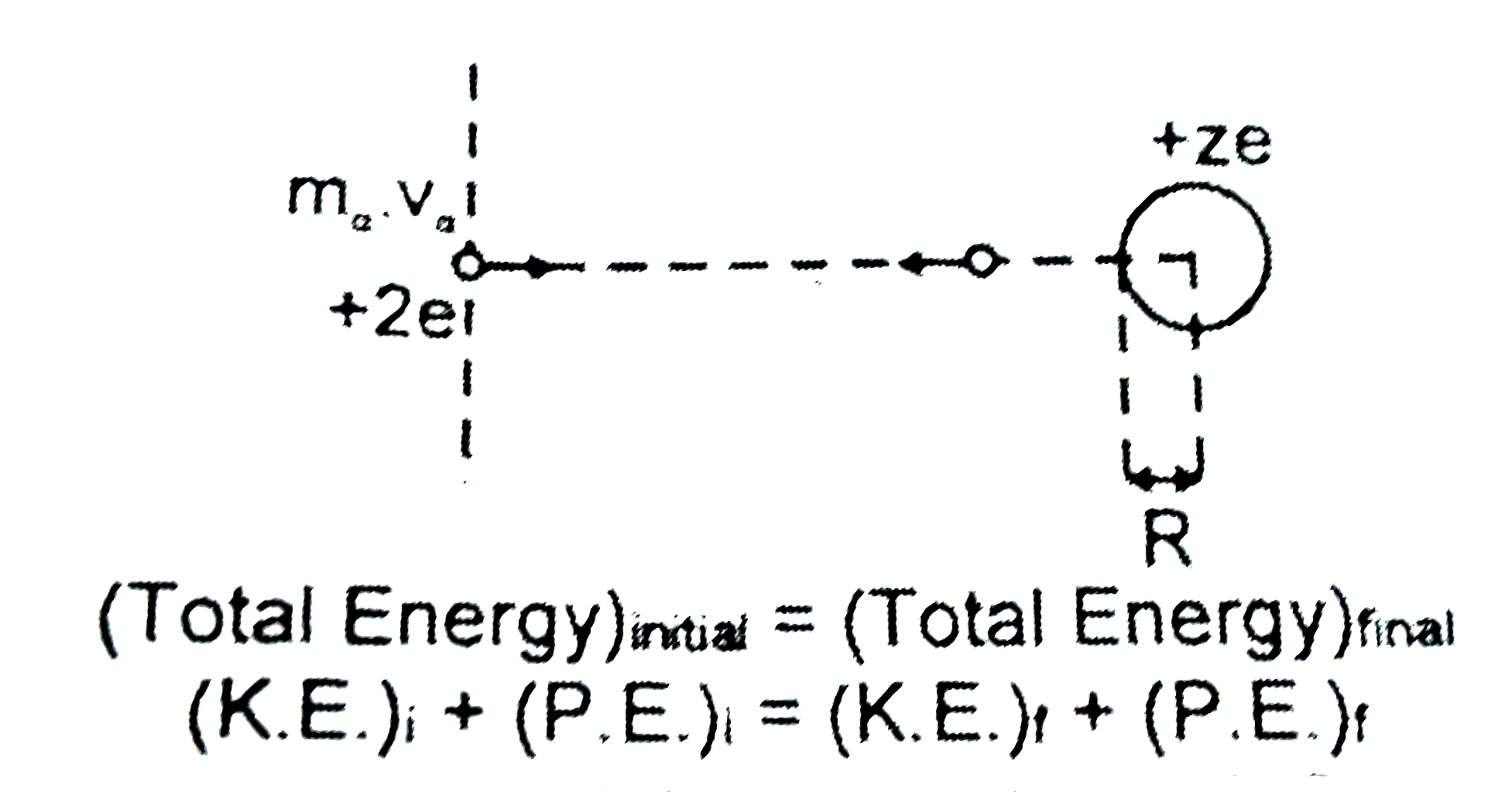
Rutherford model: The approximate size of the nucleus can be calculated by using energy conservation theorem in Rutherford's `alpha`-scattering experiment. If an `alpha`-particle is projected from infinity with speed v towards the nucleus having Z protons, then the `alpha`-particle which is reflected back or which is deflected by `180^@` must have approached closest to the nucleus .It can be approximated that `alpha` particle collides with the nucleus and gets back. Now if we apply the energy conservation equation at initial point and collision point then:

`(P.E.)_i= 0`, since P.E. of two charge system separated by infinite distance is zero. Finally the particle stops and then starts coming back.
`1/2m_alpha v_alpha^2+0=0+(Kq_1q_2)/Rimplies 1/2m_alphav_alpha^2=K(2exxZe)/R implies R=(4KZe^2)/(m_alphav_alpha^2)`
Thus the radius of nucleus can be calculated using above equation. The nucleus is so small a particle that we can't define a sharp boundary for it
An `alpha`-particle with initial speed `v_0` is projected from infinity and it approaches up to `r_0` distance from a nuclie. Then, the initial speed of `alpha`-particle, which approaches upto `2r_0` distance from the nucleus is :

A

`sqrt2 v_0`

B

`v_0/sqrt2`

C

`2v_0`

D

`v_0/2`

Text Solution

Verified by Experts

Promotional Banner

Topper's Solved these Questions

  • D BLOCK ELEMENTS

    RESONANCE|Exercise EXERCISE-3 PART-III|37 Videos
  • ELECTRO CHEMISTRY

    RESONANCE|Exercise PHYSICAL CHEMITRY (ELECTROCHEMISTRY)|53 Videos

Similar Questions

Explore conceptually related problems

Read the following passage carefully and answer the questions The approximate size of the nucleus can be calculated by using energy conservation theorem in Rutherford's alpha- scattering experiment. If an alpha- perticle is projected from infinity with speed v, towards the nucleus having z protons then the apha- perticle which is reflected back or which is deflected by 180^(@) must have approach closest to the nucleus. It can be approximated that alpha- particles collides with the nucleus and gets back. Now if we apply the energy conservation at initial and collision point then: ("Total Energy")_("initial") = ("Total Enregy")_("final") (KE)_(i) +(PE)_(i)=(KE)_(f)+(PE)_(f) (PE)_(i) =0, "since"PE of two charge system separated by infinite distance is zero, finally the particle stops and then starts coming back. 1/2m_(alpha)v_(alpha)^(2) + 0=0 + (kq_(1)q_(2))/(R) rArr1/2m_(alpha)v_(alpha)^(2)=k(2exxze)/(R)rArrR=(4kze^(2))/(m_(alpha)v_(alpha)^(2) Thus the radius of nucleus can be calculated using above equation. The nucleus is so small a particle that we can't define a sharp boundary for it . Experiments show that the average radius R fo a nucleus may be written as R=R_(0)(A)^(1//3) where R_(0) = 1.2xx10^(-15)m A= atomic mass number R=radius of nucleus If alpha- particle with speed v_(0) is projected from infinity and it approaches upto r_(0) distance from the nuclei. Then the speed of alpha- particle which approaches 2r_(0) distance from the nucleus is

Read the following passage carefully and answer the questions The approximate size of the nucleus can be calculated by using energy conservation theorem in Rutherford's alpha- scattering experiment. If an alpha- perticle is projected from infinity with speed v, towards the nucleus having z protons then the apha- perticle which is reflected back or which is deflected by 180^(@) must have approach closest to the nucleus. It can be approximated that alpha- particles collides with the nucleus and gets back. Now if we apply the energy conservation at initial and collision point then: ("Total Energy")_("initial") = ("Total Enregy")_("final") (KE)_(i) +(PE)_(i)=(KE)_(f)+(PE)_(f) (PE)_(i) =0, "since"PE of two charge system separated by infinite distance is zero, finally the particle stops and then starts coming back. 1/2m_(alpha)v_(alpha)^(2) + 0=0 + (kq_(1)q_(2))/(R) rArr1/2m_(alpha)v_(alpha)^(2)=k(2exxze)/(R)rArrR=(4kze^(2))/(m_(alpha)v_(alpha)^(2) Thus the radius of nucleus can be calculated using above equation. The nucleus is so small a particle that we can't define a sharp boundary for it . Experiments show that the average radius R fo a nucleus may be written as R=R_(0)(A)^(1//3) where R_(0) = 1.2xx10^(-15)m A= atomic mass number R=radius of nucleus Radius of a particular nucleus is calculated by the projection of alpha- particle from infinity at a particular speed. Let this radius be the true radius. If the radius calculation for the same nucleus is made by , alpha- particle with half of the earlier speed then the percentage error involved in the radius calculation is :

Read the following passage carefully and answer the questions The approximate size of the nucleus can be calculated by using energy conservation theorem in Rutherford's alpha- scattering experiment. If an alpha- perticle is projected from infinity with speed v, towards the nucleus having z protons then the apha- perticle which is reflected back or which is deflected by 180^(@) must have approach closest to the nucleus. It can be approximated that alpha- particles collides with the nucleus and gets back. Now if we apply the energy conservation at initial and collision point then: ("Total Energy")_("initial") = ("Total Enregy")_("final") (KE)_(i) +(PE)_(i)=(KE)_(f)+(PE)_(f) (PE)_(i) =0, "since"PE of two charge system separated by infinite distance is zero, finally the particle stops and then starts coming back. 1/2m_(alpha)v_(alpha)^(2) + 0=0 + (kq_(1)q_(2))/(R) rArr1/2m_(alpha)v_(alpha)^(2)=k(2exxze)/(R)rArrR=(4kze^(2))/(m_(alpha)v_(alpha)^(2) Thus the radius of nucleus can be calculated using above equation. The nucleus is so small a particle that we can't define a sharp boundary for it . Experiments show that the average radius R fo a nucleus may be written as R=R_(0)(A)^(1//3) where R_(0) = 1.2xx10^(-15)m A= atomic mass number R=radius of nucleus If the diameter of two different nuclei are in the ratio 1:2 then their mass number are in the ratio:

In Rutherford's alpha-rays scattering experiment, the alpha particles are detected using a screen coated with

The particle used by Rutherford in alpha -ray scat­tering experiment was

Rutherford's alpha particle scattering experiment led to the discovery of :

Rutherford's experiment of scattering of alpha -particles shows that atom

In Rutherford's scattering experiment of alpha -particles by metallic foils, with the increase of atomic number of nucleus, the scattering angle .

RESONANCE-DPP-QUESTIONS
  1. Which of the following pairs has different values of e/m:

    Text Solution

    |

  2. As an electron (at rest) is brought towards a proton from infinity, it...

    Text Solution

    |

  3. Rutherford model: The approximate size of the nucleus can be calculate...

    Text Solution

    |

  4. If the diameter of two different nuclei are in the ratio 2: 1, then ca...

    Text Solution

    |

  5. For a broadcasted electromagnetic wave having frequency of 1200 KHz, c...

    Text Solution

    |

  6. Calculate the ratio of the energy of a photon of wavelength 3000 Å to ...

    Text Solution

    |

  7. What volume (in mL) of liquid H2O2 has same number of molecules as the...

    Text Solution

    |

  8. If the atomic number (Z) and mass number (A) of an element X are relat...

    Text Solution

    |

  9. If the frequency of violet radiation is 7.5xx10^14 Hz, then the value ...

    Text Solution

    |

  10. A photon of 300 nm is absorbed by a gas and then re-emits two photons...

    Text Solution

    |

  11. Identify the correct statement(s)

    Text Solution

    |

  12. In which of the following conditions the de Broglie wavelength of part...

    Text Solution

    |

  13. Select the correct statement

    Text Solution

    |

  14. What change in molar energy (in J) would be associated with an atomic ...

    Text Solution

    |

  15. For a wave frequency is 10 Hz and wavelength is 2.5 m. How much distan...

    Text Solution

    |

  16. A certain dye absorbs 4000 Å and fluoresces at 8000 Å. These being wav...

    Text Solution

    |

  17. In Rutherford formula, maximum number of a-particles deflecting is for...

    Text Solution

    |

  18. If the volume of nucleus of an atom V is related to its mass number A ...

    Text Solution

    |

  19. Photon of which light has minimum energy

    Text Solution

    |

  20. Visible spectrum contains light of following colours ''Violet - Indigo...

    Text Solution

    |