

Home
Class 12
PHYSICS
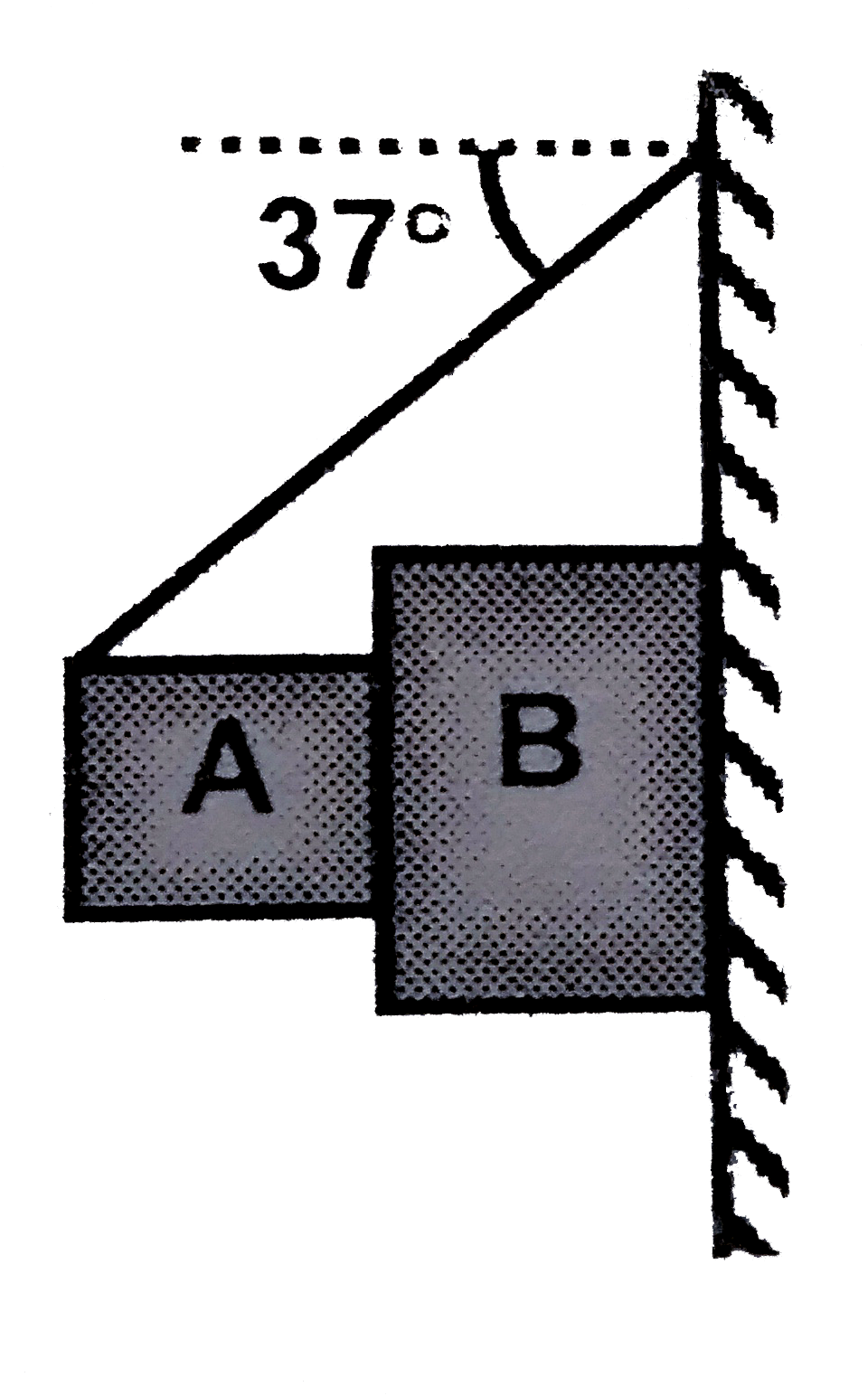
Two block A and B of mass 50 kg and 300 ...

Two block A and B of mass `50 kg` and `300 kg` respectively are placed as shown in figure. Coefficient of friction between all surface is `(1)/(2)`
Then (take `g = 10 m//s`)

Promotional Banner

Similar Questions

Explore conceptually related problems

Three blocks of masses 5 kg, 3 kg and 2 kg are placed on a rough surface as shown in figure. Coefficient of friction between block and surface is same for all the blocks and is equal to mu = 0.2 . A horizontal force of 15 N is applied on 5 kg block. The force exerted by 3 kg block on 2 kg block is : (g = 10 m/ s^(2) )

Three blocks of masses 5 kg, 3 kg and 2 kg are placed on a rough surface as shown in figure. Coefficient of friction between block and surface is same for all the blocks and is equal to mu = 0.2 . A horizontal force of 15 N is applied on 5 kg block. The force exerted by 3 kg block on 2 kg block is : (g = 10 m/ s^(2) )

A block A of mass 3kg and another block B of mass 2 kg are connected by a light inextensible string as shown in figure. If the coefficient of friction between the surface of the table and A is 0.5. What maximum mass C is to be placed on A so that the system is to be in equilibrium? (g = 10 m//s^2)

Blocks A and B each of mass 1kg are moving with 4m//s and 2m//s respectively as shown. The coefficient of friction for all surface is 0.10 . Find the distance (in m) by which centre of mass will travell before coming to rest. Assume large distance between the blocks

Blocks A and B each of mass 1kg are moving with 4m//s and 2m//s respectively as shown. The coefficient of friction for all surface is 0.10 . Find the distance (in m) by which centre of mass will travell before coming to rest. Assume large distance between the blocks

Two blocks A and B of masses 10 kg and 15 kg are placed in contact with each other rest on a rough horizontal surface as shown in the figure. The coefficient of friction between the blocks and surface is 0.2. A horizontal force of 200 N is applied to block A. The acceleration of the system is ("Take g"=10ms^(-2))

Two blocks A and B of masses 10 kg and 15 kg are placed in contact with each other rest on a rough horizontal surface as shown in the figure. The coefficient of friction between the blocks and surface is 0.2. A horizontal force of 200 N is applied to block A. The acceleration of the system is ("Take g"=10ms^(-2))

Two blocks A and B of mass 10 kg and 40 kg are connected by an ideal string as shown in the figure. Neglect the masses of the pulleys and effect of friction. (g = 10 m/s2) А B 45° Fixed 45°