

Home
Class 11
PHYSICS
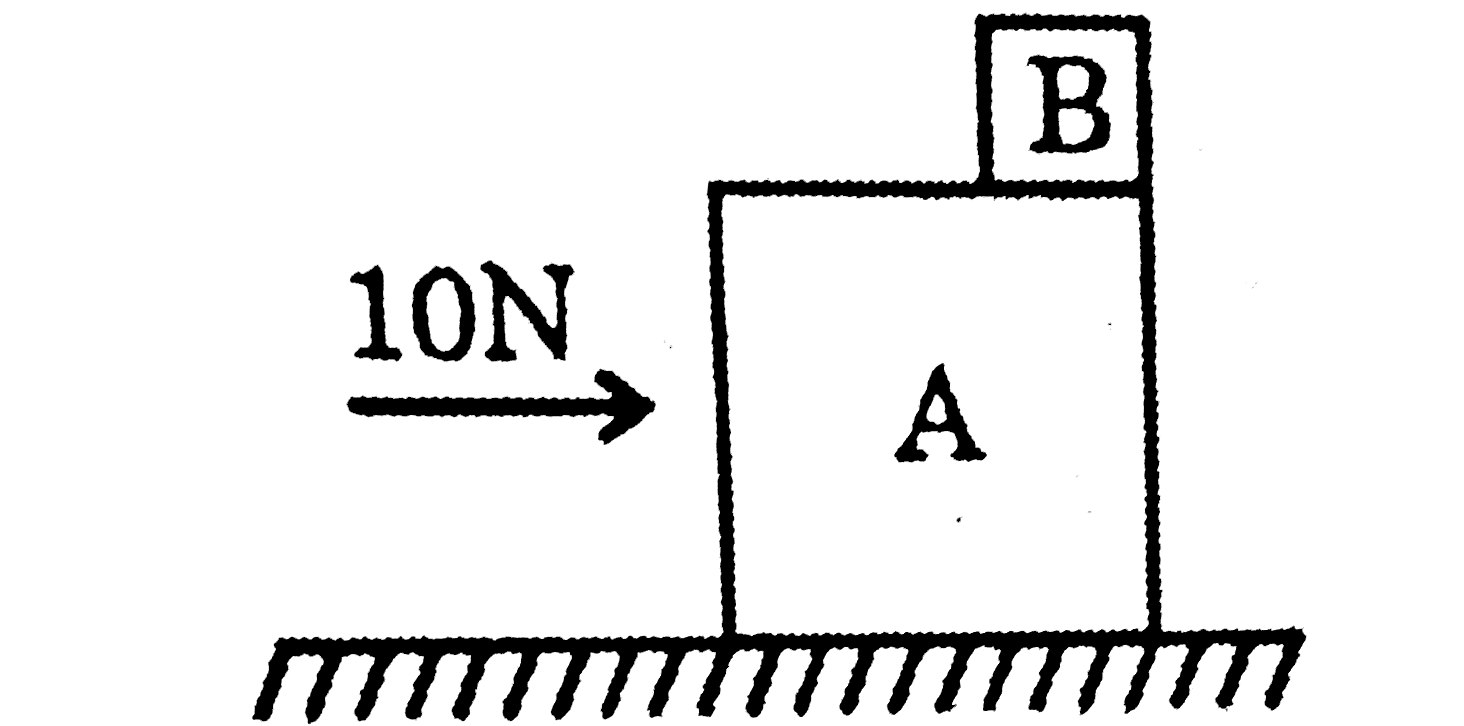
A small block B is placed on another blo...

A small block B is placed on another block A of mass 5 kg and length 20 cm. Initially, the block B is near the right end of block A. A constant horizontal force of 10 N is applied to the block A. All the surfaces are assumed frictionless. Find the time elapsed before the block B separates from A.

Promotional Banner

Similar Questions

Explore conceptually related problems

A small block B of mass m_2 is placed on another block A of mass m_1 A constant horizontal force F is applied to the block A. All the surfaces are assumed to be frictionless. Find the acceleration of center of mass of the system

A block of mass 50 kg is kept on another block of mass 1 kg as shown in figure. A horizontal force of 10 N is applied on the 1 kg block. (All surface are smooth). Find (g=10m//s^(2)) Acceleratin of block A and B.

A block of mass 50 kg is kept on another block of mass 1 kg as shown in figure. A horizontal force of 10 N is applied on the 1 kg block. (All surface are smooth). Find (g=10m//s^(2)) Force exerted by B on A.

A block of mass 50 kg is kept on another block of mass 1 kg as shown in figure. A horizontal force of 10 N is applied on the 50kg block. (All surface are smooth). Find (g = 10 m//s^(2)) Acceleration of block A and B.

A block of mass 50 kg is kept on another block of mass 1 kg as shown in figure. A horizontal force of 10 N is applied on the 50kg block. (All surface are smooth). Find (g = 10 m//s^(2)) Force exerted by B on A.

The metal blocks A and B of masses 2 kg and 1 kg , respectively are in contact on a frictionless table A constant horizontal force of 3 N is applied to the block A . Calculate the force of constant between the two blocks . If the same force is applied to the block B then what will be the force of contact ? Can you explain the difference ?

If the mass of block is 1 kg and a force of 10 / sqrt3 N is applied horizontally on the block as shown in the figure . The frictional force acting on the block is :

A block A of mass 4 kg is placed on another block B of mass 5 kg and the block rests on a smooth horizontal table. For sliding the block A on B, a horizontal force of 12 N is required to be applied on it. The maximum horizontal force that can be applied on B so that both A and B move together and the acceleration produced by this force is