

Home
Class 11
PHYSICS
A block 'A' of mass 2m is placed on anot...

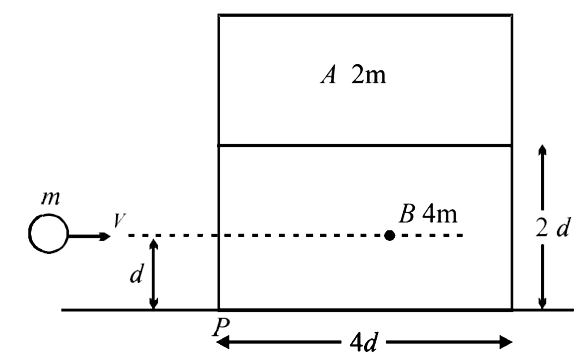
A block 'A' of mass 2m is placed on another block 'B' of mass 4m which in turn is placed on a fixed table. The two blocks have a same length 4d and they are placed as shown in fig The coefficient of friction (both static and kinetic) between the block 'B' and table is `mu`. There is no friction between the two blocks. A small object of mass m moving horizontally along a line passing through the centre of mass (cm.) of the block B and perpendicular to its face with a speed v collides elastically with the block B at a height d above the table.

(a) What is the minimum value of v(call it `v_0`) required to make the block A topple?
(b) If `v=2v_0`,find the distance (from the point P in the figure ) at which the mass m falls on the table after collision. (Ignore the role of friction during the collision).

Promotional Banner

Similar Questions

Explore conceptually related problems

The block of mass M and are arrenged as the situation in fig is shown.The coefficient of friction between two block is mu and that between the bigger block and the ground is mu find the acceleration of the block

The block of mass M and are arrenged as the situation in fig is shown.The coefficient of friction between two block is mu and that between the bigger block and the ground is mu find the acceleration of the block

A block of mass m=4kg is placed oner a rough inclined plane as shown in figure. The coefficient of friction between the block and the plane is mu=0.5 . A force F=10N is applied on the block at an angle of 30^(@) .

A block of mass m is placed on another block of mass M which itself is lying on a horizontal surface .The coefficient of friction between two blocks is mu_(1) and that between the block of mass M and horizontal surfece is mu_(2) What maximum horizontal force can be applied to the lower block move without separation?

A block of mass m is placed on another block of mass M which itself is lying on a horizontal surface .The coefficient of friction between two blocks is mu_(1) and that between the block of mass M and horizontal surfece is mu_(2) What maximum horizontal force can be applied to the lower block move without separation?

The coefficient of friction between the block A of mass m & block B of mass 2m is mu . There is no friction between A & B is released from rest & there is no slipping between A & B then:

A block of mass m is placed on the top of another block of mass M as shown in the figure. The coefficient of friction between them is mu . The maximum acceleration with which the block M may move so that m also moves along with it is

A block A slides over an another block B which is placed over a smooth inclined plane as shown in figure . The coefficient of friction between the two blocks A and B is mu . Mass of block B is two times the mass of block A . The acceleration of the centre of mass of two blocks is

A block A slides over an another block B which is placed over a smooth inclined plane as shown in figure . The coefficient of friction between the two blocks A and B is mu . Mass of block B is two times the mass of block A . The acceleration of the centre of mass of two blocks is