

Home
Class 11
PHYSICS
Figure shows a smasll sphereical bal of ...

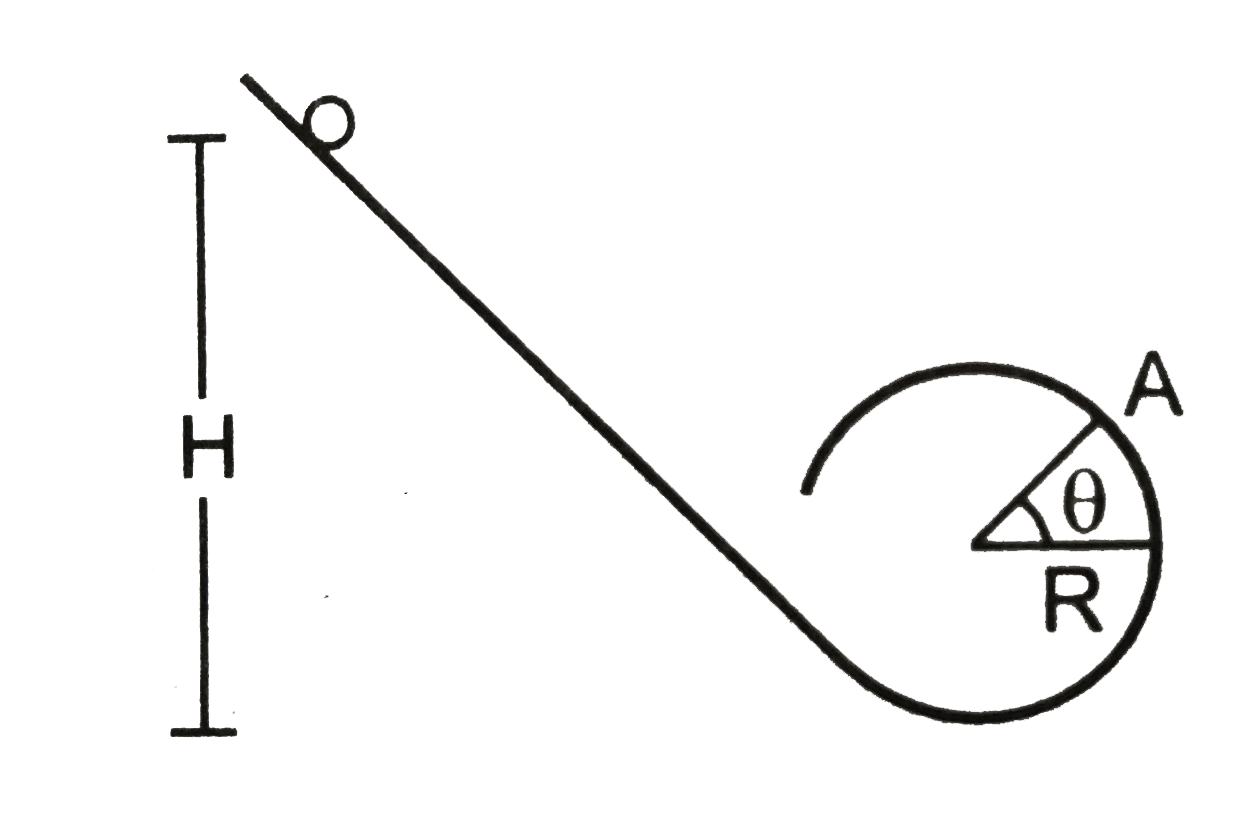
Figure shows a smasll sphereical bal of mass m rolling down the loop track. Thebasll is released on the linear portion at a verticla height H from the lowest point. The circular part show has a radius R.
a. find the kinetic energy of the ball when it is at a point where the radius makes an angle `theta` with the horizontal.
Find the radial and the tangential accelerations of the cente when the ball is at A. c. find the bnormal force and the frictionasl force acting on the ball if H=60 cm, R=10cm `theta=0` and m=70 fg.

Promotional Banner

Similar Questions

Explore conceptually related problems

A particle is projected with a speed u at an angle theta to the horizontal. Find the radius of curvature. At the point where the particle is at a highest half of the maximum height H attained by it.

A particle is projected with a speed u at an angle theta to the horizontal. Find the radius of curvature. At the point where the particle is at a highest half of the maximum height H attained by it.

A ball leaves the track at B which is at 3m height from bottom most point of the track. The ball further rises upto 4m height from the bottom most point before falling down. Find h (in m ), if the track at B makes an angle 30^@ with horizontal. .

A uniform thin spherical shell of mass m and radius R rolls down without slipping over an inclined plane of angle theta with the horizontal. The ratio of rotational kinetic energy to the total kinetic energy of the shell will be

A small spherical ball is released from a point at a height h on a rough track shown in figure. Assuming that it does not slip anywhere, find its linear speed when it rolls on the horizontal part of the track.

A small spherical ball is released from a point at a height h on a rough track shown in figure. Assuming that it does not slip anywhere, find its linear speed when it rolls on the horizontal part of the track.

A small bead of mass M slides on a smooth wire that is bent in a circle of radius R. It is released at the top of the circular part of the wire (point A in the figure) with a negligibly small velocity. Find the height H where the bead will reverse direction