

Home
Class 12
PHYSICS
Monochromatic light rays parallel to x-a...

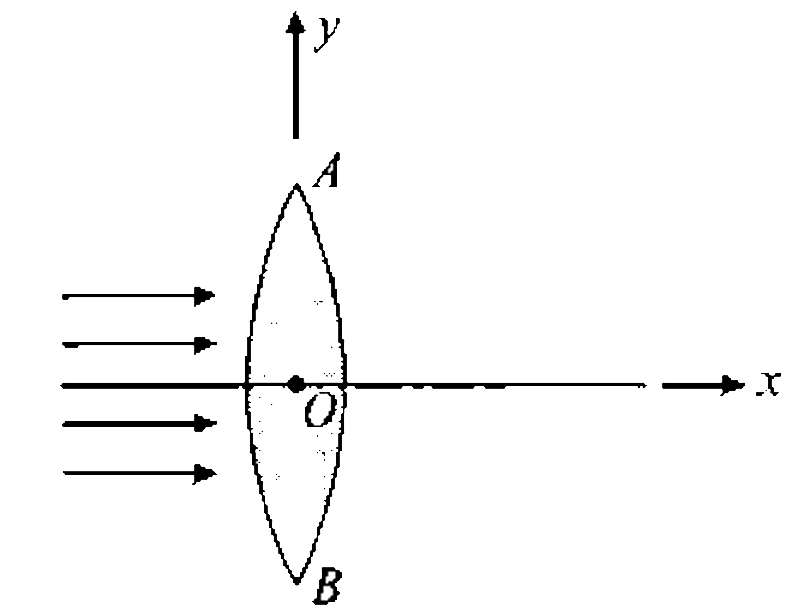
Monochromatic light rays parallel to x-axis strike a convex lens AB of refractive index `0.5`. If the lens oscillates such that AB tilts upto a small angle `theta` (in radian) on either side of y-axis, then find the distance between extreme positions of oscillating image:

Promotional Banner

Similar Questions

Explore conceptually related problems

Monochromatic light rays parallel to the principal axis (the x axis) are incident on a convex lens of focal length f. If the lens oscillates such that it tilts up to a small angle theta on either side of the y axis, then find the distance between the exterme positions of the image. Take sec theta ~~ 1 + (theta^(2))/(2) for small theta .

A parallel beam of light is incident on a lens of focal length 10 cm. A parallel slab of refractive index 1.5 and thickness 3 cm is placed on the other side of the lens. Find the distance of the final image from the lens. .

A parallel beam of light is incident on a lens of focal length 10 cm. A parallel slab of refractive index 1.5 and thickness 3 cm is placed on the other side of the lens. Find the distance of the final image from the lens. .

A light ray travelling parallel to the principal axis of a convex lens of focal length 12 cm strikes the lens at a height of 5 mm from the principal axis. What is the angle of deviation produced?

A horizontal parallel beam of light passes though a vertical convex lens of focal length 40 cm. Behind the lens there is a plane mirror making an angle theta with the principal axis of the lens. The mirror intersects the principal axis at M. Distance between the optical centre of the lens and point M is OM = 20 cm . The light beam reflected by the mirror converges at a point P. Distance OP is 20 cm. Find theta .