Home
Class 12
MATHS
Which of the following graphs represent ...

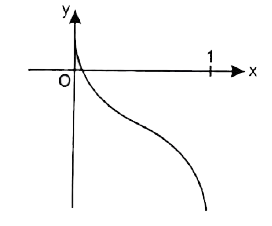
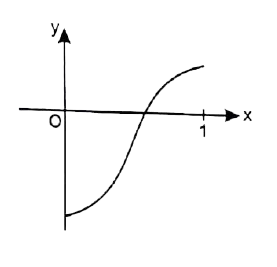
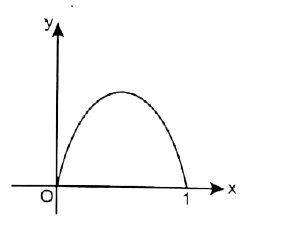
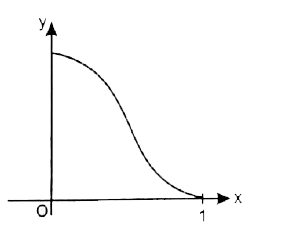
Which of the following graphs represent function whose derivatives have a maximum in the interval `(0,1)` ?

A

B

C

D

Text Solution

AI Generated Solution

The correct Answer is:

To determine which of the given graphs represents a function whose derivative has a maximum in the interval (0,1), we need to analyze the behavior of the derivatives of the functions represented by the graphs. Here is a step-by-step solution: ### Step 1: Understand the Concept of Derivatives The derivative of a function gives us the slope of the tangent line at any point on the graph. If we denote the function as \( f(x) \), then its derivative is \( f'(x) \). A maximum of the derivative occurs when \( f'(x) \) reaches its highest value. ### Step 2: Identify the Condition for Maximum of Derivative For a function \( g(x) = f'(x) \) to have a maximum at a point \( x_0 \) in the interval (0,1), the following conditions must be satisfied: 1. \( g'(x_0) = 0 \) (the first derivative of \( g \) is zero). 2. \( g''(x_0) < 0 \) (the second derivative of \( g \) is negative, indicating a maximum). ### Step 3: Analyze the Given Graphs We need to look at the graphs provided and determine where the derivative \( g(x) \) has a maximum. We will check for points in the interval (0,1) where the slope of the tangent (the derivative) is at its peak. - **Graph A**: The curve appears to have a peak in the interval (0,1). The slope increases to a maximum and then decreases, indicating that the derivative has a maximum in this interval. - **Graph B**: Similar to Graph A, this graph shows a peak in the interval (0,1), suggesting that the derivative also has a maximum here. - **Graph C**: This graph does not show a change in concavity and does not have a peak in the interval (0,1). Therefore, the derivative does not have a maximum here. - **Graph D**: This graph also shows a peak in the interval (0,1), indicating that the derivative has a maximum. ### Step 4: Conclusion From the analysis: - Graphs A, B, and D represent functions whose derivatives have a maximum in the interval (0,1). - Graph C does not represent such a function. ### Final Answer The graphs that represent functions whose derivatives have a maximum in the interval (0,1) are **A, B, and D**.
Promotional Banner

Topper's Solved these Questions

  • APPLICATION OF DERIVATIVES

    VK JAISWAL|Exercise EXERCISE (COMPREHENSION TYPE PROBLEMS)|16 Videos
  • APPLICATION OF DERIVATIVES

    VK JAISWAL|Exercise EXERCISE (MATCHING TYPE PROBLEMS)|8 Videos
  • APPLICATION OF DERIVATIVES

    VK JAISWAL|Exercise EXERCISE (SUBJECTIVE TYPE PROBLEMS)|22 Videos
  • AREA UNDER CURVES

    VK JAISWAL|Exercise EXERCISE (SUBJECTIVE TYPE PROBLEMS)|8 Videos

Similar Questions

Explore conceptually related problems

Which of the following graphs represent the function of x ? Why

Which of the following graph is a function?

Which one of the following graphs represents the function of x? why?

Which of the following graphs are graphs of a function?

Does the following graph represent a function? Justify your answer.

VK JAISWAL-APPLICATION OF DERIVATIVES -EXERCISE (ONE OR MORE THAN ANSWER IS/ARE CORRECT )
  1. The function f (x) =1+ x ln (x+ sqrt(1+ x ^(2)))-sqrt(1- x^(2)) is:

    Text Solution

    |

  2. Let m and n bwe positive integers and x,y gt 0 and x+y =k, where k is ...

    Text Solution

    |

  3. Determine the equation of straight line which is tangent at one point ...

    Text Solution

    |

  4. A curve is such that the ratio of the subnomal at any point to the sum...

    Text Solution

    |

  5. Number of A parabola of the form y= ax^2 +bx+c with a>0 intersectio...

    Text Solution

    |

  6. Find the gradient of the line passing through the point (2,8) and touc...

    Text Solution

    |

  7. The equation x + cos x = a has exactly one positive root. Complete set...

    Text Solution

    |

  8. Given that f (x) is a non-constant linear function. Then the curves :

    Text Solution

    |

  9. d (x) = int (0) ^(x) e ^(t ^(3)) (t ^(2) -1) (t+1) ^(2011) at (x gt 0)...

    Text Solution

    |

  10. Let f(x)=sinx+a x+bdot Then which of the following is/are true? f(x)=0...

    Text Solution

    |

  11. Which of the following graphs represent function whose derivatives hav...

    Text Solution

    |

  12. Consider f (x)= sin ^(5) x-1, x in [0, (pi)/(2)], which of the followi...

    Text Solution

    |

  13. Let f (x)= [{:(x ^(2alpha+1)ln x ,,, x gt0),(0 ,,, x =0):} If f (x) sa...

    Text Solution

    |

  14. Which of the following is/are true for the function f(x)= int (0) ^(x)...

    Text Solution

    |

  15. Let F (x) = (f (x ))^(2) + (f' (x ))^(2), F (0) =6, whtere f (x) is a ...

    Text Solution

    |

  16. Let f(x) = {{:( x^(3) + x^(2) - 10 x ,, -1 le x lt 0) , (sin x ,, 0 le...

    Text Solution

    |

  17. Minimum distnace between the curves y ^(2) =x-1and x ^(2) =x-1 and x ^...

    Text Solution

    |

  18. For the equation (e^-x)/(x+1) which of the following statement(s) is/a...

    Text Solution

    |

  19. If y = m x +5 is a tangent to the curve x ^(3) y ^(3) = ax ^(3) +by^(...

    Text Solution

    |

  20. If (f(x)-1) (x ^(2) + x+1)^(2) -(f (x)+1) (x^(4) +x ^(2) +1) =0 AA x...

    Text Solution

    |
