Home
Class 11
MATHS
In a A B C ,A-=(alpha,beta),B-=(1,2),C-...

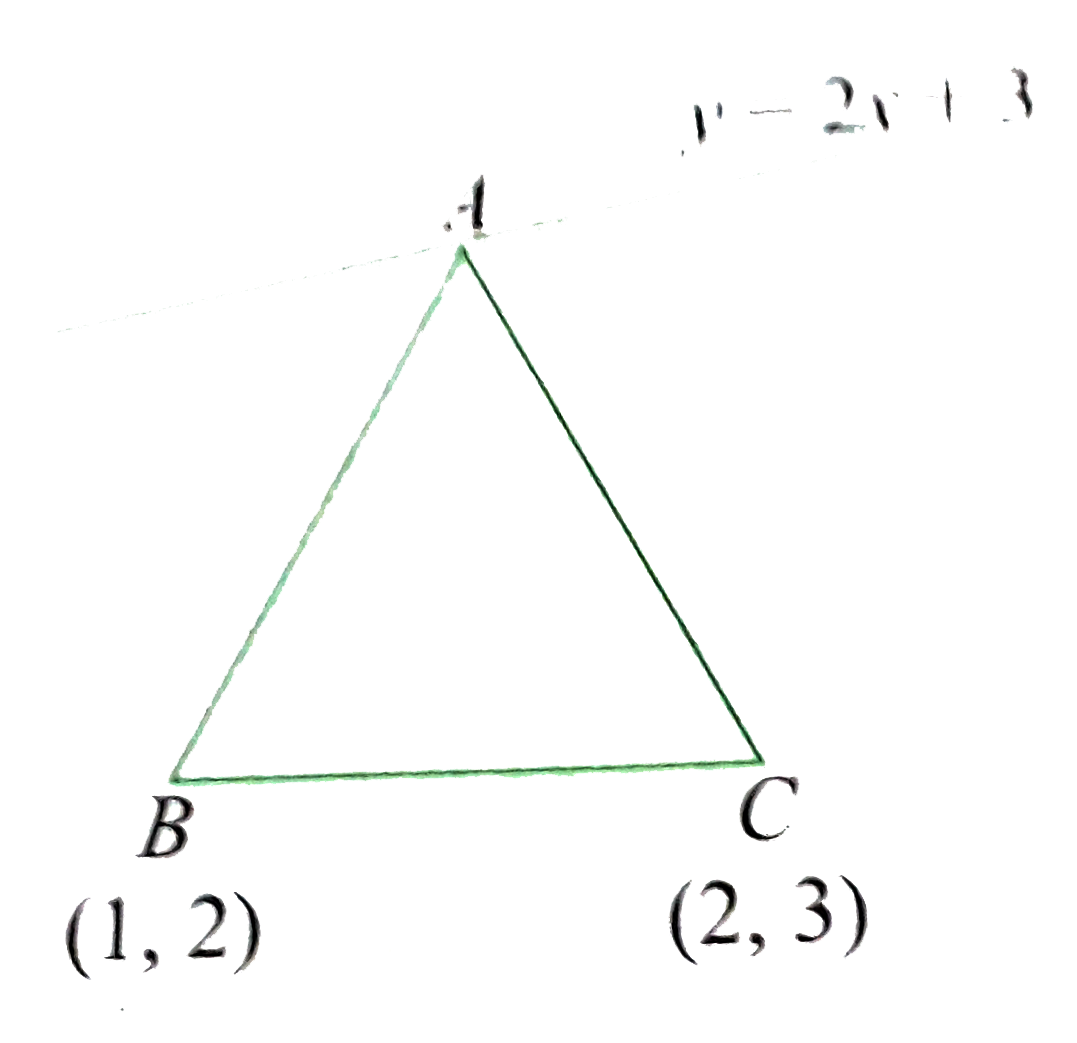
In a ` A B C ,A-=(alpha,beta),B-=(1,2),C-=(2,3),` point `A` lies on the line `y=2x+3,` where `alpha,beta` are integers, and the area of the triangle is `S` such that `[S]=2` where `[` .`]` denotes the greatest integer function. Then the possible coordinates of `A` can be (a)`(-7,-11)` (b) `(-6,-9)` (c)`(2,7)` (d) `(3,9)`

A

`(-7,-11)`

B

`(-6,-9)`

C

(2,7)

D

(3,9)

Text Solution

Verified by Experts

The point `A(alpha,beta)` lies on `y=2x+3`.
Hence,
`beta=2alpha+3`
`A=(alpha, 2alpha+3)`
Area of `Delta ABC` is `:|(1)/(2)|:{:(alpha,,2alpha+3,,1),(1,,2,,1),(2,,3,,1):}:|":|`
`=|:(1)/(2)[alpha(2-3)+(2alpha+3)(2-1)+1(3-4)]:|`
`=(1)/(2)|-alpha+2alpha+3-1|=(1)/(2)|alpha+2|=S`
`[S]=2or 2leSlt3`
`therfore2le(1)/(2)|alpha+2|lt3`
`4le |alpha+2|lt6`
`|alpha+2|le6`
or `-6lealpha+2le6`
or `-8lealphale4`
and `|alpha+2|ge4`
i.e., `alpha+2ge4 or alpha+2le-4`
i.e., `alphage2 or alphale-6`
From (1) and (2) , we get
`-8ltalphalt-6or 2lealphalt4`
or `alpha=-7,-6,2,3`
The possible coordiantes of A are `(-7,-11) ,(-6,-9) ,(2,7)` and `(3,9)`.
Promotional Banner

Similar Questions

Explore conceptually related problems

In a Delta ABC, A -= (alpha, beta), B -= (1, 2), C -= (2,3) and point A lies on the line y = 2 x + 3 where alpha, beta in l . If the area of Delta ABC be such that [Delta]=2 , where [.] denotes the greatest integer function, find all possible coordinates of A.

if alpha is a real root of 2x^(3)-3x^(2)+6x+6=0 then find [alpha] where [] denotes the greatest integer function.

In a DeltaABC , A =(h,7) , B = (1,2) , C =(2,3) If the area of DeltaABC be such that [Delta]=2 , (where [.] denotes the greatest inteher function ),find h.

In a triangle A B C ,A=(alpha,beta)B=(2,3),a n dC=(1,3)dot Point A lies on line y=2x+3, where alpha in Idot The area of A B C , , is such that [Delta]=5 . The possible coordinates of A are (where [.] represents greatest integer function). (a)(2,3) (b) (5,13) (-5,-7) (d) (-3,-5)

The period of the function f(x)=(6x+7)+cos pi x-6x, where [.] denotes the greatest integer function is: 3 (b) 2 pi(c)2(d) none of these

(lim)_(xvec(-1^-)/3)1/x[(-1)/x]= (where [.] denotes the greatest integer function) a. -9 b. -12 c. -6 d. 0

If [x]^(2)-5[x]+6=0, where [.] denotes the greatest integer function,then x in[3,4] (b) x in(2,3](c)x in[2,3](d)x in[2,4)

If the least bounded by the curves y=x^(2) and y=lamdax+12 is equal to (alpha)/(beta) , then [(alpha)/(20beta)] is equal to ________(where [.] denotes the greatest integer function)

The number of points where f(x)=[sin x+cos x] (where [.] denotes the greatest integer function x in(0,2 pi) is not continuous is (A) 3(B)4(C)5(D)6