

Home
Class 11
PHYSICS
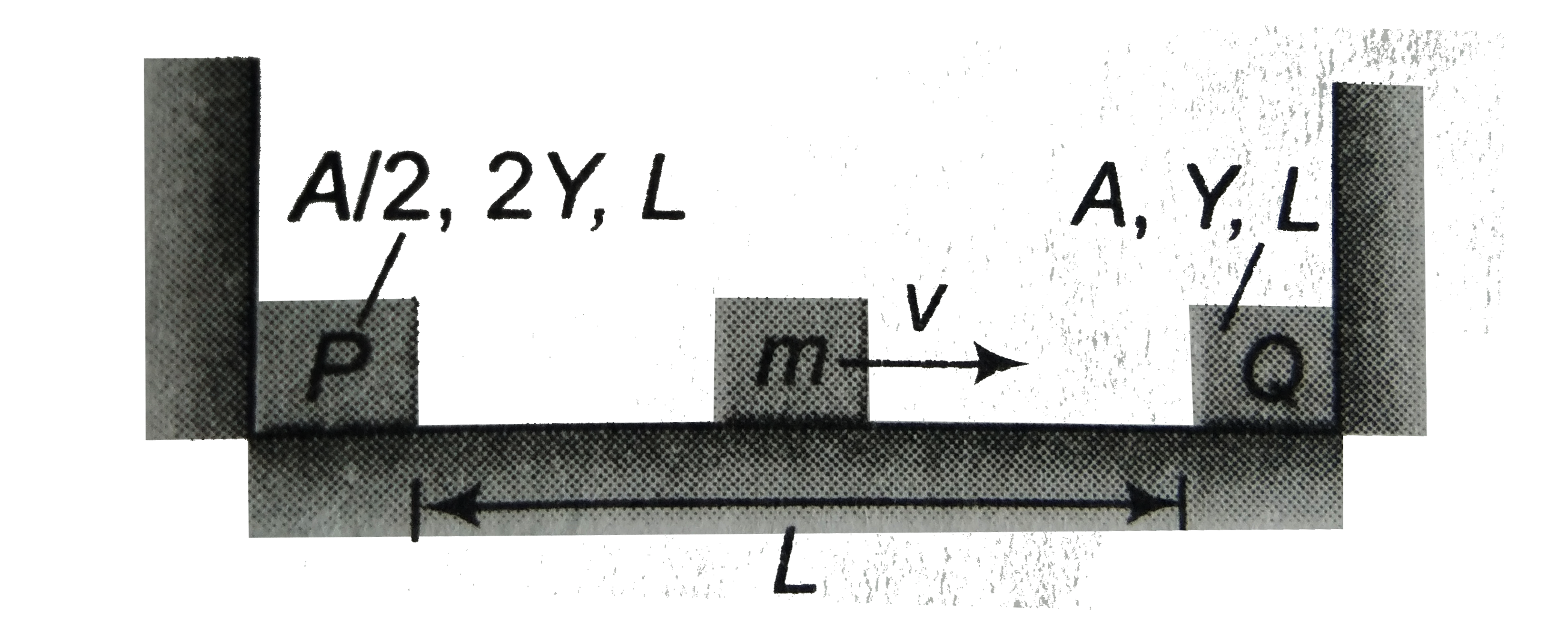
In the given figure, two elastic rods P ...

In the given figure, two elastic rods P and Q are rigidly joined to end supports. A small mass m is moving with velocity v between the rods. All collisions are assumed to be elastic and the surface is given to be smooth. The time period of small mass m will be (A=area of cross section, Y=Young's modulus, L=length of each rod)

Promotional Banner

Similar Questions

Explore conceptually related problems

A uniform rod of mass m and length l is suspended about its end. Time period of small angular oscillations is

A uniform rod of mass m and length l is suspended about its end. Time period of small angular oscillations is

A rod of length L kept on a smooth horizontal surface is pulled along its length by a force F. The area of cross-section is A and Young's modulus is Y. The extension in the rod is

A rod of length L kept on a smooth horizontal surface is pulled along its length by a force F. The area of cross-section is A and Young's modulus is Y. The extension in the rod is

A uniform rod of mass m and length L is at rest on a smooth horizontal surface. A ball of mass m, moving with velocity v_0 , hits the rod perpendicularly at its one end and sticks to it. The angular velocity of rod after collision is

Two point masses of mass m and 2m placed on smooth horizontal plane are connected by a light rod of length l. Masses are given velocities in horizontal plane perpendicular to rod as shown. If area of cross section of rod is A and Young's modulus is Y, then elongation in the rod, will be

A uniform rod of mass M and length l is placed on a smooth- horizontal surface with its one end pivoted to the surface. A small ball of mass m moving along the surface with a velocity v_(0) , perpendicular to the rod, collides elastically with the free end of the rod. Find: a. the angular velocity of the rod after collision. b. the impulse applied by the pivot on the rod during collision. (Take M//m = 2 )

A uniform rod of mass M and length l is placed on a smooth- horizontal surface with its one end pivoted to the surface. A small ball of mass m moving along the surface with a velocity v_(0) , perpendicular to the rod, collides elastically with the free end of the rod. Find: a. the angular velocity of the rod after collision. b. the impulse applied by the pivot on the rod during collision. (Take M//m = 2 )

Two balls each of mass 'm' are moving with same velocity v on a smooth surface as shown in figure. If all collisions between the balls and balls with the wall are perfectly elastic, the possible number of collisions between the balls and wall together is