

Home
Class 12
PHYSICS
Two parallel vertical metallic rails AB ...

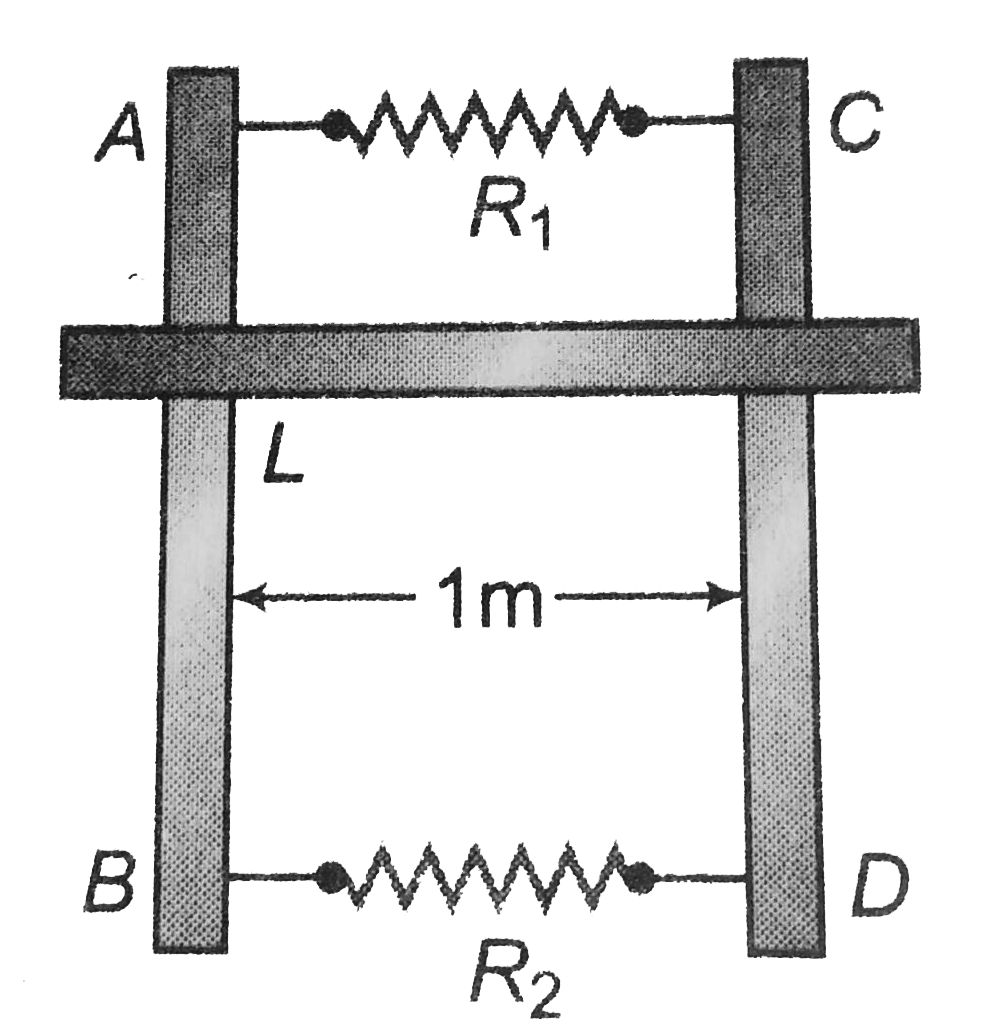
Two parallel vertical metallic rails `AB` and `CD` are separated by `1m`. They are connected at the two ends by resistances `R_1` and `R_2` as shown in the figure. A horizontal metallic bar `l` of mass `0.2 kg` slides without friction, vertically down the rails under the action of gravity. There is a uniform horizontal magnetic field of `0.6 T` perpendicular to the plane of the rails. It is observed that when the terminal velocity is attained, the powers dissipated in `R_1` and `R_2` are `0.76W` and `1.2W` respectively `(g=9.8m//s^2)`

The terminal velocity fo the bar L will be

Promotional Banner

Similar Questions

Explore conceptually related problems

Two parallel vertical metallic rails AB and CD are separated by 1m . They are connected at the two ends by resistances R_1 and R_2 as shown in the figure. A horizontal metallic bar l of mass 0.2 kg slides without friction, vertically down the rails under the action of gravity. There is a uniform horizontal magnetic field of 0.6 T perpendicular to the plane of the rails. It is observed that when the terminal velocity is attained, the powers dissipated in R_1 and R_2 are 0.76W and 1.2W respectively (g=9.8m//s^2) The value of R_1 is

Two parallel vertical metallic rails AB and CD are separated by 1m . They are connected at the two ends by resistances R_1 and R_2 as shown in the figure. A horizontal metallic bar l of mass 0.2 kg slides without friction, vertically down the rails under the action of gravity. There is a uniform horizontal magnetic field of 0.6 T perpendicular to the plane of the rails. It is observed that when the terminal velocity is attained, the powers dissipated in R_1 and R_2 are 0.76W and 1.2W respectively (g=9.8m//s^2) The value of R_1 is

Two parallel vertical metallic rails AB and CD are separated by 1m . They are connected at the two ends by resistances R_1 and R_2 as shown in the figure. A horizontal metallic bar l of mass 0.2 kg slides without friction, vertically down the rails under the action of gravity. There is a uniform horizontal magnetic field of 0.6 T perpendicular to the plane of the rails. It is observed that when the terminal velocity is attained, the powers dissipated in R_1 and R_2 are 0.76W and 1.2W respectively (g=9.8m//s^2) The value of R_2 is

Two parallel vertical metallic rails AB and CD are separated by 1m . They are connected at the two ends by resistances R_1 and R_2 as shown in the figure. A horizontal metallic bar l of mass 0.2 kg slides without friction, vertically down the rails under the action of gravity. There is a uniform horizontal magnetic field of 0.6 T perpendicular to the plane of the rails. It is observed that when the terminal velocity is attained, the powers dissipated in R_1 and R_2 are 0.76W and 1.2W respectively (g=9.8m//s^2) The value of R_2 is

Two parallel vertical metallic rails AB and CD are separated by 1m. They are connected at the two ends by resistances R_1 and R_2 as shown in the figure. A horizontal metallic bar 1 of mass 0.2 kg slides without friction, vertically down the rails under the action of gravity. There is a uniform horizontal magnetic field of 0.6 T perpendicular to the plane of the rails. It is observed that when the terminal velocity is attained, the powers dissipated in R_1 and R_2 are 0.76W and 1.2W respectively (g=9.8m//s^2) The value of R_2 is

Two parallel vertical metallic rails AB and CD are separated by 1m. They are connected at two ends by resistanace (R_1) and (R_2) as shown in fig. A horizontal metallic bar L of mass 0.2 kg slides without froction vertically down the rails under the action of gravity. THere is a uniform horizontal magnetic field of 0.6 Tesla perpendicular to the plane of the rails. It is observed taht when the teminal velocity is attained, the power dissipated in (R_1) and (R_2) are 0.6 watt and 1.2 watt respectively. Find the terminal velocity of the bar L and the values of (R_1)and (R_2) .

Two parallel vertical metellic rails AB and CD are separated by 1m . They are connecting at two ends by resistances R_(1) and R_(2) as shown in Fig. 3.96. A horizontal metallic bar L mas 0.2 kg slides without friction vertically down the rails under the action of gravity. There is a uniform horozontal magnetic field of 0.6 T perpendicular to the plane of the rails. It is observed that when the terminal velocity is attained, thwe power dissipated in R_(1) and R_(2) are 0.76 and 1.2W , respectively. Find the terminal velocity of the bar L and the values of R_(1) and R_(2) .

A conducting wire xy of lentgh l and mass m is sliding without friction on vertical conduction rails ab and cd as shown in figure. A uniform magnetic field B exists perpendicular to the plane of the rails, x moves with a constant velocity of

A conducting wire xy of lentgh l and mass m is sliding without friction on vertical conduction rails ab and cd as shown in figure. A uniform magnetic field B exists perpendicular to the plane of the rails, x moves with a constant velocity of