

Home
Class 12
PHYSICS
Consider the Gaussian surface that surro...

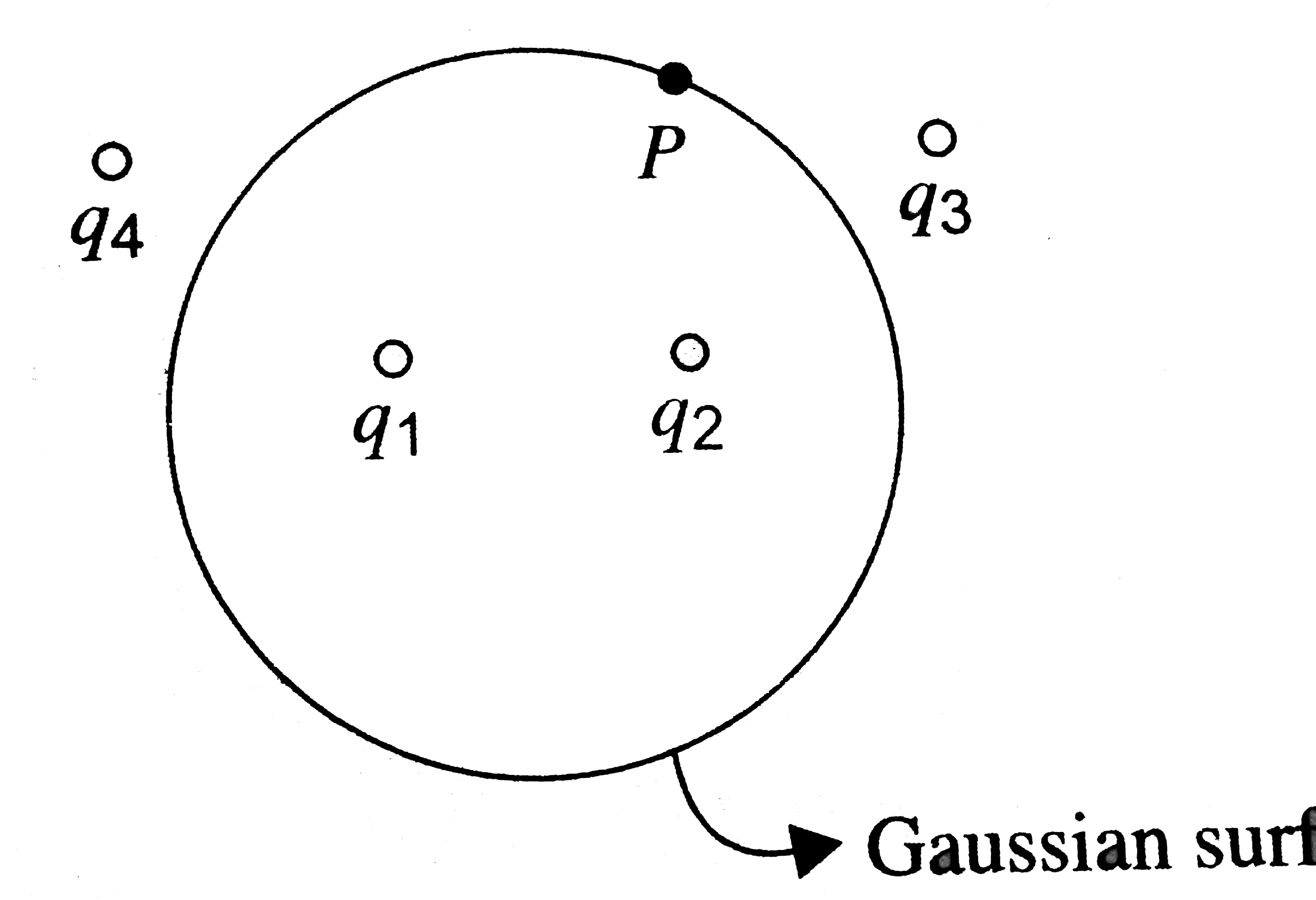
Consider the Gaussian surface that surrounds parts of the charge distribution shown in figure. Then the contribution to the electric field at point P arises from charges

Promotional Banner

Similar Questions

Explore conceptually related problems

Find the direction of electric field at P for the charge distribution as shown infigure.

Find the direction of electric field at P for the charge distribution as shown infigure.

Three infinitely long charge sheets are placed as shown in figure. The electric field at point P is

Three infinitely long charge sheets are placed as shown in figure. The electric field at point P is

Three infinitely long charge sheets are placed as shown in figure. The electric field at point P is

Three infinitely long charge sheets are placed as shown in figure. The electric field at point P is

Gauss's law and Coulomb's law , although expressed in different forms , are equivalent ways of describing the relation between charge and electric field in static conditions . Gauss's law is epsilon_(0) phi = q_(encl) ,when q(encl) is the net charge inside an imaginary closed surface called Gaussian surface. The two equations hold only when the net charge is in vaccum or air . A Gaussian surface encloses two of the four positively charged particles. The particles that contribute to the electric field at a point P on the surface are

Gauss's law and Coulomb's law , although expressed in different forms , are equivalent ways of describing the relation between charge and electric field in static conditions . Gauss's law is epsilon_(0) phi = q_(encl) ,when q(encl) is the net charge inside an imaginary closed surface called Gaussian surface. The two equations hold only when the net charge is in vaccum or air . A Gaussian surface encloses two of the four positively charged particles. The particles that contribute to the electric field at a point P on the surface are

Four charges are arranged on y axis as shown in figure. Then the electric field at point P is proportional to:

Four charges are arranged on y axis as shown in figure. Then the electric field at point P is proportional to: