Home
Class 12
PHYSICS
Two particles, A and B of masses m and 3...

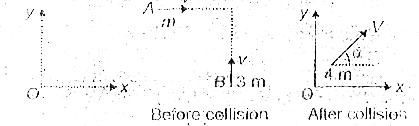
Two particles, A and B of masses m and 3m, are moving along X and Y axes respectively, with the same speed v. They collide at the origin, and coalesce into one body, after the c ollision. What is the velocity of this coalesced mass ?

Text Solution

Verified by Experts
Hint :
Let V be the speed of the combined mass and let V make an angle `alpha` with `+ve` x - axis
`mv=4mv cos alpha" …(i) (conservation of momentum for x component)"`
`3mv=4mV sin alpha" … (ii)"`
Find `tan alpha`,
Find `cos alpha and sin alpha` from (i) & (ii) and put in `cos^(2)alpha +sin^(2)alpha=1`
This will give V in terms of v

Figure shows the two particles before and after the collision. Let V be the speed of the combined mass and let the direction of `vecV` be making an angle `alpha` with the positive X - axis, after collision, Use law of conservation of linear momentum
`mv=4mV cos alpha" ...(i) (For X - components)"`
`3mv=4mV sin alpha" ...(ii) (For Y - components)"`
Divide equation (ii) by equation (i),
`(4mV sinalpha)/(4mV cos alpha)=(3mv)/(mv)`
`tan alpha=3" ...(iii)"`
From (i), `cos alpha=(v)/(4V)" ...(iv)"`
`"From (ii), "sin alpha=(3v)/(4V)" ...(v)"`
`cos^(2)alpha+sin^(2)alpha=1" ...(vi)"`
Put values from (iv) & (v) in (vi)
`((v)/(4V))^(2)+((3v)/(4V))^(2)=1`
`V^(2)=((v)/(4))^(2)+((3v)/(4))^(2)=(10)/(16)v^(2)=(5)/(8)v^(2)`
`V=sqrt((5)/(8))v`
Promotional Banner

Similar Questions

Explore conceptually related problems

Two particles A and B of masses m and 2m are moving along the X-axis and Y-axis respectively with the same speed v. They collide at the origin and coalesce into one body, after the collision. What is the velocity of this coalesced mass? What is the loss of energy during this collision?

Two bodies of masses m and 2m are moving along positive x and y axes respectively with equal speed 4 ms^-1 . They collide at origin and stick together. The final velocity of combined mass is

A body A of mass 5kg is moving along the x-axis with a velocity 2m/s. Another body (B) of mass 10 kg is moving along the y-axis with a velocity sqrt(3)m//s . They collide at the origin and stick together. What is the final velocity of the combined mass?

Two equal masses m_1 and m_2 moving along the same straight line with velocites +3 m//s and - 5 m//s respectively collide elastically. Their velocities after the collision will be respectively.

Two particles of mass m and 2 m moving in opposite directions collide elastically with velocities v and 2v. Find their velocities after collision.

Two particles of masses m and 2m moving in opposite directions collide elastically with velocity 2v and v , respectiely. Find their velocities after collision.

Two particles of mass 2m and m moving with speed v and 2v respectively pependicular to each other collides perfectly inelastically, then Speed of the particles after collision

Two objects of masses 100g and 200g are moving along the same line in the same line in the same direction with velocities of 2m//s and 1m//s , respectively. They collide and after the collison, the first object moves at a velocity of 1.67 m//s in the same direction. Determine the velocity of the second object.

