Home
Class 12
PHYSICS
Two forces of magnitudes 3N and 4 N act ...

Two forces of magnitudes 3N and 4 N act together on an object making an angle `60^(@)` with each other. Find the resultant force acting on the object.

Text Solution

Verified by Experts
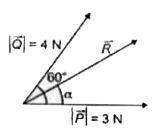
Here `|bar(P)|=3N, |bar(Q)|=4N "and" theta = 60^(@)`
Let `bar( R) = bar(P) +bar(Q)`
Using law of cosines
`R = sqrt(P^(2)+Q^(2)+2"PQcos"60^(@))`
`=sqrt(3^(2)+4^(2)+2xx3xx4(1)/(2))`
`implies R = sqrt(37)`
Let `bar(R )` make angle `alpha` with `bar(P) ` Using law of sines
`(R )/(sin60^(@))=(Q)/(sinalpha)`
`implies sin alpha= (4xxsqrt(3))/(sqrt37xx2)`
`sin alpha= (2sqrt(3))/(sqrt(37))`
`alpha=sin^(-1)2(sqrt((3)/(37)))`
Promotional Banner

Similar Questions

Explore conceptually related problems

Two equal forces acting at 60^(@) to each other. Find the forces if resultant force is 300 N.

Two forces of 5N and 7N act on a aprticle with an angle of 60^(@) between them. Find the resultant force.

A body is acted upon by two forces of manitudes F_(1)=sqrt2 Nand F_(2)=3 N which are inclined at 45^(@) to each other. There magnitude of resultant force acting on the body is

Two forces of equal magnitude act at a point making an angle theta with each other. If the direction of one of the forces is reversed, the direction of the resultant will turn through

Two forces of 12 N and 5 N are acting on a particle , with an angle of 60^(@) between them , Calculate the resultant force .

A body of mass 10 kg is acted upon by two forces each of magnitude 10 N making an angle of 60^(@) with each other. Find the net acceleration of the body

Two forces of magnitudes 3N and 4N are acted on a body. The ratio of magnitude of minimum and maximum resultant force on the body is

Two forces each of magnitude 2N, act at an angle of 60^(@) . What is the magnitude of the resultant force ?

A block is applied two forces of magnitude 5N each. One force is acting towards East and the other acting along 60^(@) North of East. The resultant of the two forces (in N) is of magnitude :-

