Home
Class 12
PHYSICS
A particle is projected at angle theta w...

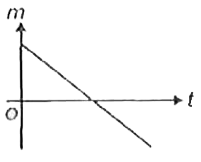
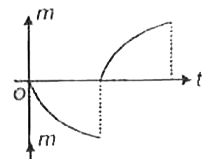
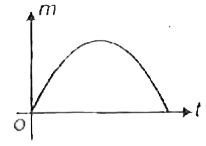
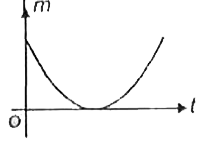
A particle is projected at angle `theta` with horizontal from ground. The slop (m) of the trajectory of the particle varies with time (t) as

A

B

C

D

Text Solution

AI Generated Solution

The correct Answer is:

To solve the problem of how the slope (m) of the trajectory of a particle projected at an angle θ with the horizontal varies with time (t), we can follow these steps: ### Step 1: Understand the Motion Components The particle is projected with an initial speed \( u \) at an angle \( \theta \). We can break this motion into horizontal and vertical components: - Horizontal component of velocity: \( u_x = u \cos \theta \) - Vertical component of velocity: \( u_y = u \sin \theta \) ### Step 2: Write the Equations of Motion For horizontal motion (x-direction): - There is no acceleration, so the position as a function of time is given by: \[ x = u_x t = u \cos \theta \cdot t \] For vertical motion (y-direction): - The vertical position as a function of time is given by: \[ y = u_y t - \frac{1}{2} g t^2 = u \sin \theta \cdot t - \frac{1}{2} g t^2 \] ### Step 3: Eliminate Time to Find the Trajectory Equation We can express time \( t \) in terms of \( x \) from the horizontal motion equation: \[ t = \frac{x}{u \cos \theta} \] Substituting this expression for \( t \) into the vertical motion equation: \[ y = u \sin \theta \left(\frac{x}{u \cos \theta}\right) - \frac{1}{2} g \left(\frac{x}{u \cos \theta}\right)^2 \] This simplifies to: \[ y = x \tan \theta - \frac{g}{2 u^2 \cos^2 \theta} x^2 \] This is the equation of the trajectory. ### Step 4: Determine the Slope of the Trajectory The slope \( m \) of the trajectory at any point is given by the derivative \( \frac{dy}{dx} \): \[ \frac{dy}{dx} = \tan \theta - \frac{g}{u^2 \cos^2 \theta} x \] This shows that the slope \( m \) is a linear function of \( x \). ### Step 5: Relate Slope to Time To express \( m \) as a function of time, we substitute \( x = u \cos \theta \cdot t \) into the slope equation: \[ m = \tan \theta - \frac{g}{u^2 \cos^2 \theta} (u \cos \theta \cdot t) \] This simplifies to: \[ m = \tan \theta - \frac{g}{u \cos \theta} t \] Thus, the slope \( m \) varies linearly with time \( t \). ### Final Result The slope \( m \) of the trajectory as a function of time \( t \) is given by: \[ m(t) = \tan \theta - \frac{g}{u \cos \theta} t \]
Promotional Banner

Similar Questions

Explore conceptually related problems

A particle is projected at an angle theta from ground with speed u (g = 10 m/ s^2 )

A heavy particle is projected with a velocity at an angle with the horizontal into the uniform gravitational field. The slope of the trajectory of the particle varies as

A heavy particle is projected with a velocity at an acure angle with the horizontal into a uniform gravitational field. The slope of the trajectory of the particle varies as

A particle is projected with speed u at angle theta with horizontal from ground . If it is at same height from ground at time t_(1) and t_(2) , then its average velocity in time interval t_(1) to t_(2) is

A particle is thrown with speed u at an angle alpha with horizontal from the ground. After how much time, the velocity of particle will make an angle beta with horizontal.

A particle of mass m is projecte dwilth speed u at an angle theta with the horizontal. Find the torque of the weight of the particle about the point of projection when the particle is at the highest point.
