Home
Class 12
CHEMISTRY
udner identical conditions, solvolysis o...

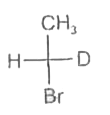
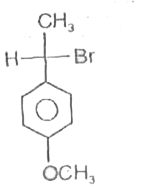
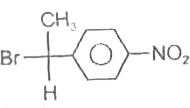
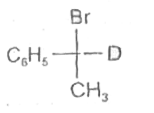
udner identical conditions, solvolysis of which of the following substrate would lead to maximum racemisation?

A

B

C

D

Text Solution

AI Generated Solution

The correct Answer is:

To determine which substrate will lead to maximum racemization under identical conditions during solvolysis, we need to analyze the stability of the carbocations formed from each substrate. The more stable the carbocation, the more racemization will occur because the SN1 mechanism allows for equal attack from both sides of the planar carbocation. ### Step-by-Step Solution: 1. **Understanding Racemization**: - Racemization occurs when a chiral compound converts into a racemic mixture, which contains equal amounts of enantiomers. This typically happens in reactions that involve carbocation intermediates, such as the SN1 mechanism. 2. **Identify the Mechanism**: - The question involves solvolysis, which often follows the SN1 mechanism. In this mechanism, the formation of a carbocation is the rate-determining step. 3. **Carbocation Stability**: - The stability of the carbocation is crucial for determining the extent of racemization. The more stable the carbocation, the more likely it is to form and lead to racemization. - Carbocation stability follows the order: tertiary > secondary > primary > methyl. Additionally, resonance and inductive effects can also stabilize carbocations. 4. **Analyze Each Substrate**: - For each substrate provided in the question, we need to analyze the carbocation that would form upon the departure of the leaving group (e.g., Br). - Consider the effects of substituents on the carbocation stability: - **Substituent Effects**: Electron-donating groups (like -OCH3) stabilize carbocations through resonance (+R effect), while electron-withdrawing groups (like -NO2) destabilize them through resonance (-R effect). 5. **Compare the Carbocations**: - Identify which substrate leads to the most stable carbocation: - **Substrate A**: Forms a carbocation stabilized by +I effect. - **Substrate B**: Forms a carbocation stabilized by +R effect from -OCH3 and +I effect from -CH3. - **Substrate C**: Forms a carbocation with resonance stabilization from benzene. - **Substrate D**: Forms a carbocation that is destabilized by -R effect from -NO2. 6. **Determine Maximum Racemization**: - The substrate that forms the most stable carbocation will lead to the maximum racemization. Based on the analysis: - Substrate B (with -OCH3) has the most stabilizing effects (three factors: +R from -OCH3, +R from benzene, and +I from -CH3). - Substrate C has two stabilizing factors. - Substrate A has one stabilizing factor. - Substrate D is destabilized. 7. **Conclusion**: - Therefore, the substrate that would lead to maximum racemization under identical conditions is **Substrate B**.
Promotional Banner

Topper's Solved these Questions

  • HALOALKANES AND HALOARENES

    AAKASH INSTITUTE|Exercise ASSIGNMENT SECTION - C|38 Videos
  • HALOALKANES AND HALOARENES

    AAKASH INSTITUTE|Exercise ASSIGNMENT SECTION -D|15 Videos
  • HALOALKANES AND HALOARENES

    AAKASH INSTITUTE|Exercise ASSIGNMENT SECTON - A|45 Videos
  • GENERAL PRINCIPLES AND PROCESSES OF ISOLATION OF ELEMENTS

    AAKASH INSTITUTE|Exercise Try Yourself|33 Videos
  • HYDROCARBONS

    AAKASH INSTITUTE|Exercise Assignment(Section - D) (Assertion -Reason Type Question)|24 Videos

Similar Questions

Explore conceptually related problems

Which of the following substrate have maximum RQ value

For which of the following ionic species radius would be maximum?

Which of the following would weigh the maximum?

Which of the following would exert maximum osmotic pressure?

Which one of the following would not lead to formation of clones?

Which of the following is not a substrate for decarboxylation?

AAKASH INSTITUTE-HALOALKANES AND HALOARENES -ASSIGNMENT SECTION - B
  1. Which one of the following is a free - radical substitution reaction ?

    Text Solution

    |

  2. Which of the following compounds undergoes mucleophilic substitution r...

    Text Solution

    |

  3. Replacement of CI of chlorobenzene to give pheno1 require drastic cond...

    Text Solution

    |

  4. Chloropicrin is obtained by the reaction of

    Text Solution

    |

  5. The raction of toluene with CI(2) in presence of FeCI(3) gives X and r...

    Text Solution

    |

  6. What is B ?

    Text Solution

    |

  7. Ethylidene chloride on treatement with aq. KOH gives

    Text Solution

    |

  8. The correct order of reactivity of the following compounds towards aqu...

    Text Solution

    |

  9. Which among the following is the correct order of melting point ?

    Text Solution

    |

  10. For which of the following G, above reaction will be the fastest ?

    Text Solution

    |

  11. Which of the following is least reactive towards nucleophilic substitu...

    Text Solution

    |

  12. Among the following The correct order of reactivity towards ArS...

    Text Solution

    |

  13. Which of the following does not give yellow precipitate with "AgNO"(3)...

    Text Solution

    |

  14. What is C ?

    Text Solution

    |

  15. The product (C ) is

    Text Solution

    |

  16. In the given reaction The product will be

    Text Solution

    |

  17. udner identical conditions, solvolysis of which of the following subst...

    Text Solution

    |

  18. The correct order of reactivity towards S(N)1 reaction is

    Text Solution

    |

  19. When cis-but-2-ene is treated with Br(2) in "CCl"(4) medium the produc...

    Text Solution

    |

  20. CH3-Cl+NaI overset("Acetone")iff CH3-I+NACl Above equilibrium is mor...

    Text Solution

    |
