

Home
Class 11
PHYSICS
A uniform spherical shell of mass M and ...

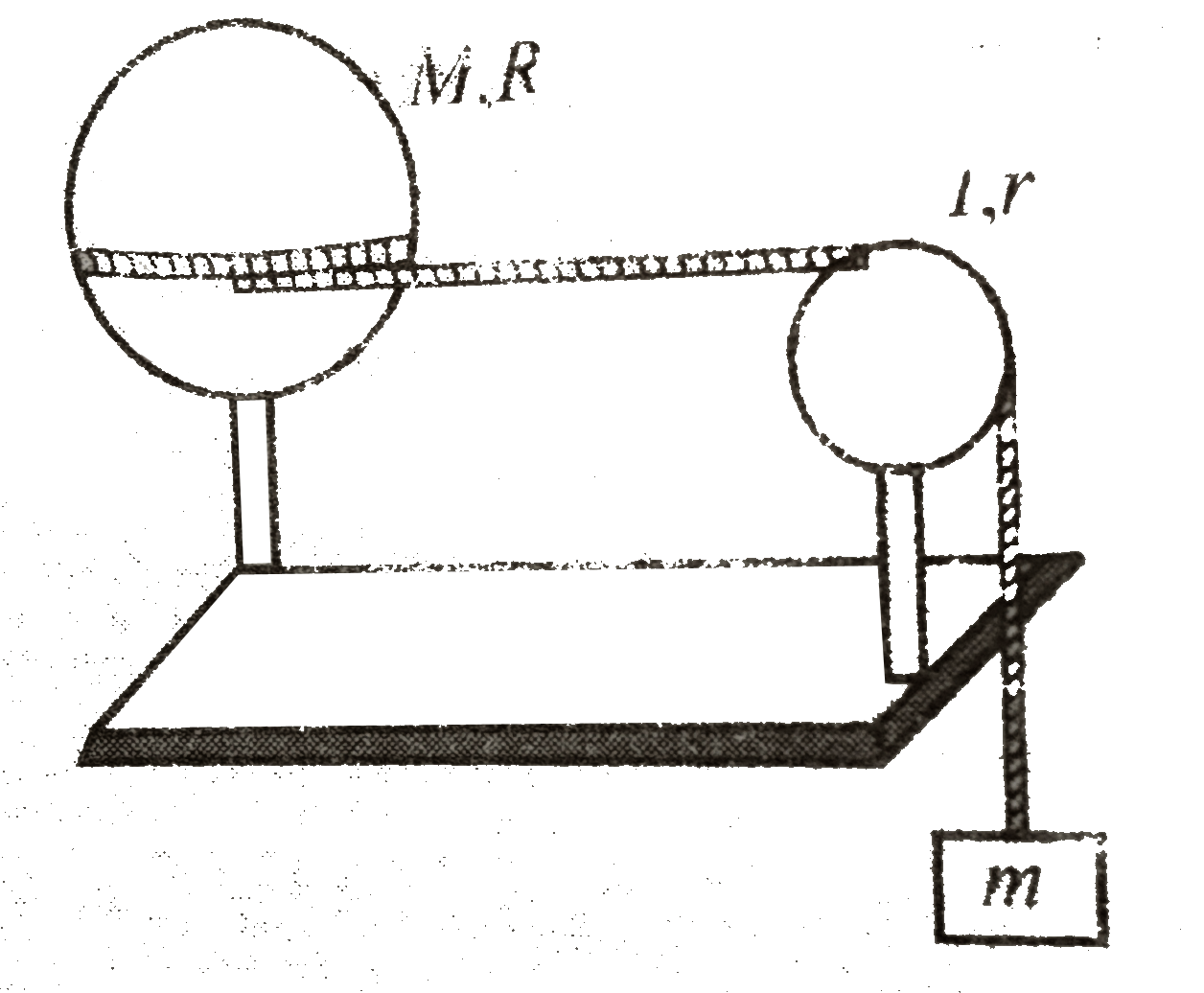
A uniform spherical shell of mass `M` and radius `R` rotates, about a vertical axis on frictionless bearing. A massless cord passes around the equator of the shell., over a pulley of rotational inertia `I` and radius `r` and is attached to small object of mass `m` that is otherwise free to fall under the influence of gravity. There is no friction of pulley's axle, the cord does not slip on the pulley. What is the speed of the object after it has fallen a distance `h`. from rest? Use work-energy considerations.

Promotional Banner

Similar Questions

Explore conceptually related problems

A uniform spherical shell of mass M = 4.5 kg and radius R = 8.5 cm can rotate about a vertical axis on frictionless bearings (Fig. 10-69). A massless cord passes around the equator of the shell, over a pulley of rotational inertia I=3.0xx10^(-3)kg*m^(2) and radius r = 5.0 cm, and is attached to a small object of mass m = 0.60 kg. There is no friction on the pulley's axle, the cord does not slip on the pulley. What is the speed of the object when it has fallen 82 cm after being released from rest? Use energy considerations.

A thin spherical shell of mass M and radius R has a small hole. A particle of mass m released at its mouth. Then

A thin spherical shell of mass M and radius R has a small hole. A particle of mass m released at its mouth. Then

A uniform disc of mass M and radius R is mounted on an axle supported in frictionless bearings. A light cord is wrapped around the rim of the disc and a steady downward pull T is exerted on the cord. The angular acceleration of the disc is

A uniform disc of mass M and radius R is mounted on an axle supported in frictionless bearings. A light cord is wrapped around the rim of the disc and a steady downward pull T is exerted on the cord. The angular acceleration of the disc is

Figure shows a hemispherical shell of mass M and radius R and a concentric shell of mass m and radius 3R/4.