Text Solution
Verified by Experts
The correct Answer is:



Topper's Solved these Questions
INVERSE TRIGONOMETRIC FUNCTIONS
CENGAGE|Exercise JEE Main Previous Year|2 VideosINVERSE TRIGONOMETRIC FUNCTIONS
CENGAGE|Exercise JEE Advanced Previous Year|8 VideosINVERSE TRIGONOMETRIC FUNCTIONS
CENGAGE|Exercise Exercise (Matrix)|5 VideosINTRODUCTION TO VECTORS
CENGAGE|Exercise JEE Previous Year|20 VideosJEE 2019
CENGAGE|Exercise Chapter 10|9 Videos
Similar Questions
Explore conceptually related problems
CENGAGE-INVERSE TRIGONOMETRIC FUNCTIONS-Exercise (Numerical)
- The solution set of inequality (cot^(-1)x)(tan^(-1)x)+(2-pi/2),cot^(-1...
Text Solution
|
- If x=sin^(-1)(a^6+1)+cos^(-1)(a^4+1)-tan^(-1)(a^2+1),a in R , then th...
Text Solution
|
- If the roots of the equation x^(3) -10 x + 11 = 0 are u, v, and w, the...
Text Solution
|
- The number of values of x for which sin^(-1)(x^2-(x^4)/3+(x^6)/9)+cos^...
Text Solution
|
- If the domain of the function f(x) = sqrt(3 cos^(-1) (4x) - pi) is [a,...
Text Solution
|
- If 0<cos^(-1)x<1a n d1+"sin"(cos^(-1)x)+sin^2(cos^(-1)x)+sin^3(cos^(-1...
Text Solution
|
- If tan^(-1)(x+3/x)-tan^(-1)(x-3/x)=tan^(-1)6/x , then the value of x^4...
Text Solution
|
- If range of function f(x)=sin^(-1)x+2tan^(-1)x+x^2+4x+1 is [p , q], th...
Text Solution
|
- If cos^(-1)(x)+cos^(-1)(y)+cos^(-1)(z)=pi(sec^2(u)+sec^4(v)+sec^6(w)),...
Text Solution
|
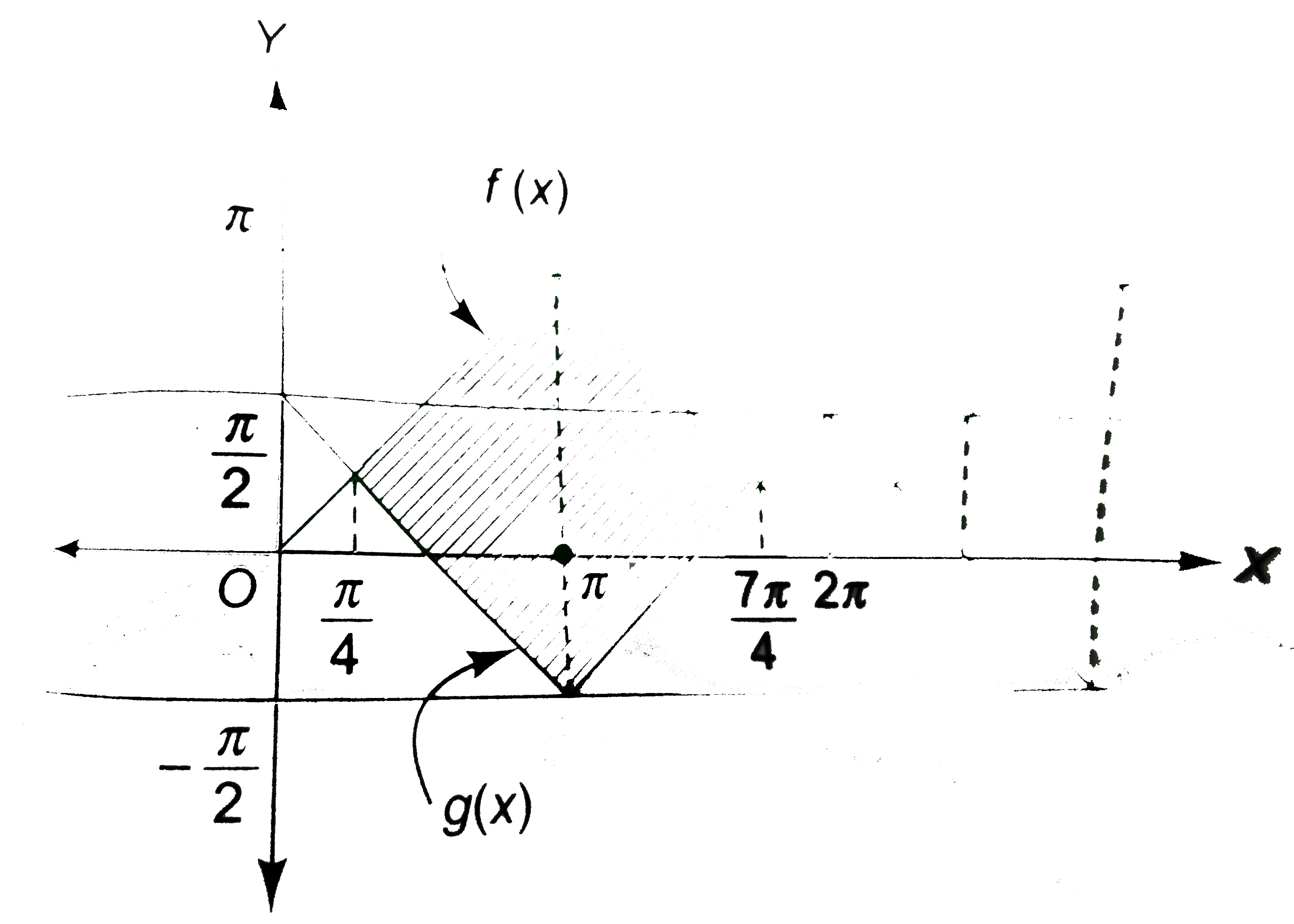
- If the area enclosed by the curves f(x) = cos^(-1) (cos x) and g(x) = ...
Text Solution
|
- Absolute value of sum of all integers in the domain of f(x)=cot^(-1)sq...
Text Solution
|
- The least value of (1+sec^(-1)x)(1+c a s^(-1)x) is
Text Solution
|
- Let cos^(-1)(x)+cos^(-1)(2x)+cos^(-1)(3x) be pi. If x satisfies the eq...
Text Solution
|
- The number of integral values of x satisfying the equation tan^(-1) (3...
Text Solution
|
- Number of solutions of equation sin(cos^(-1)(tan(sec^(-1)x)))=sqrt(1+x...
Text Solution
|
- If the equation sin^(-1)(x^2+x+1)+cos^(-1)(lambda+1)=pi/2 has exactly ...
Text Solution
|
- sin{2(sin^(-1)(sqrt(5))/3-cos^(-1)(sqrt(5))/3)} is equal to (ksqrt(5)...
Text Solution
|
- The number of solutions of "cos"(2sin^(-1)("cot"(tan^(-1)(sec(6cos e c...
Text Solution
|