

Home
Class 11
PHYSICS
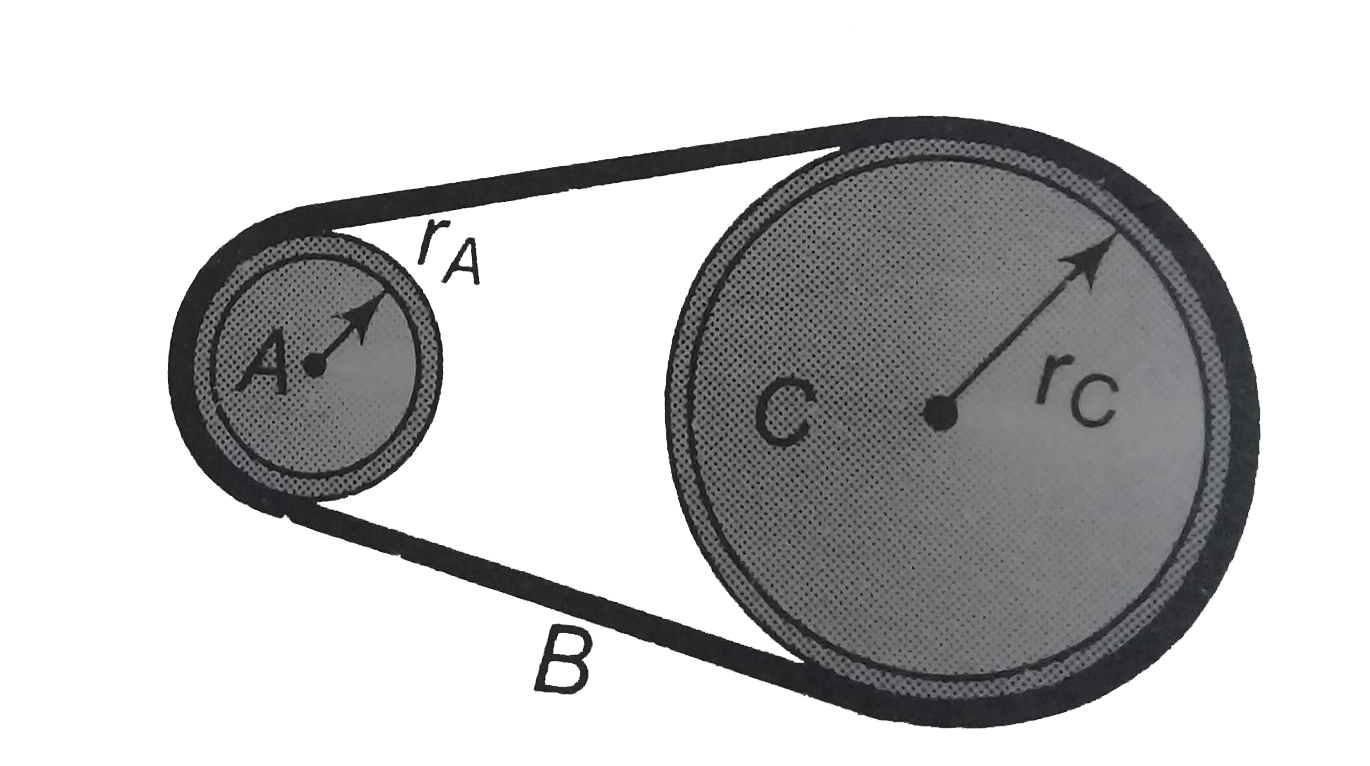
In figure wheel A of radius rA = 10 cm i...

In figure wheel `A` of radius `r_A = 10 cm` is coupled by belt `B` to wheel `C` of radius `r_C = 25 cm`. The angular speed of wheel `A` is increased from rest at a constant rate of `1.6 rad//s^2`. Find the time needed for wheel `C` to reach an angular speed of `12.8 rad//s`, assuming the belt does not slip.
.

Promotional Banner

Similar Questions

Explore conceptually related problems

In figure whell A of radius r_A = 10 cm is coupled by belt B to whell C of radius r_C = 25 cm . The angular speed of whell A is increased from rest at a constant rate of 1.6 rad//s^2 . Find the time needed for whell C to reach an angular speed of 12.8 rad//s , assuming the belt does not slip. .

In Fig. 10-54, wheel A of radius r_(A)=10cm is coupled by belt B to wheel C of radius r_(C)=25cm . The angular speed of wheel A is increased from rest at a constant rate of 2.0rad//s^(2) . Find the time needed for wheel C to reach an angular speed of 100 rev/min, assuming the belt does not slip.

A wheel having radius 10 cm is coupled by a belt to another wheel of radius 30 cm . 1st wheel increases its angular speed from rest at a uniform rate of 1.5 "rads"^(-2) . The time for 2nd wheel to reach a rotational speed of 100rev/min is ... (assume that the belt does not slip )

A wheel having radius 10cm is coupled by a belt to another wheel of radius 30cm. 1^(st) wheel increases its angular speed from rest at a uniform rate of 1.57 rads^(-2) . The time for 2^(nd) wheel to reach a rotational speed of 100 rev/min is....(assume that the belt does not slip)

A dust particle lying at the rim of a wheel has an angular speed of 22 rad/s. Find the time period.

A dust particle lying at the rim of a wheel has an angular speed of 22 rad/s. Find the time period.

Wheel A of radius r_(A)=10cm is coupled by a belt C to another wheel of radius r_(B)=25 cm as in the figure. The wheels are free to rotate and the belt does not slip . At time t=0 wheel A increases it's angular speed from rest at a uniform rate pi//2 rad //sec^(2) Find the time in which wheel B attains a speed of 100 rpm [ Hint : v_(A)=v_(B)]

Wheel A of radius r_(A)=10cm is coupled by a belt C to another wheel of radius r_(B)=25 cm as in the figure. The wheels are free to rotate and the belt does not slip . At time t=0 wheel A increases it's angular speed from rest at a uniform rate pi//2 rad //sec^(2) Find the time in which wheel B attains a speed of 100 rpm [ Hint : v_(A)=v_(B)]