Home
Class 12
PHYSICS
Block M slide donw on frictionless incli...

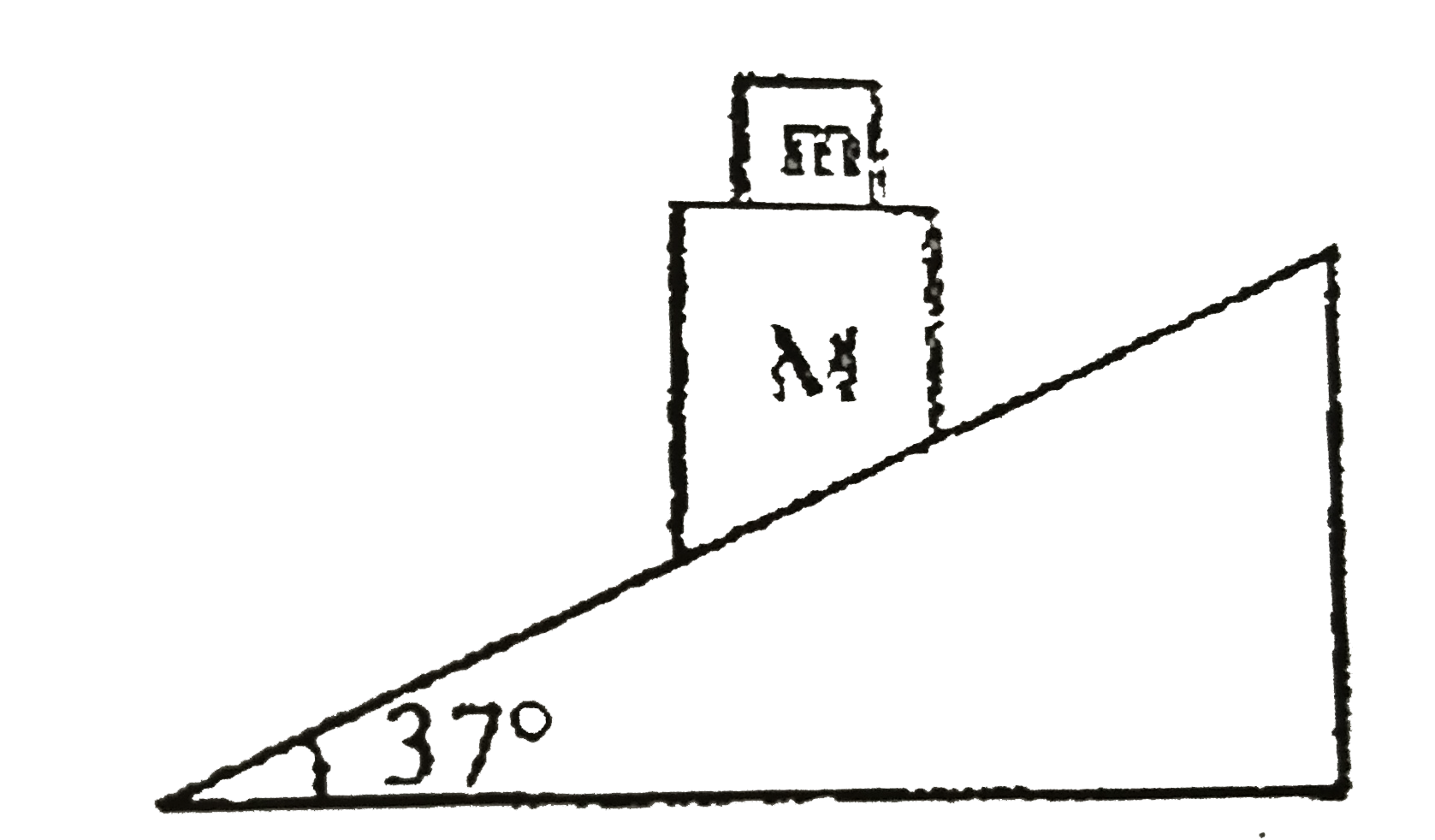
Block M slide donw on frictionless inclined plane as shown. Find frictional force acting on block m while it is at rest with respect to the block M. `(m=2kg, M=5kg,g=10m//sec^(2))`

A

8.5N

B

9.6N

C

12.8N

D

16.5N

Text Solution

Verified by Experts

`a= g sin 37^(@)`
`f=mxxaxxcos 37^(@)`
Promotional Banner

Topper's Solved these Questions

  • TEST PAPERS

    BANSAL|Exercise PHYSICS PART (A)|32 Videos
  • TEST PAPERS

    BANSAL|Exercise PHYSICS PART (B)|3 Videos
  • TEST PAPERS

    BANSAL|Exercise PHYSICS PART- C|4 Videos
  • SEMICONDUCTORS

    BANSAL|Exercise CBSE Question|32 Videos

Similar Questions

Explore conceptually related problems

Block M slides down on frictionless incline as shown. The minimum friction coefficient so that m does not slide with respect to M would be :

A block rests on a rought inclined plane making an angle of 30^(@) with horizontal. The coefficient of static friction between the block and inclined plane is 0.8 . If the frictional foerce on the block is 10 N , the mass of the block in kg is (g = 10 m//s^(2))

A block of mass m = 3 kg slides on a rough inclined plane of cofficient of friction 0.2 Find the resultant force offered by the plane on the block

consider the situation shown in figure in which a block 'A' of mass 2 kg is placed over a biock.'B' of mass 4 kg. The combination of the blocks are placed on a inclined plane of inclination 37^(@) with horizontal. The coefficient of friction between block B and inclined plane is mu_(2) and in between the two, blocks is mu_(1) . The system is released from rest. ("Take "g=10m//sec^(2)) The frictional force acting between the blocks in the previous case will be:

consider the situation shown in figure in which a block 'A' of mass 2 kg is placed over a biock.'B' of mass 4 kg. The combination of the blocks are placed on a inclined plane of inclination 37^(@) with horizontal. The coefficient of friction between block B and inclined plane is mu_(2) and in between the two, blocks is mu_(1) . The system is released from rest. ("Take "g=10m//sec^(2)) The frictional force acting between the blocks in the previous case :

consider the situation shown in figure in which a block 'A' of mass 2 kg is placed over a biock.'B' of mass 4 kg. The combination of the blocks are placed on a inclined plane of inclination 37^(@) with horizontal. The coefficient of friction between block B and inclined plane is mu_(2) and in between the two, blocks is mu_(1) . The system is released from rest. ("Take "g=10m//sec^(2)) The frictional force acting between the two blocks in the previous question is :

consider the situation shown in figure in which a block 'A' of mass 2 kg is placed over a biock.'B' of mass 4 kg. The combination of the blocks are placed on a inclined plane of inclination 37^(@) with horizontal. The coefficient of friction between block B and inclined plane is mu_(2) and in between the two, blocks is mu_(1) . The system is released from rest. ("Take "g=10m//sec^(2)) In the previous question the frictional force between block B and plane is :

A block is placed on an inclined plane as shown in figure. What must be the friction force between block and inclined if the block is not to slice along the inclined when the incline is accelerating to the right at 3 m//s^(2) ( sin 37^(@) = (3)/(5)) ? (Take g = 10 m//s^(2))

A block mass 'm' is placed on a frictionless inclined plane of inclination theta with horizontal. The inclined plane is accelerated horizontally so that the block does not slide down. In this situation vertical force exerted by the inclined plane on the block is:

A massless string and a spring connect two blocks A and B to each other. Block B slides over a frictionless inclined plane while block A slides over horizontal surface. Coefficient of friction between block a A horizontal surface is mu=0.2 . At the instant shown blocks are moving with constant speed. Mass of block A and energy stored in spring the respectively. [g=10m//s^(2),k=1000N/m, m_(B)=2kg]

BANSAL-TEST PAPERS-PHYSICS
  1. A swimmer can swim with 5ms^(-1) in still water. He wants to cross a r...

    Text Solution

    |

  2. Figure shown V(y)-t graph of a particle projected from the ground. The...

    Text Solution

    |

  3. Block M slide donw on frictionless inclined plane as shown. Find frict...

    Text Solution

    |

  4. Two particles are projected from two points 4m apart on the horizontal...

    Text Solution

    |

  5. A block is thrown with 14ms^(-1) over a long stationary plank as shown...

    Text Solution

    |

  6. A 60kg man is running on horizontal road with acceleration 2ms^(-1) fr...

    Text Solution

    |

  7. In a uniform circular motion, choose correct statement(s):

    Text Solution

    |

  8. A particle is doing uniform circular motion as shown. Magnitude of ave...

    Text Solution

    |

  9. A stone is dropped from a building, and 2 seconds later another stone ...

    Text Solution

    |

  10. A sphere is placed on two similar cubes as shown. All surfaces are smo...

    Text Solution

    |

  11. Two masses are joined together by a massless, inextensible string. A v...

    Text Solution

    |

  12. You read about a car accidnet in the newspaper. A car travelling at 70...

    Text Solution

    |

  13. You step into an elevator, and it accelerates to a downward speed of 9...

    Text Solution

    |

  14. Blocks of 1,0,2,0 and 3.0 kg are lined up on a table, as shown in fig....

    Text Solution

    |

  15. Determine the work done by the frictional force in moving a block of m...

    Text Solution

    |

  16. Find tension in the string between blocks 3kg and 4kg. Friction is neg...

    Text Solution

    |

  17. A particle is projected with 10ms^(-1) at angle theta above horizontal...

    Text Solution

    |

  18. A particle is projected with 20ms^(-1) at 30^(@) above horizontal. Fin...

    Text Solution

    |

  19. Find acceleration of 5kg bock. All stirng and pulley are ideal. (g=10m...

    Text Solution

    |

  20. Find maximum compression is the spring from the given figure.

    Text Solution

    |

