Home
Class 12
PHYSICS
Two objects that are moving an xy-plane ...

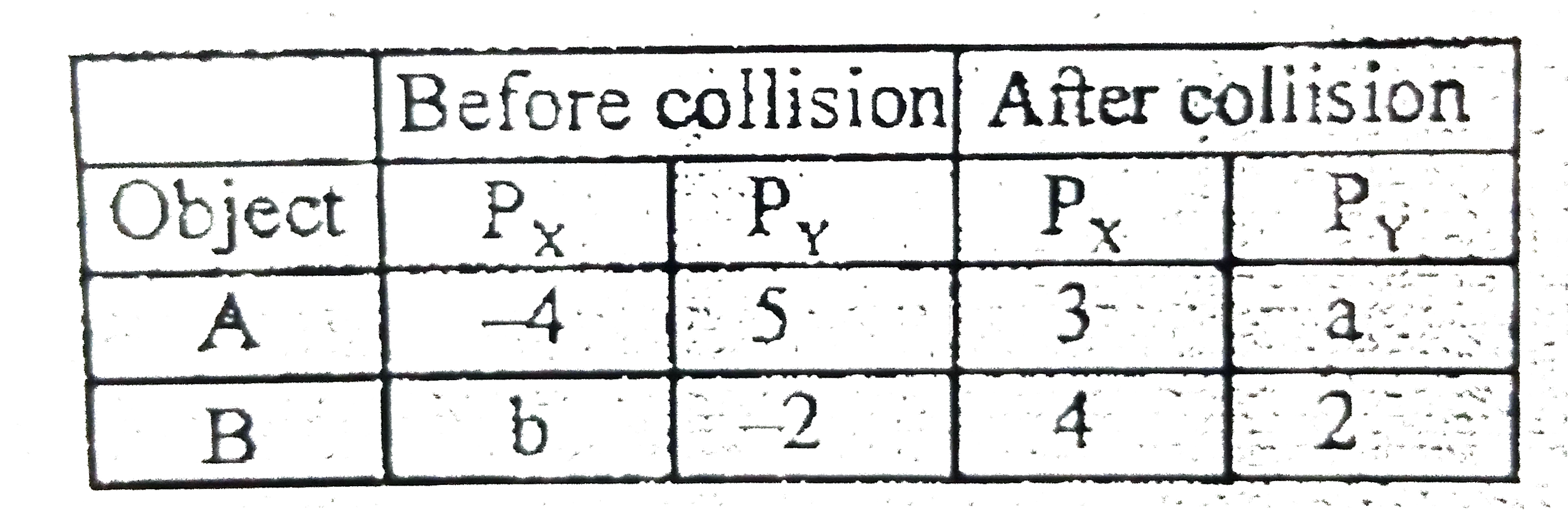
Two objects that are moving an xy-plane on a frictionless floor collide. Assume that they form a closed, isolated system. The following table gives ssome of the momentum compounds (in kilogram meters per second) before and after the collision. What are the missing values (a,b):

A

10,11

B

1,11

C

5,7

D

6,4

Text Solution

Verified by Experts

By COM
Along the x-axis
`-4+(P_(x))_(B)=3+4rArr(P_(x))_(B)=11`
Along the y=axis
`5-2=(P_(y))_(A)+2 rArr (P_(y))_(A)=1`
Promotional Banner

Topper's Solved these Questions

  • TEST PAPERS

    BANSAL|Exercise PHYSICS PART (A)|32 Videos
  • TEST PAPERS

    BANSAL|Exercise PHYSICS PART (B)|3 Videos
  • TEST PAPERS

    BANSAL|Exercise PHYSICS PART- C|4 Videos
  • SEMICONDUCTORS

    BANSAL|Exercise CBSE Question|32 Videos

Similar Questions

Explore conceptually related problems

An object A of mass 2 kg is moving on a frictionless horizontal track has perfectly inelastic collision with another object B of mass 3 kg made of the same material and moving in front of A in same direction their common speed after the collision is 4 m//s Due to the collision the temperature of the two objects which was initially the same, is increased though only by 0.006^(@) C What was the initial speed (in m//s) of the colliding object A before the collision?

Collision is a physical process in which two or more objects, either particle masses or rigid bodies, experience very high force of interaction for a very small duration. It is not essential for the objects to physically touch each other for collision to occur. Irrespective of the nature of interactive force and the nature of colliding bodies, Newton's second law holds good on the system. Hence, momentum of the system before and after the collision remains conserved if no appreciable external force acts on the system during collision. The amount of energy loss during collision, if at all, is indeed dependent on the nature of colliding objects. The energy loss is observed to be maximum when objects stick together after collision. The terminology is to define collision as 'elastic' if no energy loss takes place and to define collision as 'plastic' for maximum energy loss. The behaviour of system after collision depends on the position of colliding objects as well. A unidirectional motion of colliding objects before collision can turn into two dimensional after collision if the line joining the centre of mass of the two colliding objects is not parallel to the direction of velocity of each particle before collision. Such type of collision is referred to as oblique collision which may be either two or three dimensional. For which of the following collisions, the external force acting on the system during collision is not appreciable as mentioned in paragraph 1.

Collision is a physical process in which two or more objects, either particle masses or rigid bodies, experience very high force of interaction for a very small duration. It is not essential for the objects to physically touch each other for collision to occur. Irrespective of the nature of interactive force and the nature of colliding bodies, Newton's second law holds good on the system. Hence, momentum of the system before and after the collision remains conserved if no appreciable external force acts on the system during collision. The amount of energy loss during collision, if at all, is indeed dependent on the nature of colliding objects. The energy loss is observed to be maximum when objects stick together after collision. The terminology is to define collision as 'elastic' if no energy loss takes place and to define collision as 'plastic' for maximum energy loss. The behaviour of system after collision depends on the position of colliding objects as well. A unidirectional motion of colliding objects before collision can turn into two dimensional after collision if the line joining the centre of mass of the two colliding objects is not parallel to the direction of velocity of each particle before collision. Such type of collision is referred to as oblique collision which may be either two or three dimensional. According to the definition of collision in paragraph I, which of the following physical process is not a collision?

Collision is a physical process in which two or more objects, either particle masses or rigid bodies, experience very high force of interaction for a very small duration. It is not essential for the objects to physically touch each other for collision to occur. Irrespective of the nature of interactive force and the nature of colliding bodies, Newton's second law holds good on the system. Hence, momentum of the system before and after the collision remains conserved if no appreciable external force acts on the system during collision. The amount of energy loss during collision, if at all, is indeed dependent on the nature of colliding objects. The energy loss is observed to be maximum when objects stick together after collision. The terminology is to define collision as 'elastic' if no energy loss takes place and to define collision as 'plastic' for maximum energy loss. The behaviour of system after collision depends on the position of colliding objects as well. A unidirectional motion of colliding objects before collision can turn into two dimensional after collision if the line joining the centre of mass of the two colliding objects is not parallel to the direction of velocity of each particle before collision. Such type of collision is referred to as oblique collision which may be either two or three dimensional. According to the definition of oblique collision in the paragraph, which of the following collisions cannot be oblique'?

Collision is a physical process in which two or more objects, either particle masses or rigid bodies, experience very high force of interaction for a very small duration. It is not essential for the objects to physically touch each other for collision to occur. Irrespective of the nature of interactive force and the nature of colliding bodies, Newton's second law holds good on the system. Hence, momentum of the system before and after the collision remains conserved if no appreciable external force acts on the system during collision. The amount of energy loss during collision, if at all, is indeed dependent on the nature of colliding objects. The energy loss is observed to be maximum when objects stick together after collision. The terminology is to define collision as 'elastic' if no energy loss takes place and to define collision as 'plastic' for maximum energy loss. The behaviour of system after collision depends on the position of colliding objects as well. A unidirectional motion of colliding objects before collision can turn into two dimensional after collision if the line joining the centre of mass of the two colliding objects is not parallel to the direction of velocity of each particle before collision. Such type of collision is referred to as oblique collision which may be either two or three dimensional. Which of the following collisions is one-dimensional?

A block B is at rest on the rough horizontal surface as shown. Another block A collides with B . Then, which of the following statement is correct? ( i ) Impulsive friction acts on block B . ( ii ) Conservation of momentum can not be applied on a system (A+B) along x-"axis" for the situation just before and just after the collision. ( iii ) Conservation of momentum can be applied on system (A+B) along x-"axis" for the situation just before and just after the collision. ( iv ) Block A always moves along positive x-"axis" after collision.

Sphere of mass M and radius R is kept on a rough horizontal floor. A small particle of mass m, moving horizontally with velocity, collides with the sphere and sticks to it. Line of motion of particle before collision is at a heighth above the floor. Assume that mase of sphere is very large in comparison to particle so that we may assume that centre of mass of the combined system remains at the centre of the sphere after the collision. What will be the approximate velocity of combined system after the collision?

BANSAL-TEST PAPERS-PHYSICS
  1. A ring of radius 1m is in xy-plane with centre at the origin. In each ...

    Text Solution

    |

  2. A uniform cylinder free to turn around a fixed axis has a string wrapp...

    Text Solution

    |

  3. Two objects that are moving an xy-plane on a frictionless floor collid...

    Text Solution

    |

  4. Statement-1: A man standing at rest on ground. Force exerted by man on...

    Text Solution

    |

  5. Two smooth spheres A and B of equal radii but masses 1 kg and 2 kg mo...

    Text Solution

    |

  6. A Trolley starts moving away from a stop with an acceleration a=0.2m//...

    Text Solution

    |

  7. A particle is projected at an anlge tan^(-1)((1)/sqrt(3)). Find the he...

    Text Solution

    |

  8. Block A of mass m is placed on a smooth surface and block B of mass km...

    Text Solution

    |

  9. A ball strikes a horizontal floor at 45^(@). 25% of its kinetic energy...

    Text Solution

    |

  10. A person projected a small ball with speed U along the floor from poin...

    Text Solution

    |

  11. Two blocks of mass 10kg and 2kg respectively are connected by an ideal...

    Text Solution

    |

  12. A uniform cylinder of radius R originally had weight of 80N. It weigth...

    Text Solution

    |

  13. Wind is blowing at constant velocity vecv towards west. A man initiall...

    Text Solution

    |

  14. Four rods of equal length L are joined by four pins A,B,C & D as shown...

    Text Solution

    |

  15. Four rods of equal length L are joined by four pins A,B,C & D as shown...

    Text Solution

    |

  16. In uniform circular motion

    Text Solution

    |

  17. The semi circular ring of radius R and mass m is free to rotate about ...

    Text Solution

    |

  18. If a projectile explods in mid air then just before and just after exp...

    Text Solution

    |

  19. a sphere rolling with velocity V collides a vertical wall. The frictio...

    Text Solution

    |

  20. A particle is thrown horizontally with speed 10m/s along the rim of a ...

    Text Solution

    |

