Home
Class 12
PHYSICS
One kg of a substance (initially solid o...

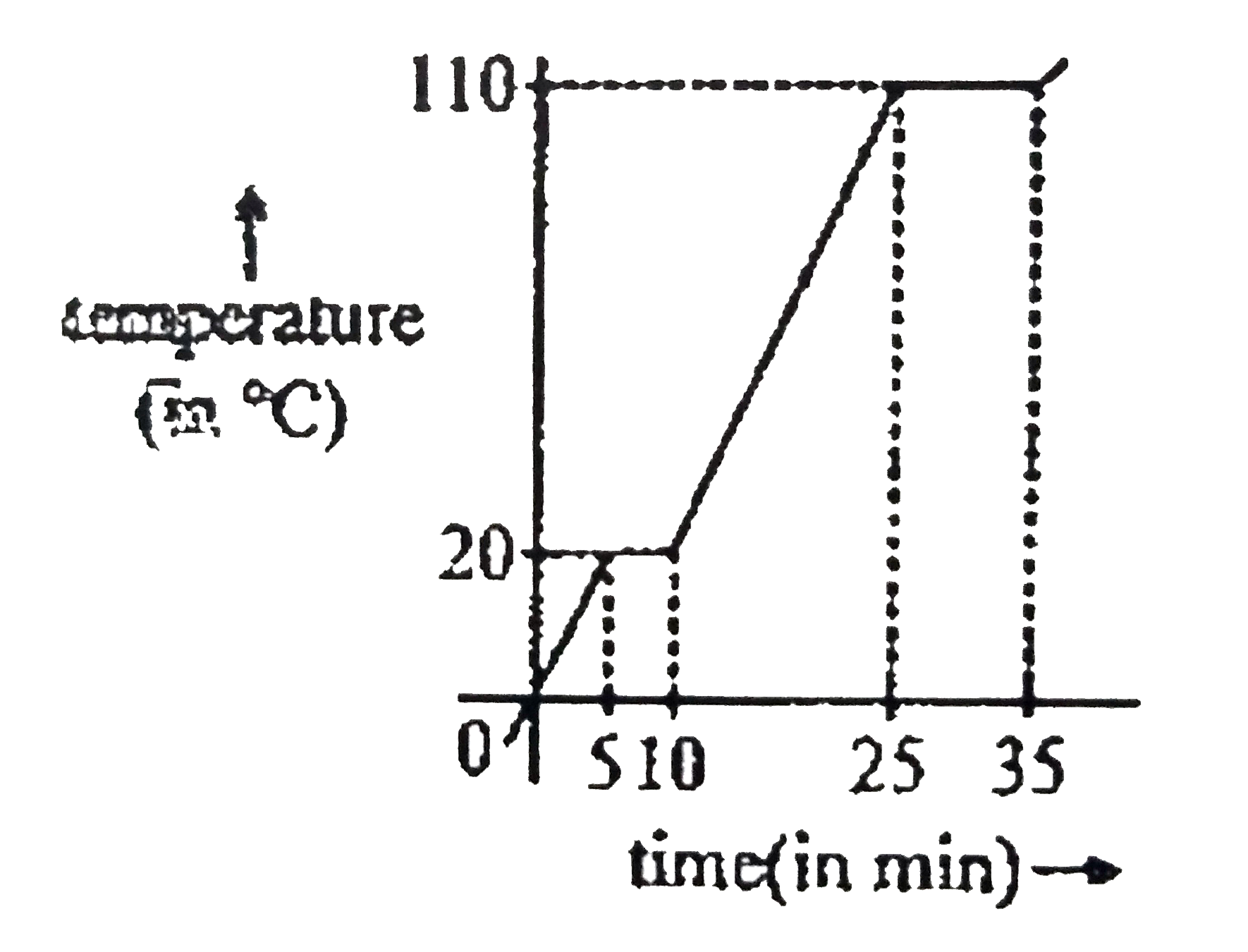
One kg of a substance (initially solid of `0^(@)C`) is supplied heat at a concentration of 2 kcal/min. suffificent of thermal expansion of the solid `(a)=4xx10^(-6)//.^(@)C` its temperature varies with increase shown.

Specific heat capacity of the liquid is-

A

`3cal//gm^(@)C`

B

`(1)/(3) cal//gm^(@)C`

C

`2 cal//gm^(@)C`

D

`(1)/(2)cal//gm^(@)C`

Text Solution

Verified by Experts

`(dQ)/(dt)=ms(dT)/(dt)`
`2000 "cal"//"min" =1xxs_("liquid")xx(110-20)/(25-10)`
`(2000)/(6)=` s in cal/kg`.^(@)C`.
`s=(1)/(3) "cal"//gm^(@)C`
Promotional Banner

Topper's Solved these Questions

  • TEST PAPERS

    BANSAL|Exercise PHYSICS PART (A)|32 Videos
  • TEST PAPERS

    BANSAL|Exercise PHYSICS PART (B)|3 Videos
  • TEST PAPERS

    BANSAL|Exercise PHYSICS PART- C|4 Videos
  • SEMICONDUCTORS

    BANSAL|Exercise CBSE Question|32 Videos

Similar Questions

Explore conceptually related problems

One kg of a substance (initially solid of 0^(@)C ) is supplied heat at a concentration of 2 kcal/min. suffificent of thermal expansion of the solid (a)=4xx10^(-6)//.^(@)C its temperature varies with increase shown. Percentage change in volume of the solid in the first 150 sec is

One kg of a substance (initially solid of 0^(@)C ) is supplied heat at a concentration of 2 kcal/min. suffificent of thermal expansion of the solid (a)=4xx10^(-6)//.^(@)C its temperature varies with increase shown. which of the following is not correct?

A substance is in the solid from at 0^(@)C . The amount of heat added to this substance and its temperature is plotted in the graph . The specific heat capacity of the solid substance is 0.5 "cal"//"g"^(@)C . Specific heat capacity in the liquid state is -

In this experiment voltage across the heater is 100.0V and current is 10.0A and heater was switched on for t = 700.0sec Initially elements were at room temperature theta_(0) = 10.0^(@)C and final temperature was measured at theta = 73.0^(@)C Mass of empty calorimeter was 1.0kg and the combined mass of calorimeter + liquid is 3.0kg THe specirfice of the calorimeter S_(c) = 3.0 xx 10^(3) J//kg^(@)C The fall in temperature 350 second after switching off the heater was 7.0^(@)C Find the specific heat capacity of the unknown liquid in proper significant (A) 3.5 xx 10^(3) J//kg^(@)C (B) 3.50 xx 10^(3) J//kg^(@)C (C) 4.0 xx 10^(3) J//kg^(@)C (D) 3.500 xx 10^(3) J//kg^(@)C .

The inernal energy of a solid also increases when heat is transferred to it from its surroundings. A 5 kg solid bar is heated at atmospheric pressure. Its temperature increases from 20^@C to 70^@C . The linear expansion coefficient of solid bar is 1xx10^(-3)//^(@)C . The density of solid bar is 50 kg//m^3 . The specific heat capacity of solid bar is 200 J//kgC^@ . The atmospheric pressure is 1xx10N//m^2 . The heat transferred to the solid bar is

The inernal energy of a solid also increases when heat is transferred to it from its surroundings. A 5 kg solid bar is heated at atmospheric pressure. Its temperature increases from 20^@C to 70^@C . The linear expansion coefficient of solid bar is 1xx10^(-3)//^(@)C . The density of solid bar is 50 kg//m^3 . The specific heat capacity of solid bar is 200 J//kg C^@ . The atmospheric pressure is 1xx10 N//m^2 . The work done by the solid bar due to thermal expansion, under atmospheric pressure is

The inernal energy of a solid also increases when heat is transferred to it from its surroundings. A 5 kg solid bar is heated at atmospheric pressure. Its temperature increases from 20^@C to 70^@C . The linear expansion coefficient of solid bar is 1xx10^(-3)//^(@)C . The density of solid bar is 50 Kg//m^3 . The specific heat capacity of solid bar is 200 J//kg C^@ . The atmospheric pressure is 1xx10 N//m^2 . The increase in the internal energy of the sold bar is

A substance of mass 1cdot5 kg absorbs 45 kcal of heat energy. If its temperature rises from 28^(@)C" to "38^(@)C , find its specific heat capacity.

BANSAL-TEST PAPERS-PHYSICS
  1. An experimentally decided formula for relation between pressure and de...

    Text Solution

    |

  2. One kg of a substance (initially solid of 0^(@)C) is supplied heat at ...

    Text Solution

    |

  3. One kg of a substance (initially solid of 0^(@)C) is supplied heat at ...

    Text Solution

    |

  4. One kg of a substance (initially solid of 0^(@)C) is supplied heat at ...

    Text Solution

    |

  5. Text Solution

    |

  6. Three rods of equal of length are joined to from an equilateral triang...

    Text Solution

    |

  7. A force vecF=(-yhati+xhatj)N acts on a particle as it undergoes counte...

    Text Solution

    |

  8. A solid cylinder of mass m and radius R rest on a plank of mass 2m lyi...

    Text Solution

    |

  9. Shown in the figure is a system of three particles having masses m(1)=...

    Text Solution

    |

  10. An iron nail of mass 0.2 kg is dropped from a height h=1m from level o...

    Text Solution

    |

  11. An advertisement claims that a certain 1200kg car can accelerate from ...

    Text Solution

    |

  12. Two men 'A' and 'B' are standing on a plank. 'B' is at the middle of t...

    Text Solution

    |

  13. The state of an ideal gas is changed through an isothermal process at ...

    Text Solution

    |

  14. A gas for which lambda=4//3, is heated at constant pressure. What perc...

    Text Solution

    |

  15. A particle moves along x-axis. The position of the particle at time t ...

    Text Solution

    |

  16. A force vecF=(3xy-5z)hatj+4zhatk is applied on a particle. The work do...

    Text Solution

    |

  17. A steel wire of length 4.7 m and cross-sectional area 3 xx 10^(-6) m^(...

    Text Solution

    |

  18. In a figure shown mass of A and B is equal to M each. Friction between...

    Text Solution

    |

  19. A block of mass m is dragged with same constant speed on two rough sur...

    Text Solution

    |

  20. Four identical rods which have thermally insulated lateral surface are...

    Text Solution

    |

