

Home
Class 12
PHYSICS
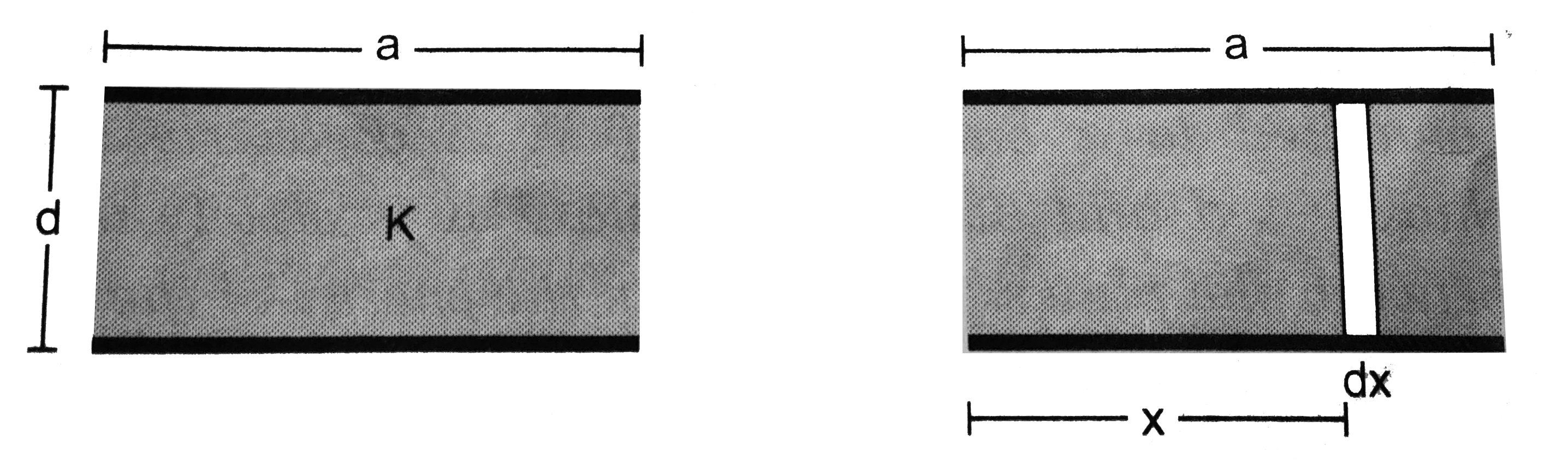
Figure shown a parallel-plate capacitor...

Figure shown a parallel-plate capacitor having square plates of edge a and plate-separation d. The gap between the plates is filled with a dielectric of dielectric constant K which varies parallel to an edge as where K and a are constants and x is the distance from the left end. Calculate the capacitance.

Promotional Banner

Similar Questions

Explore conceptually related problems

The figure shows a parallel-plate capacitor having square plates of edge a and plate-separation di The gap between the plates is filled with a directric of dielectric constant k which varies as K=K_(0) + alphax parallel to an edge as where K and alpha are constants and x is the distance from the left end. Calaculate the capacitance.

The gap between the plates of a parallel plate capacitor having square plate of edge a and plate separation d is filled with a dielectric of dielectric constant K . K varies parallel to an edge as K=K_(0)-ax where k and a are positive constants and x is the distance from one end.The value of alpha for which capacitor behaves as a capacitor of zero capacitance will be

A parallel plate capacitor has plate area A and plate separation d. The space between the plates is filled up to a thickness x (ltd) with a dielectric constant K. Calculate the capacitance of the system.

A capacitor of plate area A and separation between plates d is half filled with dielectric of dielectric constant K. What is equivalent capacitance?

A parallel plate capacitor has plate area A and plate separation d. The space betwwen the plates is filled up to a thickness x (ltd) with a dielectric constant K. Calculate the capacitance of the system.

A parallel plate capacitor has plate area A and plate separation d. The space betwwen the plates is filled up to a thickness x (ltd) with a dielectric constant K. Calculate the capacitance of the system.

A parallel plate air capacitor has capacitance C. Half of space between the plates is filled with dielectric of dielectric constant K as shown in figure . The new capacitance is C . Then