Home
Class 12
BIOLOGY
Why are F(2) phenotypic and genotypic ra...

Why are `F_(2)` phenotypic and genotypic ratios same in a cross between red- flowered snapdragon and white-flowered snapdragon plants. Explain with the help of a cross.

Text Solution

Verified by Experts
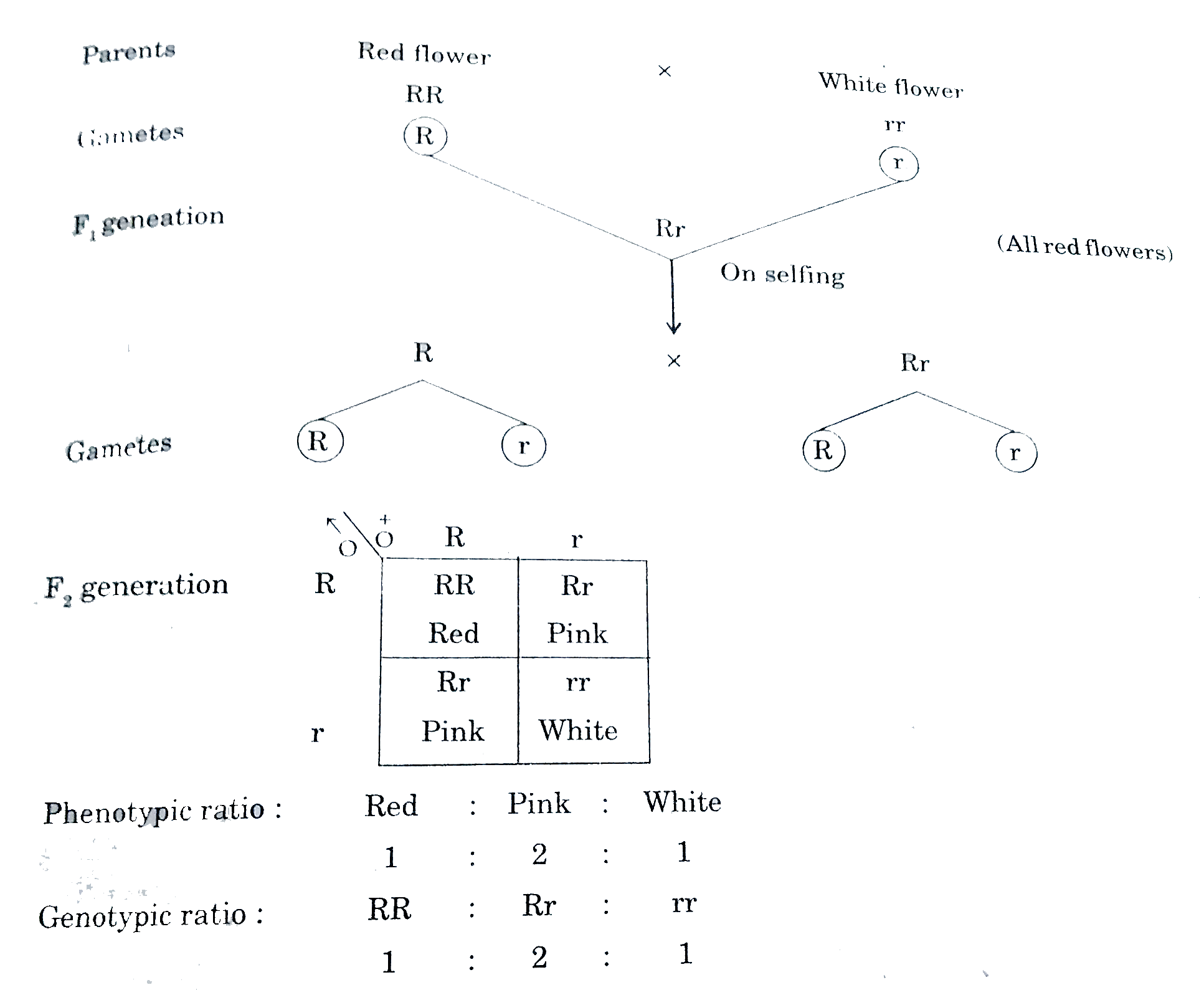
This is a case of Mendelian inheritance that shows incomplete dominance as red and white colour traits both are not expressed and produce pink trait in `F_(1)` generation.
Promotional Banner

Topper's Solved these Questions

  • XII BOARDS

    XII BOARDS PREVIOUS YEAR|Exercise SECTION-C|95 Videos
  • XII BOARDS

    XII BOARDS PREVIOUS YEAR|Exercise SECTION-D|50 Videos
  • XII BOARDS

    XII BOARDS PREVIOUS YEAR|Exercise SECTION-A|48 Videos
  • SAMPLE PAPER 2019

    XII BOARDS PREVIOUS YEAR|Exercise Section E Part B|3 Videos

Similar Questions

Explore conceptually related problems

A cross between black flowered plant and white flowered plant yielded grey flowered

In a case of red and white flowered Snapdragon, F_(1) plants will have flowers

If in a garden pea plant , cross is made between red flowered and white flowered plants . What will be the phenotypic ratio in F_(2) generation

Which cross yields red, white and pink flower variety of Snapdragon flower.

Mendel observed red flowers in F_(1) when he crossed red and white flowered plants because of

When heterozygous red flowered plant is crossed with white flowered plant the progeny will show a ratio of

When a corss is made pink flowered and red flowered snapdragon plants, what proportion of phenotypein the offspring could be expected to be

F_(2) generation of a cross between two white flowered strains of Sweet Pea yields 9 purple flowered plants: 7 white flowered plants. This is an example is

What would be the colour of flowers in F_(1) progeny as a result of cross between homozygous red and homozygous white -flowered Snapdragon

In a cross between a true breeding red flowered and true breeding white flowered snapdragon plant,the F_(1) plants Produced pink flowers.Name and explain the type of inheritance.

XII BOARDS PREVIOUS YEAR-XII BOARDS-SECTION-B
  1. How does an electrostatic precipitator work to remove particulate poll...

    Text Solution

    |

  2. Study the given aquatic food chain and answer the questions that follo...

    Text Solution

    |

  3. Why are F(2) phenotypic and genotypic ratios same in a cross between r...

    Text Solution

    |

  4. Geitonogamous flowering plants are genetically autogamous but function...

    Text Solution

    |

  5. When and where do chorionic villi appear in humans ? State their funct...

    Text Solution

    |

  6. In a cross between two tall pea plants some of the offsprings produced...

    Text Solution

    |

  7. A student on a school trip started sneezing and wheezing soon after r...

    Text Solution

    |

  8. Name two commonly used bioreactors. State the importance of using a bi...

    Text Solution

    |

  9. (a) How does cleistogamy ensure autogamy? (b) State one advantage an...

    Text Solution

    |

  10. A mature, embryo-sac in a flowering plant may possess 7-cells, but 8-n...

    Text Solution

    |

  11. Describe the structure of a nucleosome.

    Text Solution

    |

  12. Mention the evolutionary significance of the following organisms : (...

    Text Solution

    |

  13. In an agricultural field there is a prevalance of the following organi...

    Text Solution

    |

  14. How does the applications of the fungal genus, Glomus, to the agricult...

    Text Solution

    |

  15. Plenty of algal bloom is observed in a pond in your locality. a) Wri...

    Text Solution

    |

  16. Mention the role of ribosomes in peptide-bond formation. How does ATP ...

    Text Solution

    |

  17. How do copper and hormone releasing IUDs act as contraceptives? Explai...

    Text Solution

    |

  18. If you squeeze a seed of orange you might observe many embryos of diff...

    Text Solution

    |

  19. A recombinant DNA is formed when sticky ends of vector DNA and foreign...

    Text Solution

    |

  20. (i) Mention the number of primers required in each cycle of polymerase...

    Text Solution

    |

