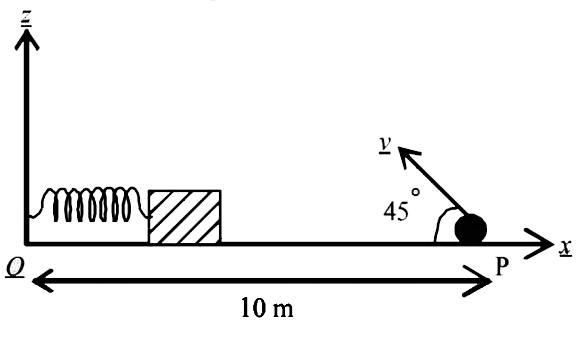
A small block is connected to one end of a massless spring of un - stretched length `4.9 m`. The other end of the spring (see the figure) is fixed. The system lies on a horizontal frictionless surface. The block is stretched by `0.2 m` and released from rest at `t = 0`. It then executes simple harmonic motion with angular frequency `(omega) = (pi//3) rad//s`. Simultaneously at `t = 0`, a small pebble is projected with speed (v) from point (P) at an angle of `45^@` as shown in the figure. Point (P) is at a horizontal distance of `10 m from O`. If the pebble hits the block at `t = 1 s`, the value of (v) is `(take g = 10 m//s^2)`.
 .
.
A small block is connected to one end of a massless spring of un - stretched length `4.9 m`. The other end of the spring (see the figure) is fixed. The system lies on a horizontal frictionless surface. The block is stretched by `0.2 m` and released from rest at `t = 0`. It then executes simple harmonic motion with angular frequency `(omega) = (pi//3) rad//s`. Simultaneously at `t = 0`, a small pebble is projected with speed (v) from point (P) at an angle of `45^@` as shown in the figure. Point (P) is at a horizontal distance of `10 m from O`. If the pebble hits the block at `t = 1 s`, the value of (v) is `(take g = 10 m//s^2)`.
.
.


Similar Questions
Explore conceptually related problems
A small block is connected to one end of a massless spring of un-stretched length 4.9 m. The other end of the spring (see the figure) is fixed. The system lies on a horizontal frictionless surface. The block is stretched by 0.2 m and released from rest at t = 0. It then executes simple harmonic motion with angular frequency omega = (pi)/(3) rad/s . Simultaneously at t = 0, a small pebble is projected with speed nu from point P at an angle of 45^(@) as shown in the figure. Point P is at a horizontal distance of 10 m from O. If the pebble hits the block at t = 1s, the value of nu is (take g = 10 m/ s^(2) )
A small block is connected to one end of a massless spring of un-stretched length 4.9 m. The other end of the spring (see the figure) is fixed. The system lies on a horizontal frictionless surface. The block is stretched by 0.2 m and released from rest at t = 0. It then executes simple harmonic motion with angular frequency omega = (pi)/(3) rad/s . Simultaneously at t = 0, a small pebble is projected with speed nu from point P at an angle of 45^(@) as shown in the figure. Point P is at a horizontal distance of 10 m from O. If the pebble hits the block at t = 1s, the value of nu is (take g = 10 m/ s^(2) )
A 100 g block is connected to a horizontal massless spring of force constant 25.6(N)/(m) As shown in Fig. the block is free to oscillate on a horizontal frictionless surface. The block is displaced 3 cm from the equilibrium position and , at t=0 , it is released from rest at x=0 It executes simple harmonic motion with the postive x-direction indecated in Fig. The position time (x-t) graph of motion of the block is as shown in Fig. Velocity of the block as a function of time can be expressed as
A 100 g block is connected to a horizontal massless spring of force constant 25.6(N)/(m) As shown in Fig. the block is free to oscillate on a horizontal frictionless surface. The block is displaced 3 cm from the equilibrium position and , at t=0 , it is released from rest at x=0 It executes simple harmonic motion with the postive x-direction indecated in Fig. The position time (x-t) graph of motion of the block is as shown in Fig. Q. When the block is at position A on the graph, its
A 100 g block is connected to a horizontal massless spring of force constant 25.6(N)/(m) As shown in Fig. the block is free to oscillate on a horizontal frictionless surface. The block is displaced 3 cm from the equilibrium position and , at t=0 , it is released from rest at x=0 It executes simple harmonic motion with the postive x-direction indecated in Fig. The position time (x-t) graph of motion of the block is as shown in Fig. Q. When the block is at position B on the graph its.
A 100 g block is connected to a horizontal massless spring of force constant 25.6(N)/(m) As shown in Fig. the block is free to oscillate on a horizontal frictionless surface. The block is displaced 3 cm from the equilibrium position and , at t=0 , it is released from rest at x=0 It executes simple harmonic motion with the postive x-direction indecated in Fig. The position time (x-t) graph of motion of the block is as shown in Fig. When the block is at position C on the graph, its
A 100 g block is connected to a horizontal massless spring of force constant 25.6(N)/(m) As shown in Fig. the block is free to oscillate on a horizontal frictionless surface. The block is displaced 3 cm from the equilibrium position and , at t=0 , it is released from rest at x=0 It executes simple harmonic motion with the postive x-direction indecated in Fig. The position time (x-t) graph of motion of the block is as shown in Fig. Q. When the block is at position B on the graph its.
A 100 g block is connected to a horizontal massless spring of force constant 25.6(N)/(m) As shown in Fig. the block is free to oscillate on a horizontal frictionless surface. The block is displaced 3 cm from the equilibrium position and , at t=0 , it is released from rest at x=0 It executes simple harmonic motion with the postive x-direction indecated in Fig. The position time (x-t) graph of motion of the block is as shown in Fig. Q. When the block is at position B on the graph its.
A 100 g block is connected to a horizontal massless spring of force constant 25.6(N)/(m) As shown in Fig. the block is free to oscillate on a horizontal frictionless surface. The block is displaced 3 cm from the equilibrium position and , at t=0 , it is released from rest at x=0 It executes simple harmonic motion with the postive x-direction indecated in Fig. The position time (x-t) graph of motion of the block is as shown in Fig. Position of the block as a function of time can now be expressed as
A 100 g block is connected to a horizontal massless spring of force constant 25.6(N)/(m) As shown in Fig. the block is free to oscillate on a horizontal frictionless surface. The block is displaced 3 cm from the equilibrium position and , at t=0 , it is released from rest at x=0 It executes simple harmonic motion with the postive x-direction indecated in Fig. The position time (x-t) graph of motion of the block is as shown in Fig. Velocity of the block as a function of time can be expressed as
Recommended Questions
- A small block is connected to one end of a massless spring of un - str...
Text Solution
|
- A block of mass 2.0 kg is moving on a frictionless horizontal surface ...
Text Solution
|
- A 100 g block is connected to a horizontal massless spring of force co...
Text Solution
|
- A 100 g block is connected to a horizontal massless spring of force co...
Text Solution
|
- A 100 g block is connected to a horizontal massless spring of force co...
Text Solution
|
- एक द्रव्यमानहीन स्प्रिंग की तनावहीन लम्बाई 4.9 सेमी है | इसका एक सिरा ...
Text Solution
|
- An ideal spring of spring constant k, is suspended from the ceiling of...
Text Solution
|
- A small block is connected to one end of a massless spring of un-stret...
Text Solution
|
- One end of a massless spring of spring constant 100 N/m and natural le...
Text Solution
|