Home
Class 9
MATHS
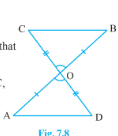
In Fig. 7.8, O A\ =\ O Ba n d\ O D\ =\ O...

In Fig. 7.8, `O A\ =\ O B``a n d\ O D\ =\ O C`. Show that `(i) DeltaA O D~=DeltaB O C ` and `(ii) A D\ ||\ B C `.

Text Solution

Verified by Experts

(1) Given :`OA = OB`And `OD = OC`
To Prove: `triangleAOD cong triangleBOC`
Proof : Lines `CD` and `AB` intersect. `angleAOD = angleBOC` (Vertically Opposite Angles)
In `triangleAOD` and `triangleBOC`,`OA = OB` (Given)
`angleAOD = angleBOC` (Vertically Opposite Angles)
`OD = OC ` (Given)
Therefore, `triangleAOD cong triangleBOC` (By SAS Congruence)----- (1)
(2) To prove`AD ║ BC`
Proof :Since `triangleAOD cong triangleBOC` {From (1)}
`angleOAD = angleOBC` { CPCT }
`angleOAD and angleOBC` for the pair of Alternate angles.
If a transversal intersects two lines such that the pair of Alternate interiors Angles are equal, then the Lines are Parallel.
Therefore, `AD ║ BC` .
Promotional Banner

Similar Questions

Explore conceptually related problems

ABCD is a quadrilateral in which and /_D A B\ =/_C B A (see Fig. 7.17). Prove that (i) DeltaA B D~=DeltaB A C (ii) B D\ =\ A C (iii) /_A B D\ =/_B A C

A point O inside a rectangle A B C D is joined to the vertices. Prove that the sum of the areas of a pair of opposite triangles so formed is equal to the sum of the other pair of triangles. Given: A rectangle A B C D\ a n d\ O is a point inside it. O A ,\ O B ,\ O C\ a n d\ O D have been joined. To Prove: a r\ (A O D)+\ a r\ ( B O C)=\ a r\ ( A O B)+\ a r( C O D)

In Figure, A B C D is a trapezium in which A B||C D . Prove that: a r( A O D)=a r( B O C)dot

A B C D is a trapezium in which A B C D . The diagonals A C and B D intersect at O . Prove that (i) A O B C O D (ii) If O A=6c m , O C=8c m , Find: (A r e a ( A O B))/(A r e a ( C O D)) (b) (A r e a ( A O D))/(A r e a ( C O D))

In Fig. 9.25, diagonals AC and BD of quadrilateral ABCD intersect at O such that O B" "=" "O D . If A B" "=" "C D , then show that: (i) a r" "(D O C)" "=" "a r" "(A O B) (ii) a r" "(D C B)" "=" "a r" "(A C B) (iii) D A" "||" "C

A B C D IS A PARALLELOGRAM AND O is any point in its interior. Prove that: a r\ ( A O B)+\ a r\ ( C O D)=\ a r\ ( B O C)+\ a r( A O D) a r\ ( A O B)+a r\ (C O D)=1/2\ a r(^(gm)A B C D) Given: A parallelogram A B C D\ a n d\ O is a point in its interior. To Prove: a r\ (\ A O B)+\ a r( C O D)=a r\ ( B O C)+a r( A O D)

In figure, O is a point in the interior of a triangle ABC, O D_|_B C ,O E_|_A C and O F_|_A B . Show that (i) O A^2+O B^2+O C^2-O D^2-O E^2-O F^2=A F^2+B D^2+C E^2 (ii) A F^2+B D^2+C E^2=A W^2+C D^2+B F^2

In fig., O is a point in the interior of a triangle ABC, OD ⊥ BC, OE ⊥ AC and OF ⊥ AB. Show that:- O A^ 2 + O B^ 2 + O C^ 2 − O D^ 2 − O E^ 2 − O F^ 2 = A F^ 2 + B D^ 2 + C E^ 2

In Fig. 4.179, A B C and D B C are on the same base B C . If A D and B C intersect at O , prove that (A r e a\ ( A B C))/(A r e a\ ( D B C))=(A O)/(D O) (FIGURE)

A point O inside a rectangle A B C D is joined to the vertices. Prove that the sum of the areas of a pair of opposite triangles so formed is equal to the sum of the other pair of triangles. GIVEN : A rectangle A B C D and O is a point inside it. O A ,O B ,O C and O D have been joined.. TO PROVE : a r(A O D)+a r( B O C)=a r( A O B)+a r( C O D) CONSTRUCTION : Draw E O F A B and L O M A Ddot
