

Home
Class 11
PHYSICS
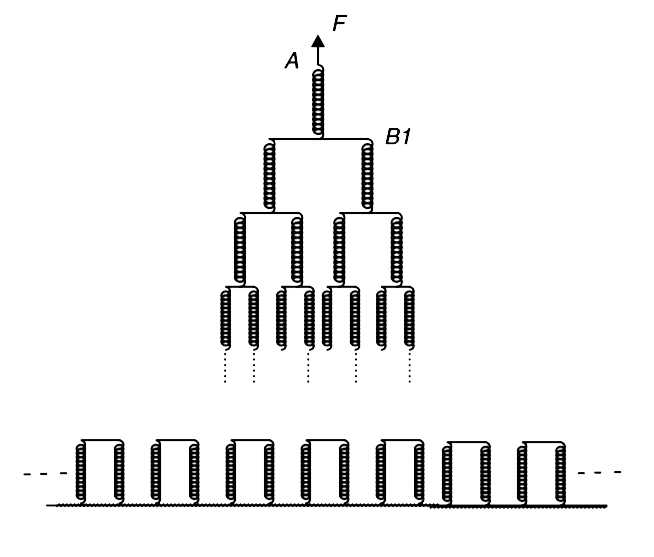
The fig. shows an infinite tower of iden...

The fig. shows an infinite tower of identical springs each having force constant k. The connecting bars and all springs are massless. All springs are relaxed and the bottom row of springs is fixed to horizontal ground. The free end of the top spring is pulled up with a constant force F. In equilibrium, find
(a) The displacement of free end A of the top spring from relaxed position.
(b) The displacement of the top bar B1 from the initial relaxed position.

Promotional Banner

Similar Questions

Explore conceptually related problems

There are tow identical spring each of spring constant k. here springs, pulley and rods are massless and the block has mass m . What is the extension of each spring at equilibrium?

There are two identical spring each of spring constant k. here springs, pulley and rods are massless and the block has mass m . What is the extension of each spring at equilibrium?

A block attached with an ideal spring is kept on a smooth horizontal surface. Now the free end of the spring is pulled with a constant velocity u horizontally. Then the maximum energy stored in the spring and bock system during subsequent motion is :

A block attached with an ideal spring is kept on a smooth horizontal surface. Now the free end of the spring is pulled with a constant velocity u horizontally. Then the maximum energy stored in the spring and bock system during subsequent motion is :

Two blocks of masses m and M connected by a spring are placed on frictionless horizontal ground. When the spring is relaxed, a constant force F is applied as shown. Find maximum extension of the spring during subsequent motion.

A slab of mass 'm' is released from a height x to the top a spring of force constant k. The maximum compression of the spring is y. Then

A block of mass M is placed on a horizontal smooth table. It is attached to an ideal spring of force constant k as shown. The free end of the spring is pulled at a constant speed u. Find the maximum extension ( x_0 ) in the spring during the subsequent motion.