

Home
Class 11
PHYSICS
Find the acceleration of masses m(1), m(...

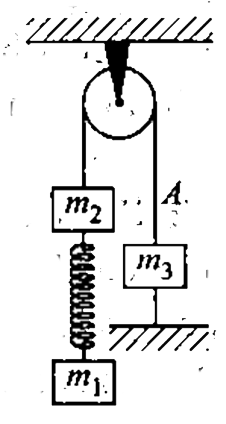
Find the acceleration of masses `m_(1), m_(2)` and `m_(3)` shown in figure-2.119 just after the string is cut at point A.

`[0,(1+(m_(1))/(m_(2)))g, g]`

Promotional Banner

Similar Questions

Explore conceptually related problems

Three blocks arranged with pullwy and spring as shown in fig. If the string connecting blocks m_(2) and m_(3) is cut at point A, find the acceleration of masses m_(1), m_(2) and m_(3) . Just after the string is cut at point A.

Three blocks arranged with pullwy and spring as shown in fig. If the string connecting blocks m_(2) and m_(3) is cut at point A, find the acceleration of masses m_(1), m_(2) and m_(3) . Just after the string is cut at point A.

Find the acceleration of masses m_(1) and m_(2) connected by an inextensible string, shown in figure-2.13(a). The string and pulley are assumed to be massless and frictionless.

Find the acceleration of masses m_(1) and m_(2) moving down the smooth incline plane. The string and the pulley are masseless and frictionless.

Two block of masses m_(1) and m_(2) are connected as shown in the figure. The acceleration of the block m_(2) is:

Two block of masses m_(1) and m_(2) are connected as shown in the figure. The acceleration of the block m_(2) is:

For the system shown in fog. m_(1) gt m_(2) gtm_(3) gt m_(4) . Initially, the system is at rest in equilibrium condition., if the string joining m_(4) and ground is cut, then just after the string is cut. Statement I: m_(1), m_(2), m_(3) remain stationary. Statement II: The value of acceleration of all the four blocks can be determined. Statement III: Only m_(4) remain stationary. Statement IV: Only m_(4) accelerates.

For the system shown in fog. m_(1) gt m_(2) gtm_(3) gt m_(4) . Initially, the system is at rest in equilibrium condition., if the string joining m_(4) and ground is cut, then just after the string is cut. Statement I: m_(1), m_(2), m_(3) remain stationary. Statement II: The value of acceleration of all the four blocks can be determined. Statement III: Only m_(4) remain stationary. Statement IV: Only m_(4) accelerates.

A situation is shown in figure-2.15, Find the acceleration of masses m_(1) abd m_(2) mass of pulley is m_(P) . Consider the string going over the pulley is massless and frictionless.