Home
Class 9
MATHS
In Fig. 7.48, sides AB and AC of DeltaA...

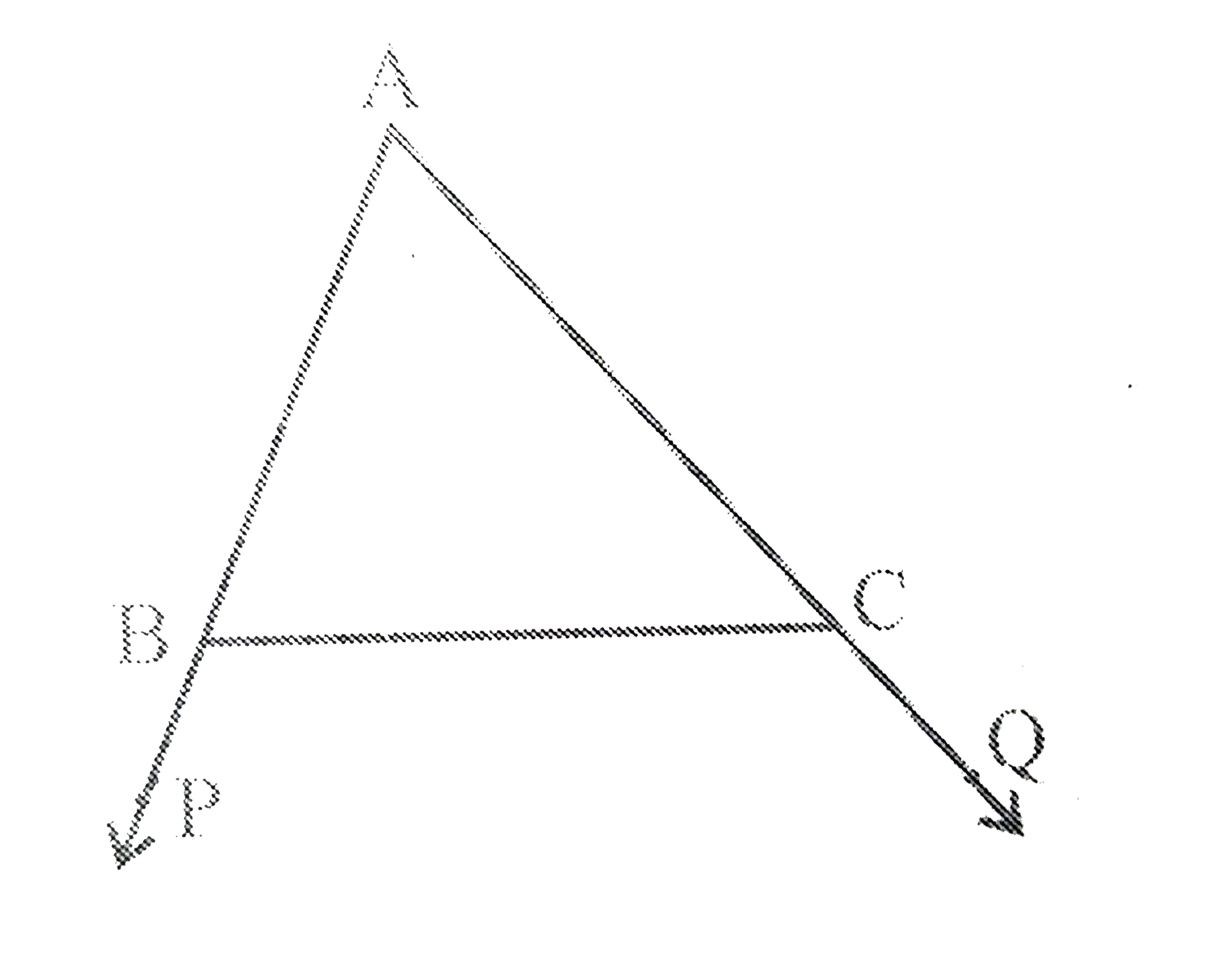
In Fig. 7.48, sides `AB and AC` of `DeltaA B C` are extended to points `P and Q` respectively. Also, `/_P B C\ < /_Q C B`. Show that `A C\ >\ A B`.

Text Solution

Verified by Experts
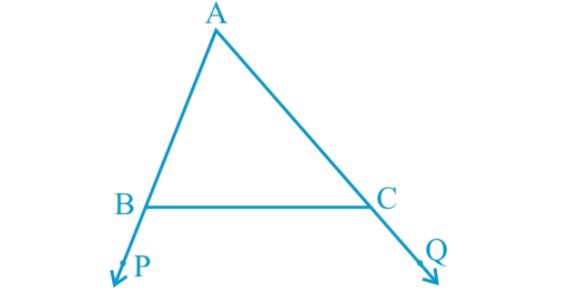

In the given figure,
`∠ABC + ∠PBC = 180^@` [Linear pair of angles]
Also, `∠ABC = 180^@- ∠PBC ` ... (1)
...
Promotional Banner

Topper's Solved these Questions

Similar Questions

Explore conceptually related problems

In the given figure, sides AB and AC of triangle ABC are extended to points P and Q respectively. Also, angle PBC lt angle QCB . Show that AC gt AB

The sides AB and CD of a quadrilateral ABCD are extended to points P and Q respectively. Is angleADQ + angleCBP = angleA + angleC ? Give reason.

The sides A B and A C of a A B C are produced to P and Q respectively. If the bisectors of /_P B C AND /_Q C B intersect at O , then /_boc=90^0-1/2/_A GIVEN : A A B C in which sides A B and A C are produced to P and Q respectively. The bisectors of /_P B C and /_Q C B intersect at Odot

Consider a triangle ABC .The sides AB and AC are extended to points D and E respectively, such that AD=3AB and AE=3AC . Then one diagonal of BDEC divides the other diagonal in the ratio p:q then p+q=

In A B C and P Q R Figure, A B=P Q ,B C=Q R and C B and R Q are extended to X and Y respectively and /_A B X =/_P Q Ydot Prove that A B C~=P Q Rdot Figure

The sides AB and AC of ABC are product to P and Q respectively.the bisectors of exterior angles at B and C of ABC meet at O( fig..19) prove that /_BOC=90^(@)-(1)/(2)/_A

In Fig. 10.20, the sides A B ,\ B C and C A of triangle A B C touch a circle with centre O and radius r at P ,\ Q and R respectively. (FIGURE) Prove that: 1) AB + CQ = AC + BQ 2) Area (ABC) = (r/2)*(Perimeter of ABC)

In Fig.100, A B C D\ a n d\ E F is a transversal intersecting AB and CD at P and Q respectively. The measure of /_D O P is (a) 65 (b) 25 (c) 115 (d) 105

In figure ABC and AMP are two right triangles, right angles at B and M respectively. Prove that(i) DeltaA B C~ DeltaA M P (ii) (C A)/(P A)=(B C)/(M P)

