

Home
Class 12
PHYSICS
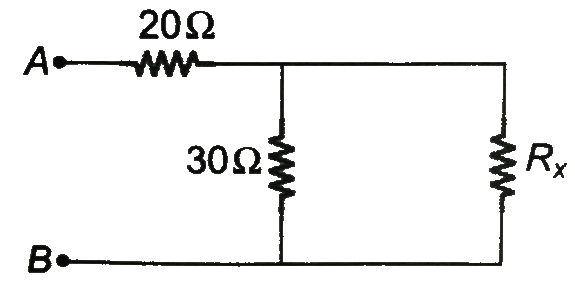
A circuit shown in the figure has resist...

A circuit shown in the figure has resistances `20 Omega` and `30 Omega`. At what value of resistance `R_x` will the thermal power generated in it be practically independent of small variations of that resistance? The voltage between points `A` and `B` is supposed to be constant in this case.

Promotional Banner

Similar Questions

Explore conceptually related problems

A circuit shown in Fig, has resistances R_(1) = 20 Omega and R_(2) = 30 Omega . At what value of the resitanace R_(x) will the thermal power generated in it practically independent of small variations of that resistance? The voltage between the points A and B is supposed to be constant in this case

In a circuit shown in figure if the internal resistance of the sources are negligible then at what value of resistance R will the thermal power generated in it be the maximum. What is its value in ohms ?

In the circuit shown in figure the total resistance between points A and B is R_0 . The value of resistance R is

In the circuit shown in figure the total resistance between points A and B is R_0 . The value of resistance R is

In a circuit shown in figure if the internal resistances of the sources are negligible then at what value of resistance R will the thermal power generated in it will be the maximum. What is the value of maximum power?

In a circuit shown in figure if the internal resistances of the sources are negligible then at what value of resistance R will the thermal power generated in it will be the maximum. What is the value of maximum power?

In the circuit shown in figure, the emfs of batteries are E_1 , and E_2 which have internal resistances R_1 , and R_2 . At what value of the resistance R will the thermal power generated in it be the highest? What it is?

In the circuit shown in figure, the emfs of batteries are E_1 , and E_2 which have internal resistances R_1 , and R_2 . At what value of the resistance R will the thermal power generated in it be the highest? What it is?

In the circuit shown in figure, power developed across 1 Omega, 2 Omega and 3 Omega resistance are in the ratio of