

Home
Class 11
PHYSICS
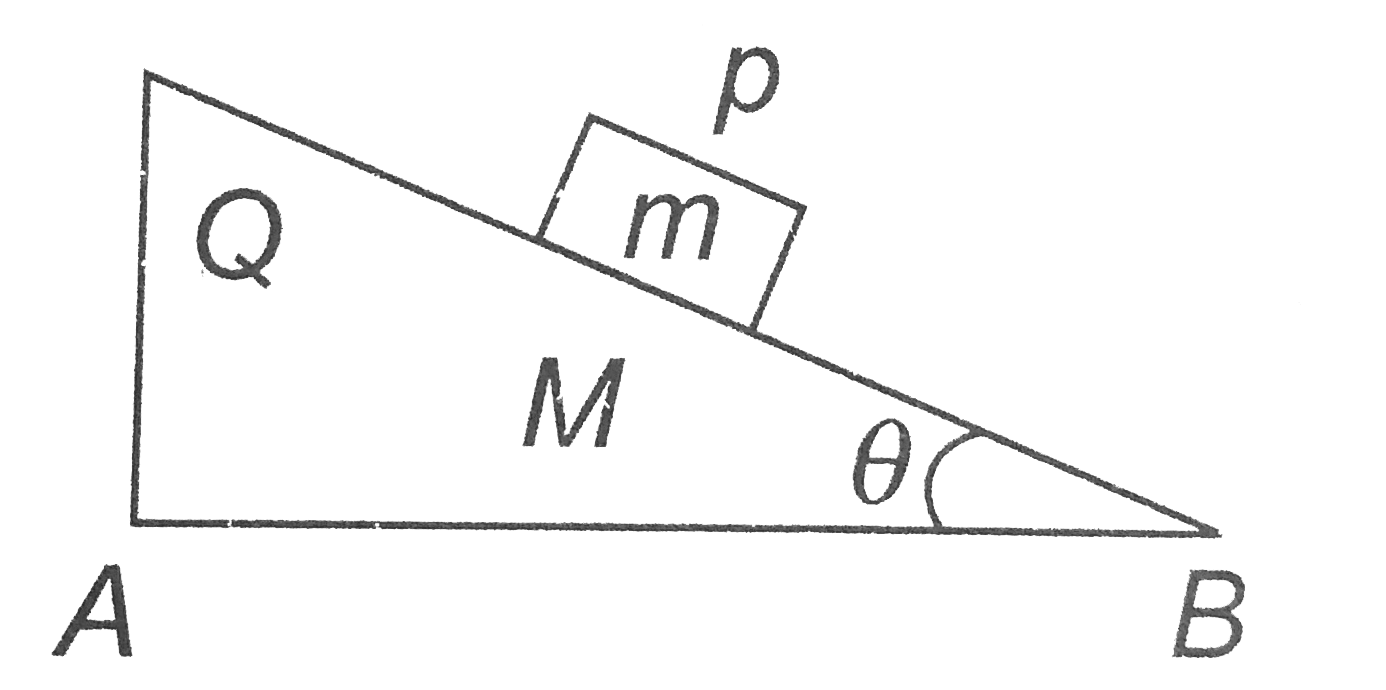
A wedge Q of mass M is placed on a horiz...

A wedge `Q` of mass `M` is placed on a horizontal frictionless surface `AB` and a its frictionless slope. As `P` slides by a length `L` on this slope of inclination `theta, Q` would slide by a distance of.
.

Promotional Banner

Similar Questions

Explore conceptually related problems

A block Q of mass 2m is placed on a horizontal frictionless plane. A second block of mass m is placed on it and is connected to a spring of spring constant K, the two block are pulled by distance A. Block Q oscillates without slipping. The work done by the friction force on block Q when the spring regains its natural length is:

A block Q of mass 2m is placed on a horizontal frictionless plane. A second block of mass m is placed on it and is connected to a spring of spring constant K, the two block are pulled by distance A. Block Q oscillates without slipping. The work done by the friction force on block Q when the spring regains its natural length is:

A wedge of mass m is placed on a horizontal smooth table. A block of mass m is placed at the mid point of the smooth inclined surface having length L along its line of greatest slope. Inclination of the inclined surface is theta= 45^(@) . The block is released and simultaneously a constant horizontal force F is applied on the wedge as shown. (a) What is value of F if the block does not slide on the wedge? (b) In how much time the block will come out of the incline surface if applied force is 1.5 times that found in part (a)

Block of mass m is placed on frictionless slope with angle 0. Normal force acting on block due to surface will be .....

If a block of mass m lying on a frictionless inclined plane of length L height h and angle of inclination theta , then the velocity at its bottom is

A wedge of mass M makes an angle theta with the horizontal. The wedge is placed on horizontal frictionless surface. A small block of mass m is placed on the inclined surface of wedge. What horizontal force F must be applied to the wedge so that the force of friction between the block and wedge is zero ?

If a block of mass m lying on a frictionless inclined plane of length L height h and angle of inclination theta , then the time taken to reach the bottom is