Home
Class 12
BIOLOGY
The following is the illustration of the...

The following is the illustration of the sequence of ovarian events (a - i) in human female.
ltimg src="https://d10lpgp6xz60nq.cloudfront.net/physics_images/SB_BIO_XII_SET_I_2012_E01_032_Q01.png" width="80%"gt
(i) Identify the figure that illustrates ovulation and mention the stage of oogenesis it represents.
(ii) Name the ovarian hormone and the pituitary hormone that have caused the above mentioned event.
(iii) Explain the changes that occur in the uterus simultaneously in anticipation.
(iv) Write the difference between 'c' and 'h'
(v) Draw a labelled sketch of the structure of a human ovum prior to fertilization.

Text Solution

Verified by Experts
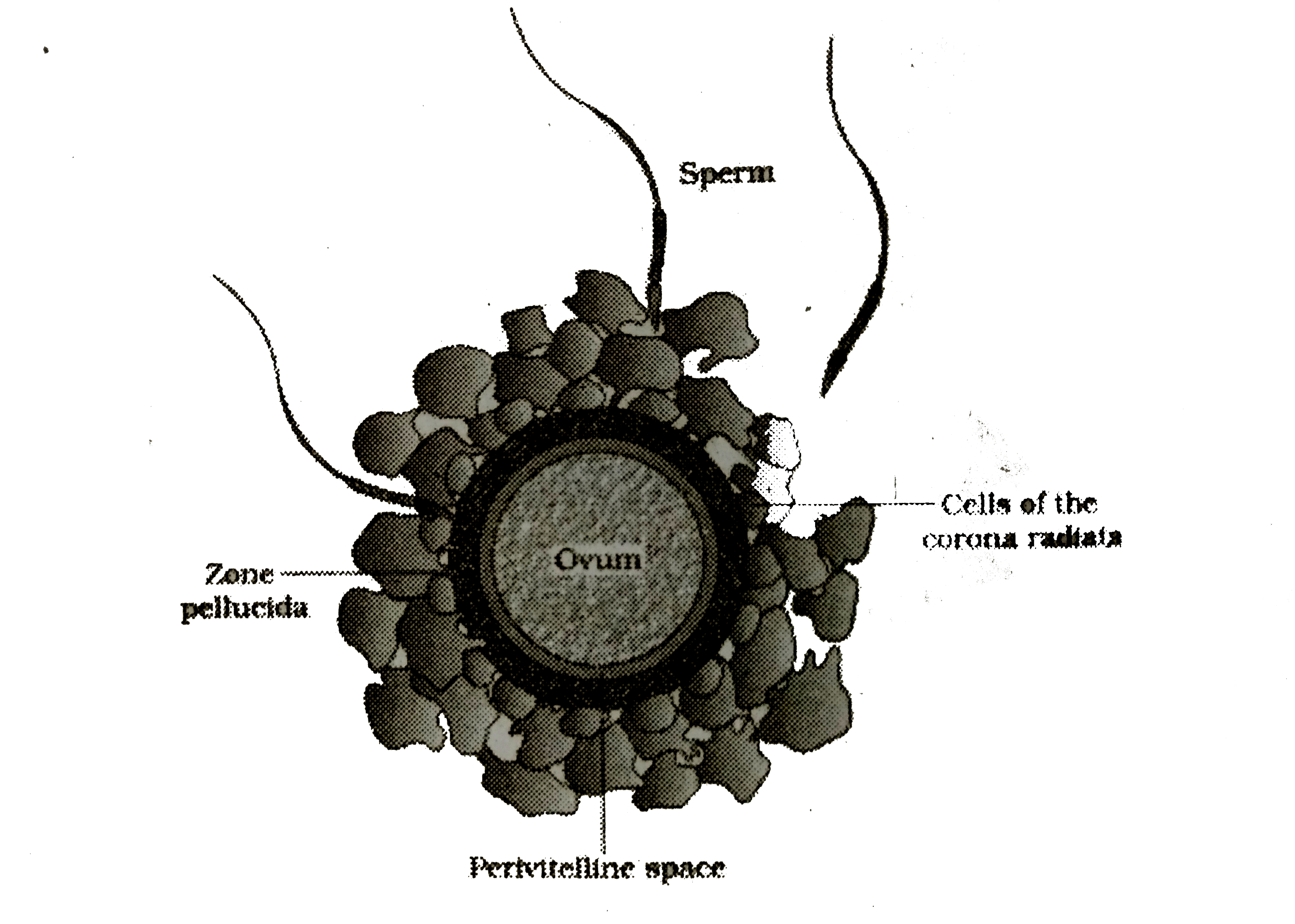
(i) Stage of Oogenesis is represented by (D Mature Graafian follicle.
(ii) Ovarian hormone - Estrogen.
Pituitary hormone - Luteinsing hormone (LH)
(iii) Endometrium proliferate (glands become cork-screw shaped) highly vascularised with high degree of regeneration anticipating implantation of the fertilised ovum.
(iv) c-developing follicle, h-regressing corpus luteum. (v)
Promotional Banner

Similar Questions

Explore conceptually related problems

ltimg src="https://d10lpgp6xz60nq.cloudfront.net/physics_images/PS_MATH_VII_C08_E04_015_Q01.png" width="80%"gt

ltimg src="https://d10lpgp6xz60nq.cloudfront.net/physics_images/PS_MATH_VII_C08_E04_016_Q01.png" width="80%"gt

In Fig, find the value of x . ltimg src="https://d10lpgp6xz60nq.cloudfront.net/physics_images/PS_MATH_IX_C12_S01_032_Q01.png" width="80%"gt

The following is the illustration of the sequence of ovarian events (a - 1) in a human female. (a) Identify the figure that illustrates ovulation and mention the stage of oogenesis it represents. (b) Name the pituitary hormone that has caused the above mentioned event. (c) Explain the changes that occur in the uterus simultaneously in anticipation (d) Write the differences between 'c and 'h'. (e ) Draw a labelled sketch of the structure of a human ovum prior to fertilization.

Find the area of figure given below. ltimg src="https://d10lpgp6xz60nq.cloudfront.net/physics_images/PS_MATH_VII_C06_S01_001_Q01.png" width="80%"gt

Identify the cell organelle 'A' :- ltimg src="https://d10lpgp6xz60nq.cloudfront.net/physics_images/ALN_BIO_C10_E08_018_Q01.png" width="80%"gt

For shown situation find angleBCA :- ltimg src="https://d10lpgp6xz60nq.cloudfront.net/physics_images/ALN_PHY_R05_E01_035_Q01.png" width="80%"gt

At x=0, value of (dy)/(dx) is : ltimg src="https://d10lpgp6xz60nq.cloudfront.net/physics_images/ALN_PHY_R04_E01_024_Q01.png" width="80%"gt

At point P, the value of (dy)/(dx) is : ltimg src="https://d10lpgp6xz60nq.cloudfront.net/physics_images/ALN_PHY_R04_E01_025_Q01.png" width="80%"gt

