Home
Class 12
CHEMISTRY
A metal ions (M^(n+)) forms octahedral [...

A metal ions `(M^(n+))` forms octahedral `[ML_(6)]^(n+)` and tetrahedral `[ML_(4)]^(n+)` complexes with same ligand at different experimental conditions. The `Delta_(o) " of "[ML_(6)]^(n+)` is 3 eV. What is the energy in eV of `e_(g)` orbital of `[ML_(4)]^(n+)` complex?

A

`4/5`

B

`-4/5`

C

`8/15`

D

`-8/15`

Text Solution

Verified by Experts

The correct Answer is:
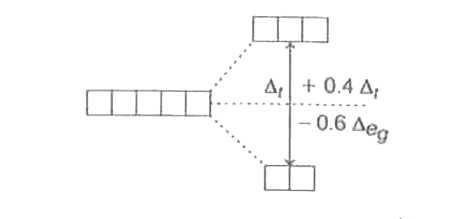
B

The energy of tetrahedral `[ML_(4)]^(n+)` complex.
Value of tetrahedral complex `Delta_(t)=4/9Delta_(o)`
So, `" "Delta_(t)=4/9 times (3)`
`" "=4/3eV`
For tetrahedral complexes,

The value of crystal field stabilisation energy (E) is either negative or zero, never be positive.
So, `" "E=(-0.6) times 4/3 =-4/5eV`
Promotional Banner

Topper's Solved these Questions

  • AP EAMCET SOLVED PAPER 2019

    TS EAMCET PREVIOUS YEAR PAPERS|Exercise CHEMISTRY|13 Videos
  • ONLINE QUESTION PAPER

    TS EAMCET PREVIOUS YEAR PAPERS|Exercise CHEMISTRY|40 Videos

Similar Questions

Explore conceptually related problems

If the crystal field splitting energy of a tetrahedral complex (Delta _(l )) of the type [ML_(4)]^(n+) is x e V what is the crystal field splitting energy with respect to an octahedral complex [ML_(6)]^(n+)?

The central metal ion in the complex makes available a number of empty orbitals for the formation of co-ordinate bonds with suitable ligands. The inner d-orbitals or outer d-orbitals are involved. The empty hybrid orbitals of metal ion overlap with the filled orbitals of ligand to from metal ligand co-ordinate bonds. For co-ordination number 6 octahedral geometry and sp^(3),d^(2)ord^(2)sp^(2) hybridisation involved and for cordiantion number 4 tetrahedral geometry, square planar geometry and sp^(3).dsp^(2) hybridisation involved. Type of complex formed in [Fe(H_(2)O)_(6)]^(+3) ion

The d-orbitals participating in hybridisation of metal atom may be from the n & (n-1) shell. This depends on the nature of metal and nature of ligand. The complexes involving the inner d-level (inner orbital complexes) results when the ligand is a powerful (or) strong ligand results in a diamagnetic (or) low spin complexes. A weak ligand usually results in the formation of outer orbital complex (or) high spin complex. Number of unpaired electrons present in [Fe(CN)_(6)]^(4-)&[Fe(H_(2)O)_(6)]^(2+) are respectively.

Heat liberated in the neutralisation of 500 ml of 1N HCl and 500ml of 1N NH_(4)OH is -1.36 K.Cals. The heat of ionisation of NH_(4)OH is

The d-orbitals participating in hybridisation of metal atom may be from the n & (n-1) shell. This depends on the nature of metal and nature of ligand. The complexes involving the inner d-level (inner orbital complexes) results when the ligand is a powerful (or) strong ligand results in a diamagnetic (or) low spin complexes. A weak ligand usually results in the formation of outer orbital complex (or) high spin complex. The hybridisation of Cu in [CuCl_(4)]^(2-)&[Cu(NH_(3))_(4)]^(2+) are respectivly

To 50ml of 0.1 N Na -(2) CO_(3) solution 150ml of water is added . What is the molarity of result solution ?

The d-orbitals participating in hybridisation of metal atom may be from the n & (n-1) shell. This depends on the nature of metal and nature of ligand. The complexes involving the inner d-level (inner orbital complexes) results when the ligand is a powerful (or) strong ligand results in a diamagnetic (or) low spin complexes. A weak ligand usually results in the formation of outer orbital complex (or) high spin complex. Among the following sets, the one having the same geometry and same magnetic property for both complexes is

In octahedral complexes having co-ordination number 6, the degeneracy of the d-orbitals of central atom is removed due to ligand electron metal electron repulsions. In the octahedral complex three orbitals have lower energy, t_(2g) set and two orbitals have higher energy, eg set. This phenomenon is formed as crystal field splitting and the energy seperation is denoted by Delta_(0) . Thus the energy of the two eg orbitals will increase by (3//5)Delta_(0) and that of the three t_(2g) will decrease by (2//5)Delta_(0) . The erystal field splitling, Delta_(0) depends upon the field produced by the ligand and charge on the metal ion. Some ligands are able to produce strong field and in these cases, the splitting will be large whereas other produce weak fields and consequently result in small splitting of d-orbitals. In an octahedral crystal field, t_(2g) orbitals are

In octahedral complexes having co-ordination number 6, the degeneracy of the d-orbitals of central atom is removed due to ligand electron metal electron repulsions. In the octahedral complex three orbitals have lower energy, t_(2g) set and two orbitals have higher energy, eg set. This phenomenon is formed as crystal field splitting and the energy seperation is denoted by Delta_(0) . Thus the energy of the two eg orbitals will increase by (3//5)Delta_(0) and that of the three t_(2g) will decrease by (2//5)Delta_(0) . The erystal field splitling, Delta_(0) depends upon the field produced by the ligand and charge on the metal ion. Some ligands are able to produce strong field and in these cases, the splitting will be large whereas other produce weak fields and consequently result in small splitting of d-orbitals. If Delta_(0)ltP , the correct electronic configuration of d^(4) system will be

12ml of H_(2)SO_(4) is completely neutralised with 15ml of 0.1N NaOH.What is the strength of acid in g L^(-1) ?

TS EAMCET PREVIOUS YEAR PAPERS-AP EAMCET SOLVED PAPER 2019 (22-04-2019, SHIFT-2)-CHEMISTRY
  1. An ideal solution of hexane and heptane at 30^(@)C has a vapour pressu...

    Text Solution

    |

  2. The vapour pressure of a solution (b) as a function of temperature (a)...

    Text Solution

    |

  3. If E(cell)^(@) is 1.05 V, the emf of the cell for the following cell r...

    Text Solution

    |

  4. Which one of the following is not the correct statement with respect t...

    Text Solution

    |

  5. 300 mL of gold sol is mixed with 30 mL of 10% NaCl solution. The mass ...

    Text Solution

    |

  6. In froth-floatation process, what is the depressant used in the separa...

    Text Solution

    |

  7. In which of the following oxyacids of phosphorus, one P = 0, two P-H n...

    Text Solution

    |

  8. Identify the reaction in which SO(2) is not formed?

    Text Solution

    |

  9. In which of the following reactions oxygen gas is not formed?

    Text Solution

    |

  10. The magnetic moment of which of the following complexes is maximum?

    Text Solution

    |

  11. A metal ions (M^(n+)) forms octahedral [ML(6)]^(n+) and tetrahedral [M...

    Text Solution

    |

  12. The catalyst triethyl aluminium and titanium tetrachloride finds use i...

    Text Solution

    |

  13. Match the following :

    Text Solution

    |

  14. Identify the correct pairs from the following :

    Text Solution

    |

  15. The number of monochloroderivatives possible, when 2, 2-dimethylpropan...

    Text Solution

    |

  16. In the following sequence of reactions identify the functional groups ...

    Text Solution

    |

  17. The correct set of reagents (X, Y, Z) required to convert benzene to m...

    Text Solution

    |

  18. The reduction products of an aldehyde, ketone and carboxylic acid in t...

    Text Solution

    |

  19. A carbonyl compound A (C(8)H(8)O) does not give iodoform test and on o...

    Text Solution

    |

  20. What is Y in the following reaction sequence C(6)H(5)N(2)Cl overset(...

    Text Solution

    |

