Home
Class 12
CHEMISTRY
Which of the following are oxidised by N...

Which of the following are oxidised by NaOCl ?
I. `RCH(OH)CH_(3)` II. `RCH_(2)CH_(2)-overset(O)overset(||)(C ) - CH_(2)CH_(3)`
III. `R - COCH_(3)` IV. `CH_(3)CHO`
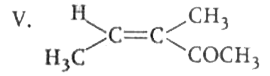
V.

A

I, III, IV, V

B

I, II, III

C

II, IV, V

D

II, III, IV

Text Solution

Verified by Experts

The correct Answer is:
A

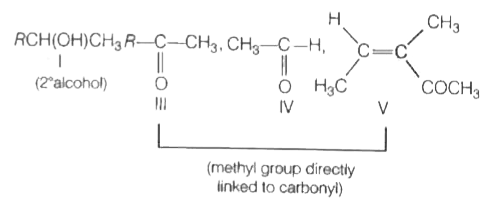
Aldehydes and ketones having atleast one methyl group linked to the carbonyl carbon atom gets oxidised by NaOCl. `2^(@)` alcohol also gets oxidised by it. This reaction is known as haloform reaction. The compounds given in options which get oxidised by NaOCl are follows :
Promotional Banner

Topper's Solved these Questions

  • QUESTION PAPER 2019

    TS EAMCET PREVIOUS YEAR PAPERS|Exercise Chemistry|80 Videos
  • TS EAMCET ENGINEERING ENTRANCE EXAM QUESTION PAPER (2018)

    TS EAMCET PREVIOUS YEAR PAPERS|Exercise CHEMISTRY|40 Videos

Similar Questions

Explore conceptually related problems

The IUPAC name of CH_(3)-overset(O)overset(||)C-O-CH_(2)-CH=CHCH_3

Write IUPAC name of the structure : CH_(3) - CH_(2) - overset(O)overset(||)(C) - CH_(3)

The IUPAC name of Ph -overset(O)overset(||)C-CH_2-CH_(2)-CH_(3) is

The IUPAC name of CH_(3)CH_(2)-CH_(2)-overset(CH=CH_(2)" ")overset("| ")("CH-CH_(2)CH_(2)CH_(3)) is

IUPAC name of CH_(3) - underset(underset(CH_(2)- CH_(3))(|))overset(overset(OH)(|))(C )-CH_(2) - CH_(2) - CH_(3)

Write the IUPAC names of the following monofunctional compounds (a) CH_(3)CH_(2)CH_(2)Coverset(overset(OH)(|))(H)CH_(3) (b) CH_(3)-O-CH_(2)-CH_(2)-CH_(3) (c ) CH_(3)CH_(2) CH_(2)COOH (d) CH_(3) - overset(overset(CH_(3))(|))(N)-C_(2)H_(5) (e ) CH_(3)CH_(2)CN

+CH_(3)CH_(2)CHO overset("dil. NaOH")rarr

Which of the following carbocation is most stable ? (a) (CH_(3))_(3)C.overset(+)(C )H_(2) (b) (CH_(3))_(3)overset(+)(C ) (c ) CH_(3)CH_(2)overset(+)(C )H_(2) (d) CH_(3)overset(+)(C )HCH_(2)CH_(3)

Write the common names of the following halides (a) CH_(3)-CH-CH_(2)Br b) CH_(3)CH_(2)CHCl_(2) c) CH_(2)-overset(I)overset(|)underset(I)underset(|)C-CH_(3) (d) CHBr_(3) e) C Cl_(4)

TS EAMCET PREVIOUS YEAR PAPERS-QUESTION PAPER 2019(SOLVED)-CHEMISTRY
  1. At T (K), the vapour pressures of pure liquids A and B are 100 mm and ...

    Text Solution

    |

  2. In which of the following cells, the space between cathode ad anode is...

    Text Solution

    |

  3. The rate equation for the reaction 2A + B rarr products is rate = k[A]...

    Text Solution

    |

  4. Which one of the following statements is not correct ?

    Text Solution

    |

  5. Identify the correct statement from the following : i. In the extrac...

    Text Solution

    |

  6. White phosphorus reacts with sulphuryl chloride to form PCl(5) and X. ...

    Text Solution

    |

  7. Identify the correct statements from the following : i. Sulphuric ac...

    Text Solution

    |

  8. Assertion (A) Helium has lowest boiling point (4.2 K). Reason (R ) T...

    Text Solution

    |

  9. Which one of the following reactions does not take place ?

    Text Solution

    |

  10. The stepwise stability constants of a complex are given below. What is...

    Text Solution

    |

  11. Number average molecular mass of a polymer that contains 15 molecules ...

    Text Solution

    |

  12. Which of the following statements are correct ? (A) A tripeptide had...

    Text Solution

    |

  13. Identify antihistamines from the following : {:("Serotonin","Dimetan...

    Text Solution

    |

  14. Identify bar(Z) in the reaction :

    Text Solution

    |

  15. What are X, Y, Z in the following reactions ? {:(" "OH),(" ...

    Text Solution

    |

  16. What are X,Y and Z in the following reactions ? (H(3)C)(3)C - overse...

    Text Solution

    |

  17. Structure of cinnamaldehyde (I), salicylaldehyde (II) and vanillin (II...

    Text Solution

    |

  18. Which of the following are oxidised by NaOCl ? I. RCH(OH)CH(3) II. R...

    Text Solution

    |

  19. Benzaldehyde on heating with concentrated NaOH gives

    Text Solution

    |

  20. The reaction Aroverset(ɵ)(N)(2)overset(o+)(C )l+Cu + HCl rarr ArCl + N...

    Text Solution

    |

