

Home
Class 12
PHYSICS
A conducting bar of length L is free to ...

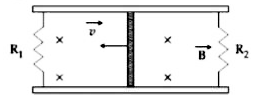
A conducting bar of length L is free to slide on two parallel conducting rails as shown in the figure

Two resistors `R_(1) and R_(2)` are connected across the ends of the rails. There is a uniform magnetic field `vecB` pointing into the page. An external agent pulls the bar to the left at a constant speed v.
The correct statement about the directions of induced currents` I_(1) and l_(2)` flowing through `R_(1)` and `R_(2)` respectively is:

Promotional Banner

Similar Questions

Explore conceptually related problems

A conducting rod of mass m and length l is free to move without friction on two parallel long conducting rails, as shown below. There is a resistance R across the rails. In the entire space around, there is a uniform magnetic field B normal to the plane of the rod and rails. The rod is given an impulsive velocity v_(0) - Finally, the initial energy (1)/(2) mv_(0)^(2)

A horizontal wire is free to slide on the verticle rails of a conducting frame as shown in figure. The wire has a mass m and length l and the resistance of the circuit is R . If a uniform magnetic field B is directed perpendicular to the frame, the terminal speed of the wire as it falls under the force of gravity is

Two idential conductors P and Q are placed on two frictionless rails R and S in a uniform magnetic field directed into the plane. If P is moved in the direction shown in figure with a constant speed, then rod Q

A conducting bar is slid at a constant velocity v along two conducting rods. The rods ar seprated by a distance l and connected across a resistor R. The entire apparatus is placed in an external magnetic field B directed into the page The induced current in the above circuit is:

A wire cd of length l and mass m is sliding without friction on conducting rails ax and by as shown. The verticle rails are connected to each other with a resistance R between a and b . A uniform magnetic field B is applied perpendicular to the plane abcd such that cd moves with a constant velocity of

A conducting wire xy of lentgh l and mass m is sliding without friction on vertical conduction rails ab and cd as shown in figure. A uniform magnetic field B exists perpendicular to the plane of the rails, x moves with a constant velocity of

Figure shows a wire sliding on two parallel, conducting rails placed at a separation L . A magnetic field B exists in a direction perpendicular to the plane of the rails. What force is necessary to keep the wire moving at a constant velocity V ?

A constant force is being applied on a road of length 'l' kept at rest on two parallel conducting rails connected at ends by resistance R in uniform magnitic field B shown.

A conducting bar is slid at a constant velocity v along two conducting rods. The rods ar seprated by a distance l and connected across a resistor R. The entire apparatus is placed in an external magnetic field B directed into the page An increase in which of the following would NOT increase the current generated by the apparatus?

A conducting bar is slid at a constant velocity v along two conducting rods. The rods ar seprated by a distance l and connected across a resistor R. The entire apparatus is placed in an external magnetic field B directed into the page Which of the following represents the current i generated by the apparantus?