

Home
Class 11
PHYSICS
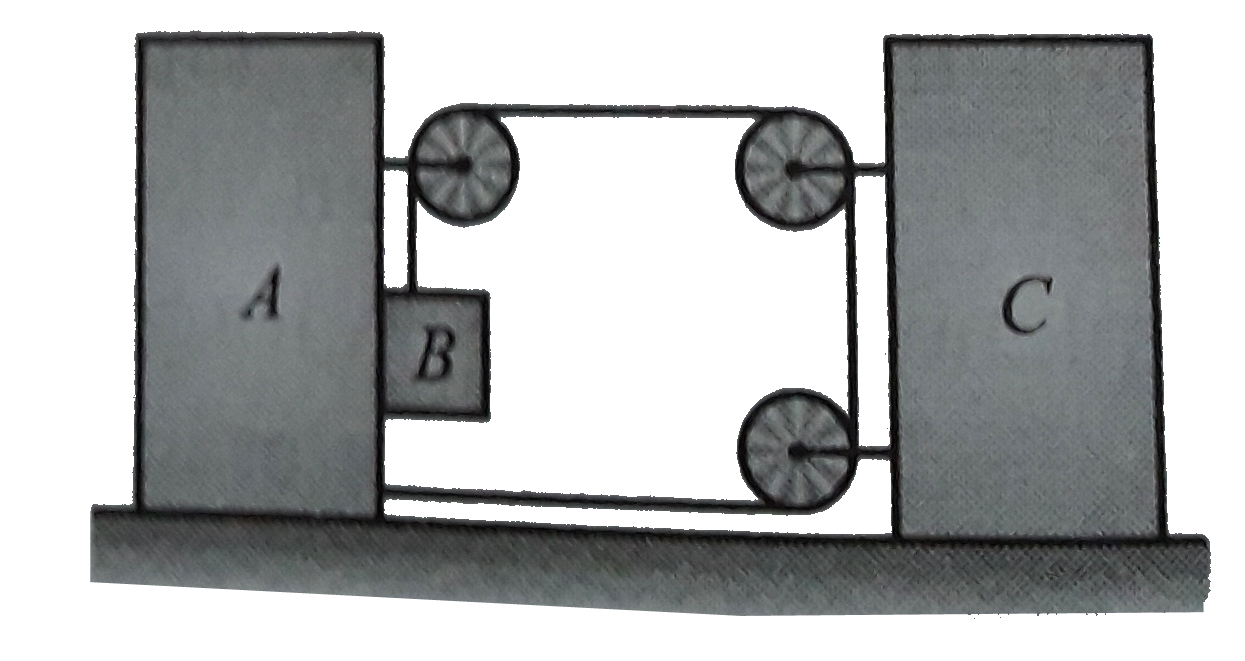
In the arrangement shown in figure mass ...

In the arrangement shown in figure mass of blocks A,B and C is `18.5 kg .8 kg` and `1.5 kg` respectively . The bottom surface of A is A is smooth while coefficient of friction that between block A and C is `mu_(1) = 1//3` between B and floor is `mu_(2) = 1//5` System is relased from rest `r = 0` and pulley are light and friction Calculate acceleration of block A ,B and C

Promotional Banner

Similar Questions

Explore conceptually related problems

In the arrangement shown in figure pulleys are mass of block A,b and C is m_(1) = 5 kg m_(2) = 4 kg and m_(3) = 2.5 kg respectively .Co-efficient acceleration of friction for both the plane is mu = 0.50 Calculate acceleration of which block when system is released from rest

In the arrangement shown in figure pulleys are mass of block A,b and C is m_(1) = 5 kg m_(2) = 4 kg and m_(3) = 2.5 kg respectively .Co-efficient acceleration of friction for both the plane is mu = 0.50 Calculate acceleration of which block when system is released from rest

In the arrangement shown in the figure the coefficient of friction between the blocks C and D is mu_(1) = 0.7 and that between block D and the horizontal table is mu_(2) = 0.2 . The system is released from rest. [ Take g = 10 ms^(–2) ] Pulleys and threads are massless. (a) Find the acceleration of the block C. (b) Block B is replaced with a new block. What shall be the minimum mass of this new block so that block C and D accelerate in opposite direction?

Consider the situation shown in figure in which a book 'A' of mass 2 kg is placed over a block 'B' of mass 4 kg . The combination of the placed on a inclined plane of inclination 37 ^(@) with horizontal. The coefficient of friction between blocks B and inclined plane is mu_(2) and in between the two bolcks is mu_(1) , The system is released from rest. ( Take g=10m//sec^(2)) In the previous question the frictional force between block B and plane is:

consider the situation shown in figure in which a block 'A' of mass 2 kg is placed over a biock.'B' of mass 4 kg. The combination of the blocks are placed on a inclined plane of inclination 37^(@) with horizontal. The coefficient of friction between block B and inclined plane is mu_(2) and in between the two, blocks is mu_(1) . The system is released from rest. ("Take "g=10m//sec^(2)) In the previous question the frictional force between block B and plane is :

Two blocks M and m are arranged as shown in the diagram The coefficient of friction between the block is mu_(1) = 0.25 and between the ground and M is mu_(2) = (1)/(3) If M = 8 kg then find the value of m so that the system will remain at rest

Two blocks M and m are arranged as shown in the diagram The coefficient of friction between the block is mu_(1) = 0.25 and between the ground and M is mu_(2) = (1)/(3) If M = 8 kg then find the value of m so that the system will remain at rest

consider the situation shown in figure in which a block 'A' of mass 2 kg is placed over a biock.'B' of mass 4 kg. The combination of the blocks are placed on a inclined plane of inclination 37^(@) with horizontal. The coefficient of friction between block B and inclined plane is mu_(2) and in between the two, blocks is mu_(1) . The system is released from rest. ("Take "g=10m//sec^(2)) The frictional force acting between the two blocks in the previous question is :

In the diagram shown coefficient of friction between 2 kg block and 4 kg block is mu =0.1 and between 4 kg and ground is mu =0.2 then answer the following quwstions .(tis time) At t=4 s, the friction between 4 kg block and ground will be

In the diagram shown coefficient of friction between 2 kg block and 4 kg block is mu =0.1 and between 4 kg and ground is mu =0.2 then answer the following quwstions .(tis time) At t=4 s, the friction between 4 kg block and ground will be