Home
Class 10
MATHS
In the given figure if angleB= 90^(@) a...

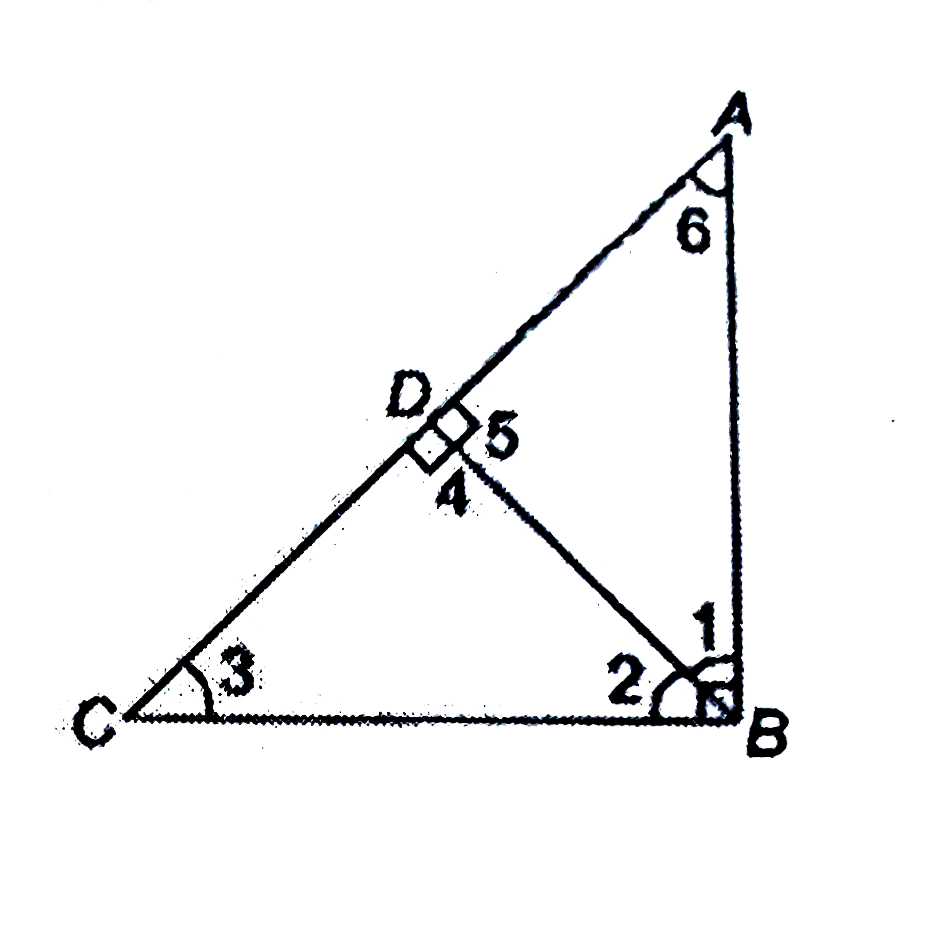
In the given figure if ` angleB= 90^(@)` and BD is perpendicular to AC then
prove that:
`(i) triangleADB~triangleBDC (ii) triangleADB~triangleABC`
(iii) `triangleBDC ~ triangleABC (iv) BD^(2)= AD xx DC`
(v) `AB^(2)= AD xx AC (vi) BC^(2)= CD xx AC`
(vii) `AB^(2)+BC^(2)= AC^(2)`

Text Solution

Verified by Experts

(i) In `triangleADB and triangleBDC`
`{:(angle5=angle4 " "("each "90^(@)),|,"Searching for second Angles"),(,"We know that " angle1+angle2=90^(@).....(1),),(,"Also, Since " angle4=90^(@),),(,:. " " angle2+angle3=90^(@),),(," (angle sum property)...(2)",),(,:. "From (1) and (2) , We get " ,),(,rArr " " angle1+angle2=angle2+angle3 " "(each 90^(@)),),(,rArr " " angle1=angle3,):}`
` angle1 = angle3` ( just proved)
(AA corollary) Hence proved.
(ii) `triangle BDC and triangleABC`
`angle4= angle1+angle2 ("each" 90^(@))`
` angle3= angle3` ( common)
(AA corollary) Hence poved.
(iii) In `triangleBDC and trinangleABC`
`angle4= angle1+angle2 ( "each" 90^(@))`
`angle3=angle3 ` (common)
[from part (i)
(corresponding sides of similar triangles are proportional)
(iv) For `BD^(2)= AD xx DC` . we need to prove two `triangles` similar which contain BD, AD and DC as sides.
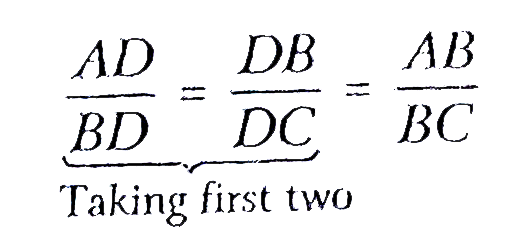
Obviosly these are `triangleABD and triangleBDC`, we have proved these `triangles` as similar in part (i). so ,
[from part (ii)]
( corresponding sides of similar triangle are proportional)

`BD^(2)= ADxx DC` Hence proved.
(v) For ` AB^(2)= AD xx AC` we need to prove two triangles similar which contain AB, AD and AC as sides. Obviosusly these are `triangleABD and triangleABC`. we have already proved these `triangles` as similar in part (ii)
` triangleADB ~ triangleABC` [ from part (ii) ]
` Rightarrow AB^(2)= ADxx AC` .... (1) Hence proved
(vi) For `BC^(2)= CDxxAC` we need to prove two triangles similar which contains BC, CD and AC as sides. Obviosly these are `triangleBDC and triangleABC` , we have proved these triangles as similar in part (iii)
so,
( cossesponding sides of similar triangle are proportional)

`BC^(2) = CD xx AC` ....(2) Hence proved.
(vii) Addings results (1) and (2), we get
`AB^(2)+BC^(2)= ADxxAC+CDxxAC`
`AC ( AD + CD)
= AC xx AC = AC^(2)` Hence proved.
Promotional Banner

Topper's Solved these Questions

  • TRIANGLES

    NAGEEN PRAKASHAN|Exercise Problems From NCERT/ Exemplar|14 Videos
  • TRIANGLES

    NAGEEN PRAKASHAN|Exercise Exercise 6a|23 Videos
  • STATISTICS

    NAGEEN PRAKASHAN|Exercise Revision Exercise Long Answer Questions|5 Videos
  • VOLUME AND SURFACE AREA OF SOLIDS

    NAGEEN PRAKASHAN|Exercise Revisions Exercise Long Answer Questions|5 Videos

Similar Questions

Explore conceptually related problems

In the adjoining figure /_ABC=90^(@) and BD is perpendicular to AC express (AD xx DC) in terms of BD

In the given figure angleABC=90^(@) and CD bot AB . Prove that (BC^(2))/(AC^(2))=(BD)/(AD)

In the figure, AD is perpendicular to BC, prove that AB+AC gt 2AD .

In a triangle ABC, angle B=90^(@), AB=8 cm, BC=6cm . BD is perpendicular to AC, then find the length of CD, AD and BD.

In the given figure, if AC = BD, then prove that AB = CD.

In a Delta ABC , angleB is an acute-angle and AD bot BC Prove that : (i) AC^(2) = AB^(2) + BC^(2) - 2 BC xx BD (ii) AB^(2) + CD^(2) = AC^(2) + BD^(2)

In DeltaABC,angleC=90^(@) and CD is perpendicular to AB at D. If (AD)/(BD)=sqrtk , then (AC)/(BC)=?

In the given figure ABCD is a trapezium with AB || Dc and AD = BC prove that diagonal AC = diagonal BD