Home
Class 12
PHYSICS
Derive the expression for the radius of ...

Derive the expression for the radius of the orbit of the electron and its velocity using Bohr atom model.

Text Solution

Verified by Experts
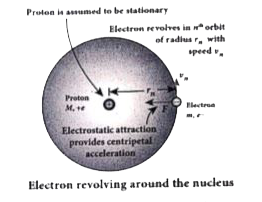
(i) Consider an atom which contains the nucleus at rest and an electron revolving around the nucleus in a circular orbit of radius `r_n`. as shown in Figure.
(ii) Nucleus is made up of protons and neutrons. Since proton is positively charged and neutron is electrically neutral, the charge of a nucleus is purely the total charge of protons.

(iii) Let Z be the atomic number of the atom, then +Ze is the charge of the nucleus. Let -e be the charge of the electron. From Coulomb.s law, the force of attraction between the nucleus and the electron is
`vecF_("coloumb") = 1/(4 piepsi_(0)) ((+Z3)(-e))/r_n^2`
`=- 1/(4 piepsi_(0))(Ze^2)/r_n^2hatr`
(iv) This force provides necessary centripetal force `vecF_("centripetal") = (mv_n^2)/r_n hatr`
(v) where m be the mass of the electron that moves with a velocity `v_n`, in a circular orbit. Therefore,
`|vecF_("coloumb")|=|vecF_("centripetal")|`
`1/(4 piepsi_(0))(Ze^2)/r_n^2 = (mv_m^2)/r_n`,
`r_n = (4 piepsi_(0)(mv_nr_n)^2)/(Zme^2)`
From Bohr.s ssumption, the angular momentum quantization condition
`mv_n r_n = nh`
`:." "r_n = (4pi epsi_0(mv_nr_n)^2)/(Zme^2)`
`r_n = (4pi epsi_0(nh)^2)/(Zme^2) = (4piepsi_0 n^2h^2)/(Zme^2)`
`r_n = ((epsi_0 h^2)/(pime^2))n^2/Z" "( :.h= h/(2pi))`
Where n`inNN`. Since, `epsi_0`, h, e and `pi` are constants. Therefore, the radius of the orbit becomes
`r_n = a_0 n^2/Z`
where `a_0=(epsi_0 h^2)/(pime^2) = 0.529`.
Promotional Banner

Similar Questions

Explore conceptually related problems

Derive an expression for Radius of gyration.

Derive an expression for orbital velocity of the satellite.

Derive an expression for power and velocity.

Write down the expression for the radii of orbits of hydrogen atom. Calculate the radius of the smallest orbit.

A particle known as mu mean has a charge equal to that of no electron and mass 208 times the mass of the electron B moves in a circular orbit around a nucleus of charge +3e Take the mass of the nucles to be infinite Assuming that the bohr's model is applicable to this system (a)drive an eqression for the radius of the nth Bohr orbit (b) find the value of a for which the redius of the orbit it approninately the same as that at the first bohr for a hydrogen atom (c) find the wavelength of the radiation emitted when the u - mean jump from the orbit to the first orbit

