Home
Class 9
MATHS
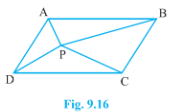
In Fig. 9.16, P is a point in the inter...

In Fig. 9.16, P is a point in the interior of a parallelogram ABCD. Show that(i) `a r(A P B)+a r(P C D)=1/2a r(A B C D)`(ii) `a r(A P D)+a r(P B C)=a r(A P B)+ar(P C D)`

Text Solution

Verified by Experts

If a triangle and parallelogram are on the same base and between the same parallel lines, then the area of the triangle will be half of the area of the parallelogram.
i) Let us draw a line segment `EF`, passing through the point P and parallel to line segment `AB` in parallelogram `ABCD`
.`AB || EF` (By construction) .....(1)
We know that `ABCD` is a parallelogram.
∴ `AD || BC` (Opposite sides of a parallelogram are parallel) ` AE || BF` ..... (2)
From Equations (1) and (2), we obtain
`AB || EF and AE || BF`
Therefore, quadrilateral `ABFE` is a parallelogram.
Similarly, it can be deduced that quadrilateral `EFCD` is a parallelogram.It can be observed that `triangleAPB` and parallelogram `ABFE` is lying on the same base `AB` and between the same set of parallel lines `AB` and `EF`
Area`(triangleAPB)` = 1/2 Area `(ABFE)` .....(3)
Similarly, for `trianglePCD` and parallelogram `EFCD`, Area `(trianglePCD)` = 1/2 Area `(EFCD)` .....(4)
Adding Equations (3) and (4), we obtain Area `(triangleAPB)` + Area `(trianglePCD)` = 1/2 [Area `(ABFE)` + Area `(EFCD)`]
Area `(triangleAPB)` + Area `(trianglePCD)` = 1/2 Area `(ABCD)` .....(5)
ii) Let us draw a line segment `MN`, passing through point P and parallel to line segment `AD`.
In parallelogram `ABCD`, `MN || AD` (By construction) .....(6)
We know that `ABCD` is a parallelogram.
`AB || DC` (Opposite sides of a parallelogram are parallel)
AM || DN.....(7)
From Equations (6) and (7), we obtain`MN || AD` and `AM || DN`
Therefore, quadrilateral `AMND` is a parallelogram.
It can be observed that `triangleAPD` and parallelogram `AMND` is lying on the same base `AD` and between the same parallel lines `AD` and `MN`.
Area `(triangleAPD)` = 1/2
Area (AMND) .....(8)
Similarly, for `trianglePCB` and parallelogram`MNCB`
Area `(trianglePCB)` = 1/2 Area `(MNCB)` .....(9)
Adding Equations (8) and (9), we obtain,
Area `(triangleAPD)` + `Area (trianglePCB)` = 1/2 [Area `(AMND)` + Area `(MNCB)`]
Area `(triangleAPD)` + Area `(trianglePCB)` = `1/2 `Area `(ABCD)` .....(10)
On comparing equations (5) and (10), we obtain
Area `(triangleAPD)` + Area `(trianglePBC)` = Area `(triangleAPB)` + Area`(trianglePCD)`
Promotional Banner

Similar Questions

Explore conceptually related problems

In Figure, P is a point in the interior of a parallelogram A B C D . Show that a r( A P B)+a r( P C D)=1/2a r(^(gm)A B C D) a R(A P D)+a r( P B C)=a r( A P B)+a r( P C D)

In Figure, P is a point in the interior of a parallelogram A B C Ddot Show that a r( A P B)+a r( P C D)=1/2a r\ (|""|^(gm)A B C D) a r\ ( A P D)+a r\ ( P B C)=a r\ ( A P B)+a r( P C D)

In Figure, A B C D\ a n d\ A E F D are two parallelograms? Prove that: a r\ (\ A P E):\ a r\ (\ P F A)=\ a r\ \ (Q F D)\ : a r\ (\ P F D)

A B C D IS A PARALLELOGRAM AND O is any point in its interior. Prove that: a r\ ( A O B)+\ a r\ ( C O D)=\ a r\ ( B O C)+\ a r( A O D) a r\ ( A O B)+a r\ (C O D)=1/2\ a r(^(gm)A B C D) Given: A parallelogram A B C D\ a n d\ O is a point in its interior. To Prove: a r\ (\ A O B)+\ a r( C O D)=a r\ ( B O C)+a r( A O D)

If A B C D is a parallelogram, then prove that a r\ (\ A B D)=\ a r\ (\ B C D)=\ a r\ (\ A B C)=\ a r\ (\ A C D)=1/2\ a r\ (|""|^(gm)A B C D)

p A N D q are any two points lying on the sides D C a n d A D respectively of a parallelogram A B C Ddot Show that a r( A P B)=a r ( B Q C)dot

In A B C ,D is the mid-point of A B ,P is any point of B CdotC Q P D meets A B in Q . Show that a r( B P Q)=1/2a r( A B C)dot TO PROVE : a r( B P Q)=1/2a r( A B C) CONSTRUCTION : Join CD.

Diagonals A C\ a n d\ B D of a quadrilateral A B C D intersect each at Pdot Show That: a r(A P B)\ x\ a r\ ( C P D)=\ a r\ (\ A P D)\ \ x\ \ a r\ (\ P B C)

In Figure, A B C D is a parallelogram. Prove that: a r( B C P)=a r( D P Q) CONSTRUCTION : Join A Cdot

Diagonals AC and BD of a quadrilateral ABCD intersect each other at P. Show that a r" "(A P B)" "xx" "a r" "(C P D)" "=" "a r" "(A P D)" "xx" "a r" "(B P C)dot
