Home
Class 11
BIOLOGY
Describe Crassulacean Acid Metabolism (C...

Describe Crassulacean Acid Metabolism (CAM Cycle).

Text Solution

Verified by Experts
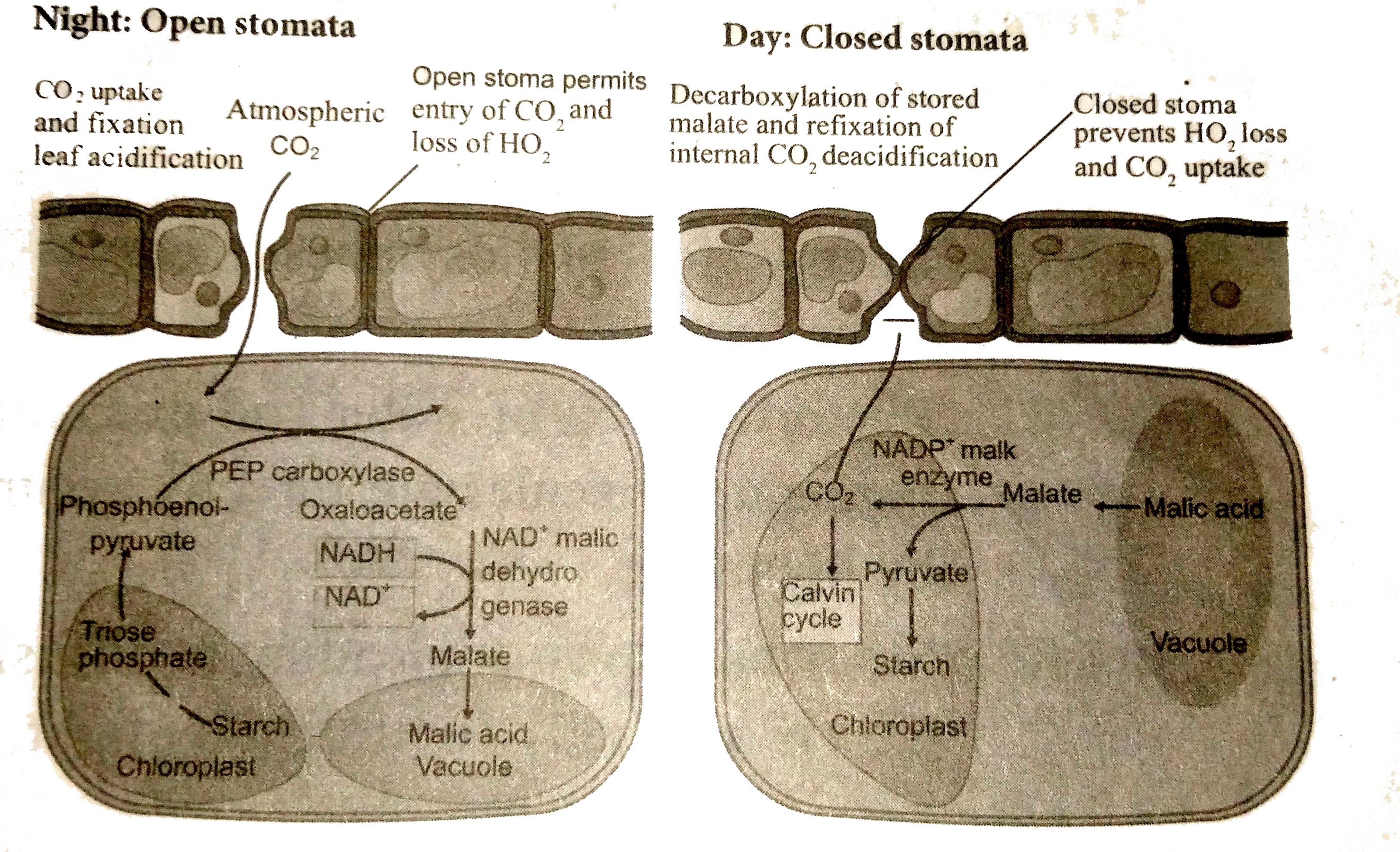

1. It is one of the carbon pathways identified in succulent plants growing in semi-arid or xerophytic condition.
2. First observed in Crassulaceae family plants like Bryophyllum, Sedum, Kalanchoe and is the reason behind the name of this cycle .
3 . Also noticed in plants from other families Eg.., Agave , Opuntia , Pineapple , Orchids , etc.
4 . The stomata are closed during day and are open during night ( Scotoactive) . This reverse stomatal rhythm helps to conserve water loss through transpiration and will stop the fixation of `CO_(2)` during the day time .
5. At night time CAM plants fix `CO_(2)` with the help of Phospho Enol Pyruvic acid (PEP) and produce Oxalo Acetic Acid (OAA) .
5. Subsequently OAA is converted into Malic acid like `C_(4)` Cycle and gets accumulated in vacuole increasing the acidity .
6. During the day time stomata are closed and Malic acid is decarboxylated into Pyruvic acid resulting in the decrease of acidity . `CO_(2)` thus formed enters into Calvin Cycle and produces carbohydrates .
Significance of CAM Cycle .
1 It is advantageous for succulent plants to obtain `CO_(2)` from malic acid when stomata are closed.
2 During day time stomata are closed and `CO_(2)` is not taken but continue their photosynthesis .
3. Stomata closed during the day time and help the plants to avoid transpiration and water loss .
Promotional Banner

Similar Questions

Explore conceptually related problems

Explain in detail about Crassulacean Acid Metabolism.

Crassulacean acid metabolism or CAM cycle was first observed in:

Define Metabolism ?

Wht is metabolism?

Describe Krebs' cycle.

Write a note on Nitrogen metabolism.

Derive the respiratory quotient for carbohydrate as substrate in oxidative metabolism.

Describe diplontic life cycle.

