Home
Class 11
BIOLOGY
How does carbon dioxide travel through t...

How does carbon dioxide travel through theespiratory system? Explain the role of theenzyme involved during respiration.[OR]
Explain the transport of `CO_(2)` from tissues to the lungs.

Text Solution

Verified by Experts
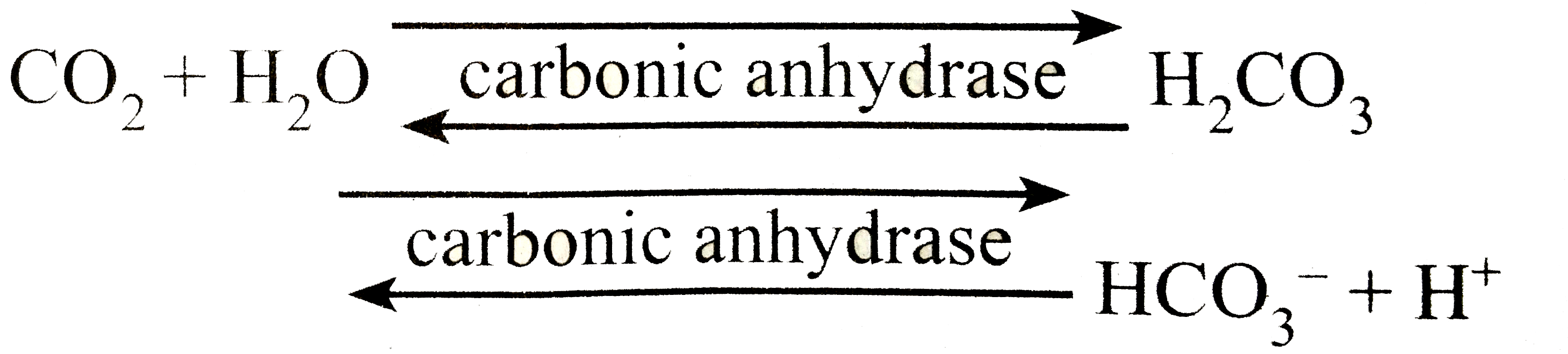
Transport of Carbon-dioxide : Blood transports `CO_(2)` from the tissue cells to the lungs in three ways,
(i) Dissolved in plasma : about 7- 10 % of `CO_(2)` is transported in a dissolved form in the plasma.
(ii) Bound to haemoglobin : About 20-25 % of dissolved `CO_(2)` is bound and carried in the RBCs as carbaminohaemoglobin `(Hb CO_(2))`
`CO_(2)+ Hb hArr Hb CO_(2)`
(iii) As bicarbonate ions in plasma : A bout 70 % of `CO_(2)` is transported by `pCO_(2)` and the degree of haemoglobin oxygenatoin. RBCs contain a high concentration of the enzyme , carbonic anhydrase,Whereas small amounts of carbonic anhydrase is present in the plasma. 2. At the tissues the `pCO_(2)` is high due to catabolism and diffuses into the blood to form `HCO_(3)^(-)` and `H+` ions. When `CO_(2)` diffuses into the RBCs it comines with water forming carbonic acid `(H_2CO_3)` catalyzed by carbonic anhydrase. Carbonic acid is unstable and dissociates into hydrogen and bicarbonate ions. < br> 3. Carbonic anhydrase facilitates the reaction is both directinos.
4. The `HCO_(3)^(-)` moves quickly form the RBCs into the plasma, where it is carried to the lungs. At the alveolar site where `pCO_(2)` is low, the reaction is reversed leading to the formation of `CO_(2)` and water. Thus `CO_(2)` trapped as `HCO_(3)` - at the tissue level it is transported to the alveoli and released out as `CO_(2)`
5. Every 100 mL of deoxygenated blood delives 4 mL of `CO_(2)` to the alveoli for elimination.
Promotional Banner

Similar Questions

Explore conceptually related problems

Identify the correct statements from the below about "steps involved in respiration", (I) Exchange of air between the atmosphere and the lungs. (II) The exchange of O_(2) and CO_(2) between the lungs and the blood. (III) Transport of O_(2) and CO_(2) by the lungs (IV) Exchange of CO_(2) between the cells only

Identify the correct statements from the below. (I) Sponges and coelenterates lack circulatory system. (II) Oxygen and carbon dioxide are exchanged in the lungs and tissues. (III)Nutrients from the digestive system are carried to the liver. (IV) Waste from the tissues are carried by the liver.

Answer the following questions a. Explain qualitatively on the basis of domain picture the irreversibility in the magnetisation curve of a ferromagnet. b. The hysteresis loop of soft iron piece has a much smaller area than that of a carbon steel piece. If the material is to go through repeated cycles of magnetisation , which piece will dissipate greater heat energy ? c. 'A system displaying a hysteresis loop such as a ferromagnet , is a device for storing memory ? ' Explain the meaning of this statement. d. What kind of ferromagnetic material is used for coating magnetic tapes in a cassette player , or for building ' memory stores ' in a modern computer ? e. A certain region of space is to be shielded from magnetic fields . Suggest a method.

Identify the wrong statements from the below. (I) oxidation of complex inorganic substances release energy during respiration. (II) amount of CO_2 evolution is equal to that of amount of O_2 consumed is called compensation point. (III) AMP is a nucleotide which consists of a base, sugar and phosphate group. (IV) NADH +H^+ releases a pair of electrons through oxidation reaction.

Assertion (A): Photosynthesis balances the oxygen and carbon cycle in nature. Reason (R): Plants play a vital and important role in maintaining balance between oxygen and carbon dioxide. Plants takes CO_(2) from atmosphere in the process of photosy

Answer the following questions . a. The earth's magnetic field varies from point is space. Does it also change with time ? It so , on what time scate does it change appreciably ? b. The earth's core is known to contain iron. Yet geologists do not regard this as a source of the earth's magnetism why ? c. The charged currents in the outer conducting regions of the earth's core are thought to be responsible for earth's magnetism . What might be the ' battery ' (i.e., the source of energy) to sustain these currents ? d. The earth may have even reversed the direction of its field several times during its history of 4 to 5 billion years. How can geologists know about the earth's field in such distant past ? e. The earth's field departs from its dipole substantially at large distances (greater than about 30,000 km) what agencies may be responsible for this distortion ? f. Interstellar space has an extremely weak magnetic field of the order of 10^(-12) T, Can such a weak field be of any significant consequence ? Explain. [Note : Exercise 2 is meant mainly to arouse your curiosity . Answers to some question above are tentative or unknown . Brief answers wherever possible are given at the end . For details , you should consult a good text on geomagnetism.]

