Home
Class 9
MATHS
In Fig. 9.17, PQRS and ABRS are paralle...

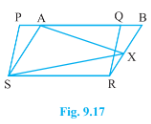
In Fig. 9.17, `PQRS` and `ABRS` are parallelograms and X is any point on side BR. Show that (i) `a r(P Q R S) = a r(A B R S)`(ii) `a r(A XS)\ =1/2 ar(P Q R S)`

Text Solution

Verified by Experts

If a triangle and a parallelogram are on the same base and between the same parallel lines, the area of the triangle will be half of that of a parallelogram or if two parallelograms are on the same and between two parallel lines then their area will be equal.
i) It can be observed from the figure that parallelogram `PQRS` and `ABRS` lie on the same base `SR` and also, they lie between the same parallel lines `SR` and `PB`.
According to Theorem 9.1, Parallelograms on the same base and between the same parallel lines are equal in area.
`Area (PQRS) = Area (ABRS)` .....(1)
ii) Consider `triangleAXS` and parallelogram `ABRS`
As both lie on the same base AS as well as between the same parallel lines `AS` and `BR`,
`Area (triangleAXS) = 1/2 Area (ABRS) .....(2)`
From Equations (1) and (2),
we obtain `Area (triangleAXS) = 1/2 Area (PQRS)`
Promotional Banner

Similar Questions

Explore conceptually related problems

In the figure, PQRS and ABRS are parallelograms and X is any point on side BR. Show that ar(PQRS) = ar(ABRS)

In Figure, P Q R S and A B R S are parallelograms and X is any point on side B Rdot Show that : a r(^(gm)P Q R S)=a r(^(gm)A B R S) a r(A X S)=1/2a r( P Q R S)

In Fig. 9.32, ABCD is a parallelogram and BC is produced to a point Q such that A D" "=" "C Q . If AQ intersect DC at P, show that a r" "(B P C)" "=" "a r" "(D P Q)dot

In Figure, P Q R is a triangle and S is any point in its interior, show that S Q+S R

P Q R S is a trapezium having P S\ a n d\ Q R as parallel sides. A is any point on P Q\ a n d\ B is a point on S R such that A B Q R . If area of P B Q is 17\ c m^2, find the area of \ A S R

ABCD is a quadrilateral in which P, Q, R and S are mid-points of the sides AB, BC, CD and DA. AC is a diagonal. Show that : (i) S R\ ||\ A C and S R=1/2A C (ii) P Q\ =\ S R (iii) PQRS is a parallelogram.

In Figure, P Q R S is a parallelogram. If X\ a n d\ Y are mid-points of P Q\ a n d\ S R respectively and diagonal S Q is jointed. The ratio a r\ (^(gm)\ X Q R Y):\ a r\ ( Q S R)= 1:4 (b) 2:1 (c) 1:2 (c) 1:2 (d) 1:1

Prove that the figure formed by joining the mid-points of the pair of consecutive sides of a quadrilateral is a parallelogram. OR B A C D is a parallelogram in which P ,Q ,R and S are mid-points of the sides A B ,B C ,C D and D A respectively. A C is a diagonal. Show that : P Q|| A C and P Q=1/2A C S R || A C and S R=1/2A C P Q=S R (iv) P Q R S is a parallelogram.

In Fig. 4.238, S and T are points on the sides P Q and P R respectively of P Q R such that P T=2c m , T R=4c m and S T is parallel to Q R . Find the ratio of the areas of P S T and P Q R . (FIGURE)

In a parallelogram PQRS (taken in order), P is the point (-1, -1), Q is (8, 0) and R is (7, 5). Then S is the point :
