Home
Class 9
MATHS
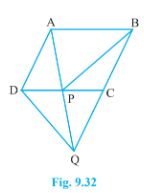
In Fig. 9.32, ABCD is a parallelogram a...

In Fig. 9.32, ABCD is a parallelogram and BC is produced to a point Q such that`A D\ =\ C Q`. If AQ intersect DC at P, show that `a r\ (B P C)\ =\ a r\ (D P Q)dot`

Text Solution

Verified by Experts

It is given that `ABCD` is a parallelogram.
`AD || BC` and `AB || DC` (Opposite sides of a parallelogram are parallel to each other).
Now, join the points A and C. Consider `triangleAPC` and `triangleBPC`
`triangleAPC` and `triangleBPC` are lying on the same base `PC` and between the same parallels `PC and AB.`
According to Theorem 9.2:
Two triangles on the same base (or equal bases) and between the same parallels are equal in area.
Therefore,`Area (triangleAPC) = Area (triangleBPC`) ...(1)
In quadrilateral `ACQD`, it is given that `AD = CQ`
Since `ABCD` is a parallelogram,
`AD || BC`(Opposite sides of a parallelogram are parallel)
`CQ` is a line segment that is obtained when line segment `BC` is produced.
`AD || CQ`
We have, `AD = CQ` and `AD|| CQ`
Hence, `ACQD` is a parallelogram.
Consider `triangleDCQ` and `triangleACQ`
These are on the same base `CQ` and between the same parallels `CQ` and `AD.`
Therefore, `Area (triangleDCQ) = Area (triangleACQ)`
`Area (triangleDCQ) - Area (trianglePQC) = Area (triangleACQ) - Area (trianglePQC)`
[Subtracting `Area` (`trianglePQC`) on both sides.]
`Area (triangleDPQ) = Area (triangleAPC)` ...(2)
...
Promotional Banner

Topper's Solved these Questions

  • AREAS OF PARALLELOGRAMS AND TRIANGLES

    NCERT|Exercise EXERCISE 9.1|1 Videos
  • AREAS OF PARALLELOGRAMS AND TRIANGLES

    NCERT|Exercise Exercise 9.2|6 Videos
  • CIRCLES

    NCERT|Exercise EXERCISE 10.2|2 Videos

Similar Questions

Explore conceptually related problems

In the figure, ABCD is a parallelogram and BC is produced to a point Q such that AD = CQ. If AQ intersect DC at P, show that ar( Delta BPC) = ar( Delta DPQ).

ABCD is a parallelogram. Any line through A cuts DC at a point P and BC produced at Q.Then,

A B C D is a parallelogram whose diagonals A C and B D intersect at Odot A Line through O intersects A B at P and D C at Qdot Prove that a r( P O A)=a r( Q O C)dot

A B C D is a parallelogram whose A C\ a n d\ B D intersect at Odot A line through O intersects A B\ a t\ P\ a n d\ D C\ at Qdot Prove that a r\ (\ P O A)=\ a r\ (\ Q O C)dot

A B C D is a parallelogram. P is the mid-point of A BdotB D\ a n d\ C P intersect at Q such that C Q : Q P=3: 1. If a r\ ( P B Q)=10\ c m^2, find the area of parallelogram A B C D

A B C D is a parallelogram. P is a point on A D such that A P=1/3\ A D\ a n d\ Q is a point on B C such that: C Q=1/3B Cdot Prove that A Q C P is a parallelogram.

In Figure, A B C D is a parallelogram in which P is the mid-point of D C\ a n d\ Q is a point on A C such that C Q=1/4A Cdot If P Q produced meets B C\ a t\ R , prove that R is a mid-point of B C

ABCD is a parallelogram in which P is the midpoint of DC and Q is a point on AC such that CQ =(1)/(4) AC . If PQ produced meets BC at R, prove that R is the midpoint of BC.

A B C D is a parallelogram whose diagonals intersect at Odot If P is any point on B O , prove that: a r\ ( A D O)=A R\ ( C D O) a r\ (\ A B P)=\ a r\ (\ C B P)
