Home
Class 10
PHYSICS
What is tyndall effect?...

What is tyndall effect?

Text Solution

Verified by Experts
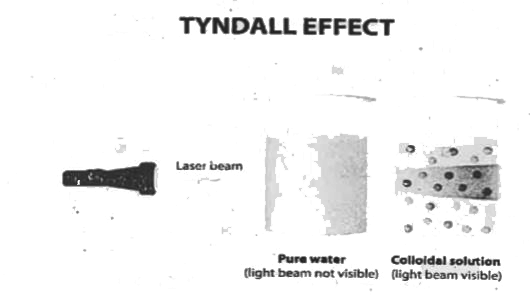
The tyndall effect is the effect of light scattering in colloidal dispersion. While showing no light in a true solution. This effect is used to determine whether a mixture is a true solution or a colloid.
"To be classified colloidal, a material must have one or more of its dimensions (length, width, or thickness) in the approximate range of 1-1000 nm.Because a colloidal solution or substance (like fog) is made up of scattered particles (like dust and water in air) light cannot travel straight through. Rather, it collides with these micro-particles and scatters causing the effect of a visible light beam. This effect was observed and described by John Tyndall as the Tyndall Effect.
The tyndall effect is an easy way of determining whether a mixture is colloidal or not.
When light is shined through a true solution, the light passes cleanly through the solution,
When light is passed through a colloidal solution, the substance in the dispersed phases scatters the light in all directions, showing it is colloidal solution.
Promotional Banner

Similar Questions

Explore conceptually related problems

(a) Write any two application of adsorption . (b) (i) What is 'Tyndall effect' ? (ii) In the coagulation of negative sol, arrange the following ions in ascending order of their flocculating power . Ba^2+Na+Al^3+ c) What is Heterogeneous catalysis ?

What is dynamo effect ?

(a) Give any three differences between physical adsorption and chemical adsorption. (b) What is (i) Tyndall effect (ii) Peptisation ?

What is founder effect?

What is (i) Tyndall Effect. (ii) Peptisation.

Which of the following will show Tyndall effect ?

Define : i) Brownian movement ii) Tyndall effect.

What is magnus effect ?

What is Doppler effect? Write any two applications of it.

