

Home
Class 11
PHYSICS
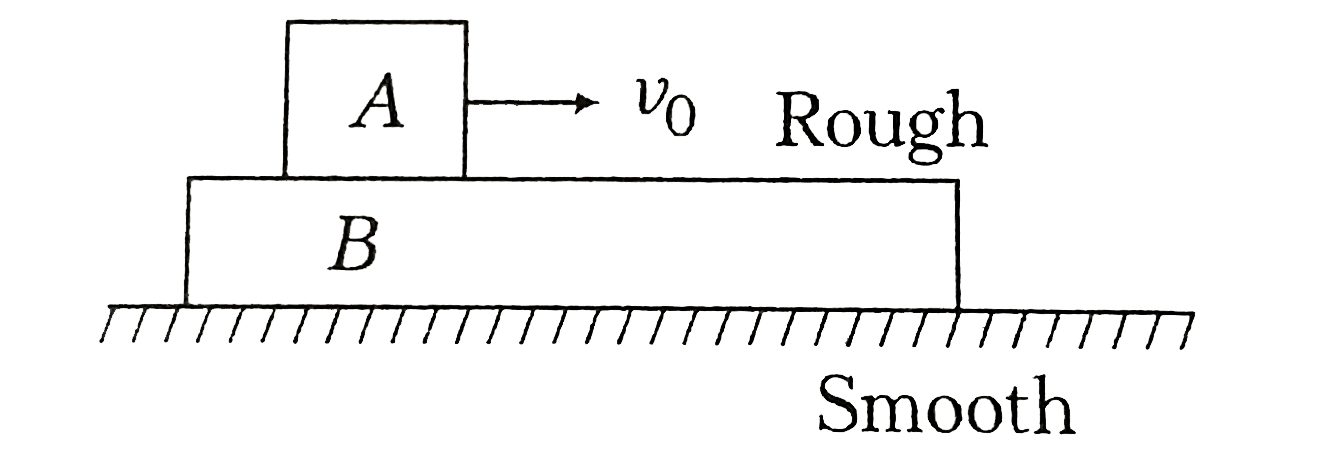
In a two block system an initial velocit...

In a two block system an initial velocity `v_(0)` with respect to ground is given to block A

Promotional Banner

Similar Questions

Explore conceptually related problems

Figure shows three identical blocks 1,2 & 3 each of mass m kept on frictionless surface. Block 1 is given initial velocity v_(0) in the direction shown. Block 1 hits block 2 and stops

Figure shown a spring block system hanging in equilibrium. If a velocity v_(0) is imparted to the block in downwards direction . Find the amplitude of SHM of the block and the time after which it will reach a point at half the amplitude of block

Figure shown a spring block system hanging in equilibrium. If a velocity v_(0) is imparted to the block in downwards direction . Find the amplitude of SHM of the block and the time after which it will reach a point at half the amplitude of block

A smooth sledge is moving with constant velocity v_(0) toward left. A block is pushed toward right with a velocity v_(0)’ (relative to ground). (A) Find the velocity with which the block escapes from the sledge and necessary critical v_(0) for escaping from the sledge (B) Will the block launch onto the sledge again?

A smooth sledge is moving with constant velocity v_(0) toward left. A block is pushed toward right with a velocity v_(0) (relative to ground). (A) Find the velocity with which the block escapes from the sledge and necessary critical v_(0) for escaping from the sledge (B) Will the block launch onto the sledge again?

A block of mass 10kg is released on a fixed wedge inside a cart which is moved with constant velocity 10m//s towards right. Take initial velocity of block with respect to cart zero. Then work done by normal reaction (with respect to ground) on block in two second will be :(g=10 m//s^(2)) .

Three blocks are initially placed as shown in the figure. Block A has mass m and initial velocity v to the right. Block B with mass m and block C with mass 4 m are both initially at rest. Neglect friction. All collisions are elastic. The final velocity of block A is

Three blocks are initially placed as shown in the figure. Block A has mass m and initial velocity v to the right. Block B with mass m and block C with mass 4m are both initially at rest. Neglect friction. All collisions are elastic. The final velocity of blocks A is

Three blocks are initially placed as shown in the figure. Block A has mass m and initial velocity v to the right. Block B with mass m and block C with mass 4m are both initially at rest. Neglect friction. All collisions are elastic. The final velocity of blocks A is

The block shown in the diagram has a mass of 2mug and a charge of 2xx10^(-9)C . If the block is given an initial velocity of 2ms^(-1) in the x - direction at t = 0 and an electric field of 2NC^(-1) is switched on in the x - direction, then the range (R) of the block on the ground will be