Home
Class 9
MATHS
In Figure, A B C D E\ is a pentagon. A ...

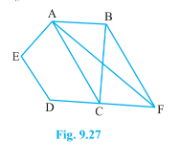
In Figure, `A B C D E\ ` is a pentagon. A line through `B` parallel to `A C` meets `D C` produced at `Fdot`


Show that: `a r\ ( A C B)=a r\ ( A C F)`
`a r\ (A E D F)=a r\ (A B C D E)`

Text Solution

Verified by Experts

i) `triangle ACB` and `triangleACF` are lying on the same base `AC` and are existing between the same parallels `AC` and `BF`
According to Theorem 9.2: Two triangles on the same base (or equal bases) and between the same parallels are equal in area.
Therefore, `ar (triangleACB) = ar (triangleACF)`
ii) It can be observed that`ar (triangleACB) = ar (triangleACF)`
Adding area (ACDE) on both the sides.
Area `(triangleACB)` + Area (ACDE) = `Area (triangleACF)` + Area (ACDE)
Area (ABCDE) = Area (AEDF)
Hence proved.
Promotional Banner

Similar Questions

Explore conceptually related problems

In Figure, A B C D E is a pentagon. A line through B parallel to A C meets D C produced at Fdot Show that a r( A C B)=a r( A C F) (ii) a r( A E D F)=a r(A B C D E)

A B C D is a quadrilateral. A line through D , parallel to A C , meets B C produced in P as shown in Figure. Prove that a r\ ( A B P)=a r\ (Q u a ddotA B C D)dot

A B C D is a trapezium with A B||D C . A line parallel to A C intersects A B at X a n d B C at Ydot Prove that a r( A D X)=a r( A C Y)dot

In Figure, P is a point in the interior of a parallelogram A B C Ddot Show that a r( A P B)+a r( P C D)=1/2a r\ (|""|^(gm)A B C D) a r\ ( A P D)+a r\ ( P B C)=a r\ ( A P B)+a r( P C D)

In Figure, A B C\ a n d\ ABD are two triangles on the base A Bdot If line segment C D is bisected by A B\ a t\ O , show that a r\ ( A B C)=a r\ (\ A B D)

The side A B of a parallelogram A B C D is produced to any point Pdot A line through A parallel to C P meets C B produced in Q and the parallelogram P B Q R completed. Show that a r(^(gm)A B C D)=a r(^(gm)B P R Q)dot CONSTRUCTION : Join A C and PQ. TO PROVE : a r(^(gm)A B C D)=a r(^(gm)B P R Q)

In Figure D\ a n d\ E are two points on B C such that B D=D E=E Cdot Show that a r(\ A B D)=\ a r\ (\ A D E)=a r\ (\ A E C)dot

If A B C D is a parallelogram, then prove that a r\ (\ A B D)=\ a r\ (\ B C D)=\ a r\ (\ A B C)=\ a r\ (\ A C D)=1/2\ a r\ (|""|^(gm)A B C D)

Any point D is taken in the base B C of a triangle A B C\ a n d\ A D is produced to E , making D E equal to A Ddot Show that a r\ ( B C E)=a r( A B C)

The diagonals of a parallelogram A B C D intersect at Odot A line through O meets A B in X and C D in Ydot Show that a r( A X Y D)=1/2(A R ^(gm)A B C D)
