Home
Class 12
BIOLOGY
Briefly explain the process of Translati...

Briefly explain the process of Translation during protein synthesis?

Text Solution

Verified by Experts
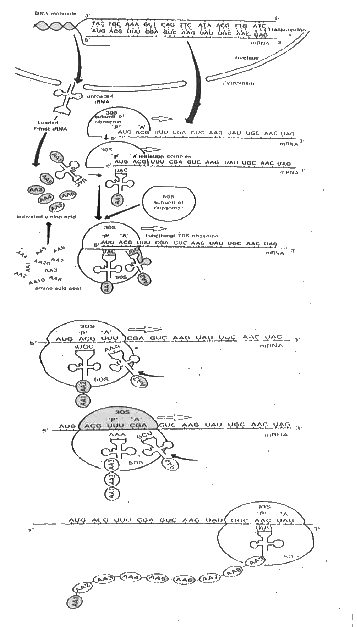
Translation is the second step during protein synthesis in which using genetic information on mRNA in nucleotide language, protein synthesis takes place on the ribosome in the amino acid lineage. mRNA carrying coded message for the synthesis of protein will be released into cytoplasm. With the help of this mRNA translation occurs in four steps.
They are (1) Activation and selection of amino acids (2) Chain initiation (3 ) Chain elongation
(4) Chain termination.
1. Activation and selection of amino acids: In this step, amino acid combines with ATP in the presence of amino acid synthetase and forms activated amino acid and this process Is known as activation. The activated amino acid thus will be picked up by specific +RNA molecule and form amino acid +RNA.
Amino acid + ATP —» Activated amino acid.
Activated amino acid + +RNA —> Amino acid +RNA
2. Chain initiation: During this process, initially mRNA attaches to the smaller ribosomal Subunit. Then +RNA carrying methionine attaches to the initiator codon (AUG) of mRNA. Now, larger ribosomal subunit attaches to mRNA, such that the +RNA with amino acid coincides at the P-Site. Soon after this, another +RNA with the second amino acid attaches to the A-site and a peptide bond is formed, between the first amino acid occupying A-site. Chain initiation needs ATP and proteins called initiation factors.
3. Chain elongation: Soon after chain initiation, ribosomal subunits slide along mRNA. This shifts the+RNA occupying A-site automatically to the Posited. Now to the emptied A-site, +RNA carrying the third amino acid gets attached. With this, peptide bond is established between second and third amino acids. This results in the growing of polypeptide chain referred to as chain elongation. Chain elongation requires GTP, elongation factors and `Mg(+2)` ions.
4. Chain termination: As soon as the sliding ribosomal subunits arrive at the terminator codons, the protein synthesis is stopped with the association of releasing factors to the larger subunit of ribosome. This is known as chain termination. Soon after chain termination, the newly formed polypeptide chain undergoes processing and attains a specific structure.
Promotional Banner

Topper's Solved these Questions

  • SUPER MODEL QUESTION PAPER 1

    SUBHASH PUBLICATION|Exercise PART-D (SECTION-II)|5 Videos
  • SUPER MODEL QUESTION PAPER 1

    SUBHASH PUBLICATION|Exercise ANSWER THE FOLLOWING QUESTIONS IN ONE WORD OR ONE SENTENCE EACH|10 Videos
  • SUPER MODEL QUESTION PAPER 1

    SUBHASH PUBLICATION|Exercise PART-C|7 Videos
  • SUPER MODEL QUESTION PAPER (FOR PRACTICE) 3

    SUBHASH PUBLICATION|Exercise PART-D (SECTION-II)|5 Videos
  • SUPER MODEL QUESTION PAPER 2

    SUBHASH PUBLICATION|Exercise PART D|11 Videos

Similar Questions

Explore conceptually related problems

Explain the process of translation in protein synthesis.

How many high-energy phosphate bond equivalents are utilized in the process of activation of amino acids for protein synthesis?

The initiation codon in protein synthesis is

Briefly explain about zeolites .

Describe the process of translation of mRNA.

Briefly explain external respiration.

