

Home
Class 11
PHYSICS
A plank A of mass M rests on a smooth ho...

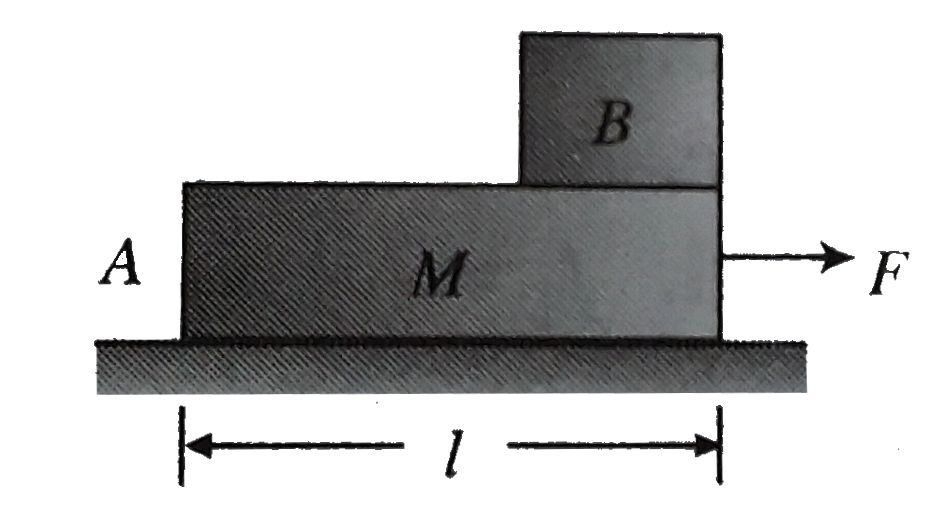
A plank A of mass `M` rests on a smooth horizontal surface over which it can move without friction A cabe B of mass m lies on the plank at one edge .The coefficient of friction between the plank and the cube is `mu` The size of cube is very small in comparison to the plank.

At what force `F` applied to the plank in the horizontal direction will be cube begin to slide towards the other end of the plank?

Promotional Banner

Similar Questions

Explore conceptually related problems

A plank A of mass M rests on a smooth horizontal surface over which it can move without friction A cabe B of mass m lies on the plank at one edge .The coefficient of friction between the plank and the cube is mu The size of cube is very small in comparison to the plank. In what time will the cube fall from the plank if the length of the latter is l ?

A plank of mass M is placed on a rough horizontal force F is applied on it A man of mass m rens on the plank find the acceleration of the man so that the plank does not move on the surface . The coefficent of friction between the plank and the surface is mu Assume that the man does not slip on the plank

A plank of mass M is placed on a rough horizontal surface and a contant horizontal force F is applied on it . A man of mass m runs on the plank find the range of acceleration of the man that the plank does not move on the surface is mu .Assume that the does not slip on the plank

A plank of mass M is placed on a rough horizontal surface and a contant horizontal force F is applied on it . A man of mass m runs on the plank find the range of acceleration of the man that the plank does not move on the surface is mu .Assume that the does not slip on the plank

A small block of mass 1kg is placed over a plank of mass 2kg. The length of the plank is 2 m. coefficient of friction between the block and the plnak is 0.5 and the ground over which plank in placed is smooth. A constant force F=30N is applied on the plank in horizontal direction. the time after which the block will separte from the plank is (g=10m//s^(2))

A small block of mass 1kg is placed over a plank of mass 2kg. The length of the plank is 2 m. coefficient of friction between the block and the plnak is 0.5 and the ground over which plank in placed is smooth. A constant force F=30N is applied on the plank in horizontal direction. the time after which the block will separte from the plank is (g=10m//s^(2))

A plank of mass 10kg rests on a smooth horizontal surface. Two blocks A and B of masses m_(A)=2kg and m_(B)=1kg lies at a distance of 3m on the plank as shown in the distance of 3m on the plank as shown in the figure. The friction coefficient between the blocks and plank are mu_(A)=0.3 and mu_(B)=0.1 . Now a force F = 15 N is applied to the plank in horizontal direction. Find the time after which block A collides with B.

A horizontal plank having mass m lies on a smooth horizontal surface. A sphere of same mass and radius r is spined to angular frequency omega_(0) and gently placed on the plank as shown in the figure. If coefficient of friction between the plank and the sphere is mu . Find the distance moved by the plank till sphere starts pure rolling on the plank. the plank is long enough.

A horizontal plank having mass m lies on a smooth horizontal surface. A sphere of same mass and radius r is spined to angular frequency omega_(0) and gently placed on the plank as shown in the figure. If coefficient of friction between the plank and the sphere is mu . Find the distance moved by the plank till sphere starts pure rolling on the plank. the plank is long enough.