

Home
Class 11
PHYSICS
A block of mass m = 1 kg is kept pressed...

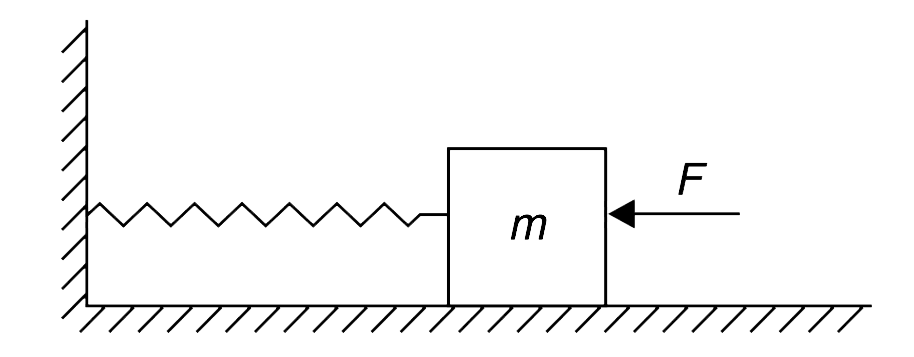
A block of mass m = 1 kg is kept pressed against a spring on a rough horizontal surface. The spring is compressed by 10 cm from its natural length and to keep the block at rest in this position a horizontal force (F) towards left is applied. It was found that the block can be kept at rest if `8 Nle F le 18 N`. Find the spring constant (k) and the coefficient of friction `(mu)` between the block and the horizontal surface.

Promotional Banner

Similar Questions

Explore conceptually related problems

A block of mass m connected to a spring of stiffness k is placed on horizontal smooth surface. When block is at x=0 , spring is in natural length. The block is also subjected to a force F=(k|x|)/(@) then

A block of unknown mass is at rest on a rough, horizontal surface. A horizontal force F is applied to the block. The graph in the figure shows the acceleration of the block with respect to the applied force. The mass of the block is

A block of unknown mass is at rest on a rough, horizontal surface. A horizontal force F is applied to the block. The graph in the figure shows the acceleration of the block with respect to the applied force. The mass of the block is

A block of mass M is kept on a rough horizontal surface and is attached with massless spring of force constant k .The minimum constant force applied on the other end of the spring to lift the block is

A block of mass m = 2 kg is connected to a spring of force constant k = 50 n//m . Initially the block is at rest and the spring has natural length . A constant force f = 60 N , is applied horizontally towards right, the maximum speed of the block (in m//s will be (neglect frication).

A block of mass m is kept on a rough horizontal surface and is attached with a massless spring of force constant k. The minimum constant force applied on the other end of the spring of lift the block is

A block of mass m is attached to a spring of force constant k whose other end is fixed to a horizontal surface. Initially the spring is in its natural length and the block is released from rest. The average force acting on the surface by the spring till the instant when the block has zero acceleration for the first time is

A block of mass m is attached to a spring of force constant k whose other end is fixed to a horizontal surface. Initially the spring is in its natural length and the block is released from rest. The average force acting on the surface by the spring till the instant when the block has zero acceleration for the first time is

A block of mass 70kg is kept on a rough horizontal surface (mu=0.4) . A person is trying to pull the block by applying a horizontal force, but the block is not moving. The net contact force exerted by the surface on the block is F , then:

Initialy spring is in the natural length and blocks A & B are at rest. Find maximum value of constant force F that can be applied on B such that block A remains at rest. (g = 10 m//s^(2)) (given answer in Newton)